- English
- ePUB (mobile friendly)
- Available on iOS & Android
eBook - ePub
About this book
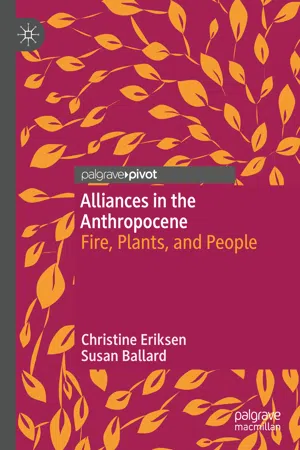
This book explores how fire, plants and people coexist in the Anthropocene. In a time of dramatic environmental transformation, the authors examine how human impacts on the planetary system are being felt at all levels from the geological and the arboreal to the atmospheric. The book brings together the disciplines of human geography and art history to examine fire-plant-people alliances and multispecies world-making. The authors listen carefully to the narratives of bushfire survivors. They embrace the responses of contemporary artists, as practice becomes interwoven with fire as well as ruin and regrowth. Through visual, textual and felt ways of being, the chapters illuminate, illustrate, impress and imprint the imagined and actual agency of plants and people within a changing climate — from Aboriginal ecocultural burning to nuclear fire. By holding grief and enacting hope, the book shows how relationships come to be and are likely to change due to the interdependencies of fire, plants and people in the Anthropocene.
Information
Topic
Ciencias socialesSubtopic
Ciencia medioambiental© The Author(s) 2020
C. Eriksen, S. BallardAlliances in the Anthropocenehttps://doi.org/10.1007/978-981-15-2533-9_11. Imperfect Alliances
Christine Eriksen1 and Susan Ballard2
(1)
School of Geography and Sustainable Communities, University of Wollongong, Wollongong, NSW, Australia
(2)
School of the Arts, English and Media, University of Wollongong, Wollongong, NSW, Australia
Abstract
This chapter introduces three sets of alliances that centre the multiple reflections around which our analysis of the Anthropocene revolves. We visually map the alliances and their movements through a kaleidoscopic representation. Cycles of ruin and regrowth, world-making and storytelling circulate through the alliances. One set of alliances explores the intricate relationship between fire and plants. The embodied and emotive tension that emerges from this analysis simultaneously exists between plants and people—another set of alliances. Embodied, emotive and productive tensions also span a third set of alliances—the powerful and, at times, troublesome alliance between people and fire. The chapter also posits the book’s dual purpose of considering the agencies and entanglements of fire, plants and people whilst simultaneously challenging our own comfortable defaults. It poses a challenge to think differently together by opening up alternative ways of witnessing and expressing the embodied and emotive affects of living with plants, fire, ruin and regrowth. This challenge rests in our desire to deepen understandings of belonging and existence by entangling contemporary visual art with geographical narratives in the context of climate change. This highlights the methodological importance of the visual and the sensory in storying and world-making.
Keywords
Understanding alliances Storying Ruin and regrowth Human geography Art history This book is an invitation to think differently about fire, plants, people, belonging and existence in Australia in the Anthropocene. It is a consideration of how interdependencies come to be or are contested. It is an exploration of how sets of alliances form between fire, plants and people. Through these three sets of alliances, we think together about the agency and interdependencies of the human and nonhuman, trees and insects, fire and rain, wind and atmospheric particles, soil and plants, climate and material ecologies. We place conversations with people who have experienced bushfires alongside thoughts and ideas found within contemporary art about alliances—both real and imagined. Between experiences of grief, hope, humility and renewal, we find narratives of world-making, storying, ruin and regrowth, which provide insights into how relationships come to be, and are likely to change in the Anthropocene.
The book is framed within the current epoch—the Anthropocene: a geological era with a contested start date defined by human activity (Lewis and Maslin 2015; Zalasiewicz et al. 2017). It is a time of dramatic environmental transformation where the impacts of the human on the planetary system are felt at all levels from the geological, to the arboreal, to the atmospheric. These transformations mean that the ‘usual’ environmental or ecological systems of relationships between people, fire and plants are suddenly rendered acute. The future is now a period ‘out of human control, due to rapid, unpredictable and non-linear change’ set in train by human activity (Head 2016, 5). Adapting to the uncertain, yet likely catastrophic, future consequences requires, in the words of geographer Noel Castree, ‘a new sensitivity and a new humility’ engendered by a ‘proper recognition that we [humans] are both children of the Earth and yet now a planetary force in our own right’ (2014b, 456).
Examining and acknowledging the consequences of this acuteness has in recent years resulted in a distinct body of provocative work within the social sciences, humanities, and science and technology studies, which informs our thinking in this book. This body of work challenges the status quo by asking difficult questions that decentre anthropocentric worldviews. Geographer Nigel Clark, for example, frames an ‘inhuman nature’ to address his pressing concern about a sociable life on a dynamic planet:
My pressing concern is about how we might get by, and get on with each other, in the full knowledge that most of material reality is not ours to make over. So while we certainly need to hammer away at the ethical and political implications of those aspects of physical existence conducive to recomposition, we must also account for forces, events and objects that can’t be done differently or done away with – or things that will be otherwise whatever we chose to do. These too are political questions. But they are also questions about the limits of what usually counts as politics, about the limits of any kind of human action, doing or making. (Clark 2011, xx, italics in original)
When confronted with the reality of catastrophic disasters that limits—in the conventional anthropocentric sense—‘human action, doing or making’, Christine’s interdisciplinary work with Victoria Sword-Daniels et al. (2018) embraces ‘embodied uncertainty’ in order to live with complexity and natural hazards. Geographer Lesley Head (2016) grapples with practices of hope that counter grief for the modern self with emotional work, which enable us to live in uncertainty and through abundance and scarcity without stress. Castree (2014a, b, c) warns that the future environmental changes associated with the Anthropocene and planetary boundaries oblige societies to ‘re-graph the geo’ imaginatively and practically (2014c, 464).
These understandings of humans, plants, fire and the planet also extend to ways of thinking about the boundaries of the human in the Anthropocene (Rose 2011). Revisiting her earlier question—‘why should our bodies end at the skin?’ (Haraway 1991, 178)—feminist scholar Donna Haraway (2016) instructs us to ‘make kin in the Chthulucene’. Karen Barad (2007), a scientist who works alongside Haraway in feminist studies, describes the ‘entanglement of matter and meaning’, and anthropologist Anna Tsing et al. (2017) trace the arts of living on this damaged planet. Anthropologist Elizabeth Povinelli (2016) suggests that attention be paid to the operations of power at the boundary between life and nonlife. Each author, in their own way, acknowledges that ‘Nothing comes without its world’ (Puig de la Bellacasa 2012). They entangle the human with the world and its multiple occupants at a deeper, less tangible but more embodied level. Amidst the work of these writers and thinkers, new alliances emerge that foreground how ‘Kinships and alliances become transformative connections—merging inherited and constructed relations’ (Puig de la Bellacasa 2017, 73). They provoke us to new thoughts, and building on their provocations, we find ourselves holding onto the concept of alliances as a technique for examining relationships that reach beyond the human.
An alliance is an association formed for mutual benefit. A relationship. It refer...
Table of contents
- Cover
- Front Matter
- 1. Imperfect Alliances
- 2. Illuminations: This Is Bigger than Us
- 3. Illustrations: Echoes of What Was
- 4. Impressions: Embodying Uncertainty
- 5. Imprints: Ways of Seeing
- 6. Impermanence: Elemental Forces
- 7. Illusions: World-Making in the Anthropocene
- Back Matter
Trusted by 375,005 students
Access to over 1.5 million titles for a fair monthly price.
Study more efficiently using our study tools.
Frequently asked questions
Yes, you can cancel anytime from the Subscription tab in your account settings on the Perlego website. Your subscription will stay active until the end of your current billing period. Learn how to cancel your subscription
No, books cannot be downloaded as external files, such as PDFs, for use outside of Perlego. However, you can download books within the Perlego app for offline reading on mobile or tablet. Learn how to download books offline
Perlego offers two plans: Essential and Complete
- Essential is ideal for learners and professionals who enjoy exploring a wide range of subjects. Access the Essential Library with 800,000+ trusted titles and best-sellers across business, personal growth, and the humanities. Includes unlimited reading time and Standard Read Aloud voice.
- Complete: Perfect for advanced learners and researchers needing full, unrestricted access. Unlock 1.5M+ books across hundreds of subjects, including academic and specialized titles. The Complete Plan also includes advanced features like Premium Read Aloud and Research Assistant.
We are an online textbook subscription service, where you can get access to an entire online library for less than the price of a single book per month. With over 1.5 million books across 990+ topics, we’ve got you covered! Learn about our mission
Look out for the read-aloud symbol on your next book to see if you can listen to it. The read-aloud tool reads text aloud for you, highlighting the text as it is being read. You can pause it, speed it up and slow it down. Learn more about Read Aloud
Yes! You can use the Perlego app on both iOS and Android devices to read anytime, anywhere — even offline. Perfect for commutes or when you’re on the go.
Please note we cannot support devices running on iOS 13 and Android 7 or earlier. Learn more about using the app
Please note we cannot support devices running on iOS 13 and Android 7 or earlier. Learn more about using the app
Yes, you can access Alliances in the Anthropocene by Christine Eriksen,Susan Ballard in PDF and/or ePUB format, as well as other popular books in Ciencias sociales & Ciencia medioambiental. We have over 1.5 million books available in our catalogue for you to explore.