This monograph has two aims. The first aim is to present an exploration of discourse relating to memory and refugees/asylum seekers with a particular focus on the United Kingdom. The second aim is to explore a methodological approach called ‘facet methodology’. In this approach, a series of diverse studies addressing a research question are undertaken. The two aims are intertwined, since facet methodology is used in order to undertake the study of discourse relating to memory and refugees/asylum seekers, and putting the methodological approach into practice in this way provides material for methodological reflection. The monograph contributes to filling two research gaps. Firstly, there has been little research undertaken on memory and refugees/asylum seekers in the UK context, and secondly, there has been limited methodological reflection in the field of Memory Studies. This chapter takes ‘discourse’ as its framework, first discussing definitions of the term ‘discourse’ before providing a foundation for the study that consists of an investigation of discourses around memory and refugees, and discourse on method.
‘Discourse’ is a word that has multiple meanings and several are used in the monograph. Firstly, discourse refers to oral, textual and medial utterances such as written texts, television programmes and oral accounts, among others. The case studies that comprise the monograph are based on such items that we might name ‘discursive products’. The discursive products that are studied belong to specific discursive genres such as television documentaries, oral histories or novels. They are publicly available and may serve as memory artefacts, that is, records of the past. In a wider perspective, discourse can be defined as the whole process of social interaction of which the text or medial item is a part (Titscher et al. 2000, 147). This has methodological implications: for example, in studying a documentary, as well as focussing on the documentary itself, attention will be paid to the points of view expressed by the documentary maker and participants, and by the audience. A further sense of discourse that has been adopted by critical linguists takes ‘discourse’ to be speech or writing seen from the point of view of the beliefs and values that they embody, a way of looking at the world, an ideology (Fowler cited in Mills 2004, 5). An important task of critical discourse analysts has been to reveal hidden ideologies in what is generally accepted as ‘neutral’ discourse; it is discourse that has been ‘naturalized’ (Fairclough 1989). Methodologically, such an approach adopts an a priori stance of seeking out ideologies and power differentials. Foucauldian senses of discourse seem to avoid this. For Foucault, discourse refers to a past or present set of socially circulating ideas and associated language relating to a particular topic or discipline, for example the ‘discourse of mental illness’ and ‘political discourse’. It is clear that such discursive unities are not in fact unified, as they comprise schisms and a variety of sometimes contradictory theses. Foucault (1972, 38) points out that a discourse or in his terms a ‘discursive formation’ is based on a system of dispersion. Furthermore, discourses are dynamic and change over time; discourses may be abandoned or come into existence. When a discourse is acknowledged as knowledge, as the ‘truth’, it influences or even structures the way we perceive reality; dominant discourses inform how we can think and act only within certain parameters at each historical time (Mills 2004). Yet, the relationship is not deterministic, as discourse is both socially constitutive and socially conditioned (Khosravinik 2009, 478), and resistant ‘counter-discourses’ proliferate. Insofar as such discourses stem from particular institutions or social groups, they work in the interests of those groups. In Foucauldian theory, discursive practice is linked to various institutional sites, and to the roles of individuals who contribute to circulating the discourse (ibid, 50–54). Whether in a broad Foucauldian sense or in the sense of utterances proffered in specific contexts, systematically organised semiotic resources can be highly powerful in the lived world. Discursive representation constructs influential categories, accomplishes social actions, persuades others and achieves changes in the social world (Kirkwood et al. 2016). It can also be argued that in contemporary societies, power has a more discursive nature than in the past, as mass and digital media have a crucial role in creating knowledge and beliefs (Khosravinik 2009, 479).
A concept related to discourse is ‘narrative’. A narrative or story has a particular relational and temporal form: a beginning, middle and end. Narrative form holds a strong attraction in human communication. Somers and Gibson (1993) distinguish personal narratives (stories individuals tell themselves) that influence and are influenced by public narratives (shared socially circulating narratives). Discourse (utterances) may take a narrative form, and discourse (socially circulating ideas and ideologies) may be embedded in narratives, for example, an account of one’s life may contain traces of feminist discourse. Another sense of discourse inspired by Foucault (1972) that is used in this monograph takes the ‘discursive formation’ as a site of investigation. Here the discourse is a new unity, yet unrecognised and unpowerful, to be investigated/constructed by the researcher. For Foucault (ibid, 38), a discursive formation can be posited if there is a series of underlying regularities that provide the conditions of existence for the discourse. These regularities concern the objects (topics) of discourse, enunciative modalities (subject positions), concepts and theoretical or thematic options. ‘Memory and refugees in the UK’ is a yet unsettled discursive formation that will be investigated in this monograph.
Discourses on Memory and Refugees/Asylum Seekers
‘Memory’ as an object of scientific discourse arose in the late nineteenth century. ‘Memory’, taken to refer to a capacity or product of the individual brain, was primarily the terrain of medical practitioners. Freud (Terdiman 2010) famously attributed pathological behaviour in his patients to the repression of their traumatic childhood memories or of instinctual impulses manifesting themselves as phantasies. The objects of trauma and therapy as a focus in the study of memory continued in the twentieth century, particularly after World War II as the Holocaust provided a tragic and seemingly inexplicable event about which belatedly and with difficulty testimonies were produced (Caruth 1995). In the discipline of psychology, important work continues to be undertaken by psychologists and neurologists who propose ways of understanding the functioning of the brain/mind in terms of memory (see Conway 1990, 2005; Brown and Reavey 2015). Interrogating memory and gathering recollections of the past at the level of individuals has also been embraced in the domains of ethnography and oral history (Perks and Thomson 2006), but with a community dimension. It was Halbwachs (1975 [1925]), indeed, who in the early twentieth century challenged the exclusively psychological focus and the notion of memory belonging to a lone individual by illustrating the necessary interdependence of the individual and the social. Halbwachs introduced the term ‘collective memory’. In this perspective, the individual is both influenced by and influences shared memories and normative practices coming from the past of the social groups to which she or he belongs. Memory is thus taken to include not only shared memorial constructions of past events and people, but also shared traditions and cultural practices that are passed down through the generations in an evolving mix of continuation and modification (Shils 1981; Soares 1997). In that process, Assmann (1995) emphasised the importance of long-held rituals and artefacts, certain texts, rites and monuments in the transmission of ‘cultural memory’. Halbwachs’ work paved the way for ‘memory’ as an object of discourse to cover shared knowledge and representations of the past not only across social groups (family, professional group, religious denominations, social class) but also across the unit of the nation as a whole with its symbolic memorial items that are constantly reiterated (Nora 1984; Erll 2009).
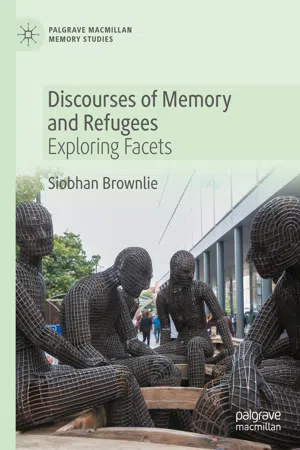
A recent development in discourse on memory has been to emphasise how memory is related to movement. Memory is considered to be always a matter of movement as exchange of information between individuals, motion between minds and media products, and movement across time and across territorial boundaries by means of human carriers, transnational institutions and the mass media (Assmann and Conrad 2010; Erll 2011). Movement across broad groupings of people is encapsulated in the concepts ‘transnational memory’ (emphasising the continued importance of national borders, De Cesari and Rigney 2014, 4) and ‘transcultural memory’. In discursively innovative work, Rothberg (2009) has coined the term ‘multidirectional memory’ to capture how quite extraordinarily different memories from different historical, geographical and cultural spheres may be linked together. An example of this is provided on the cover of this book: the artwork by Kalliopi Lemos features a boat used by Syrian refugees traversing from Turkey to Greece in 2015; it is purposefully located in a square in the London area of Spitalfields where successive waves of migrants and refugees have lived, the first of which were Protestant Huguenots fleeing religious persecution in France—they arrived by boat in the late seventeenth century.1
It is posited that contemporary media and technological capacities have reinforced transnational/cultural possibilities in our ever more digitally connected world (Hoskins 2011). The different scalar levels (personal, group, national, transnational) at which memory operates in a dynamic process are of course theorised as being intertwined (De Cesari and Rigney 2014, 6). Key elements that are proposed in the academic study of memory as an individual and social phenomenon have been how memory is propagated through various vehicles (oral discussions, writings, commemorations, monuments, museums, etc.), the importance of memory for identity, the variability and selectivity of memory reconstruction and representation, the politics of memory defined as contested attempts in dealing with historical legacies, and interscalarity that includes relations and slippage between different time scales and individual/social group scales (Keightley and Pickering 2013; Kleist 2017). The concept of interscalarity is taken up in this monograph in different ways: how individual memories...