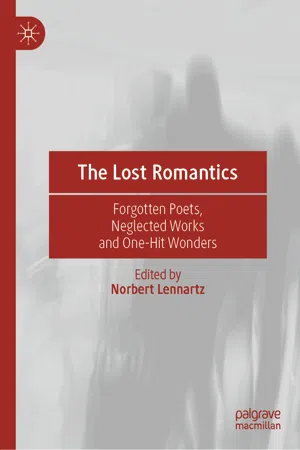
Probing the realms of literary and cultural lostness, this book identifies different strata of oblivion and shows how densely the net of contacts and rivalries was woven around the ostensibly monolithic stars of the Romantic age. It reveals how the lost poets inspired the production of anthologised poetry, that they served as indispensable muses, sidekicks and interlocutors of the big six and that their relevance for the literary scene has been continuously underrated. This is also surprisingly true for some creators of famous one-hit wonders (Frankenstein, The Vampyre) who were suddenly rocketed to fame or notoriety, but could not help seeing their other works of fiction turning into abortive flops.
- English
- ePUB (mobile friendly)
- Available on iOS & Android
eBook - ePub
About this book
This book features a collection of essays, shedding subversively new light on Romanticism and its canon of big-six, white, male Romantics by focusing on marginalised, forgotten and lost writers and their long-neglected works.
Information
© The Author(s) 2020
N. Lennartz (ed.)The Lost Romanticshttps://doi.org/10.1007/978-3-030-35546-3_2Six Characters in Search of Their Lost Playwrights
Frederick Burwick1
(1)
University of California, Los Angeles, Los Angeles, CA, USA
Because we are learned scholars of Romantic literature, we not only know the characters, we also know something of the literary origin of these familiar characters whose playwrights we—collectively and with few exceptions—have neglected. The characters that we Romanticists know best are the monster introduced in Mary Shelley’s Frankenstein, or the Modern Prometheus (1818) and the bloodsucking aristocrat in John Polidori’s The Vampyre (1819). The authors of the prose narratives may not be lost, but the playwrights who brought them to the stage—who were they? Other still popular characters of the Romantic theatre are even more radically disconnected from their playwrights: when did the first Wolfman howl from the stage? When was the first Mummy resurrected in quest for his lost love? When did the first ghostly Highwayman ride in the darkness to claim the innkeeper’s daughter as his bride? When was the first stage wedding performed when bride or groom were dead? The phantom Captain of the Flying Dutchman (1843) you know from Wagner’s opera. Because of your wide-ranging interests, you know him as well from the Disney films of The Pirates of the Caribbean (2003–17). Which Romantic playwright first had this spectral captain dock his spectral ship upon the London stage? Although few know anything about their authors, these characters were first introduced on the Romantic stage and have maintained their familiarity through subsequent literature and drama of the Victorian era right up to present times.
Character One
One exception is the case of the character from Presumption; or, The Fate of Frankenstein (English Opera House, 28 July 1823) by playwright Richard Brinsley Peake. The play is readily available in Susan Wolfson’s edition for Longman, and also in Stephen Behrendt’s online edition for The Romantic Circles.1 Unlike many of the other plays to be discussed in relation to the persistence of their characters, Peake’s play and a few subsequent adaptations are frequently revived.2 Granting that Peake’s adaptation significantly altered Mary Shelley’s narrative, her response to the play is generous.
After Percy Bysshe Shelley’s death on 8 July 1822, Mary Shelley remained in Italy for the ensuing year, living with Leigh Hunt and his family in Genoa. Anticipating her return to England, William Godwin wrote to his daughter on 22 July 1823, to inform her of the theatrical event that was to open within the week.3 On 23 July 1823, Mary Shelley left Genoa with her son Percy Florence, arriving in England on 25 August. Four nights later, accompanied by her father, she attended a performance. She liked the dashes in the playbill identifying the creature by ‘this nameless mode of naming the un{n}amiable’, and she affirmed that Thomas Potter Cooke played the role ‘extremely well’.4 Just as in the film from Universal Pictures (1931), Frankenstein secretly constructs a creature from body parts. Designed to engender suspense and fright, the film makes much of robbing the corpses in the graveyard, and elaborates the laboratory scenes with extensive electronic apparatus. In Peake’s version all of that action takes place offstage in Act I, which closes with the first appearance of Frankenstein’s monster.
From offstage the audience hears Frankenstein cry ‘it lives!’ He then runs on stage as his creation breaks down the laboratory door and crashes through the balustrade. As played by Cooke costumed in a Roman tunic, the creature gives his maker that arch but coy look that questions whether he has done something wrong. Frankenstein draws a sword and points it at the Creature, who transforms himself in a heroic stance, snatches the sword and breaks it in two. Throwing Frankenstein to the floor, the Creature runs up the staircase and exits through a window. As in the film version almost a century later, Peake’s unnamed creature is mute. As in the film, he is a naïve innocent, more a noble savage, at least at the outset, than a murderous monster. As played by Boris Karloff, the creature’s crime was inadvertent, not realising that throwing a little girl in the pond was not the same as throwing flowers in the pond. Peake’s creature took on strangeness not by showing torso and limbs stitched together, but by having his skin tinted blue. Peake keeps the episode with the De Lacey family and Safie, the Arabian girl. Costumed in a Roman toga, the blue-skinned creature, as conceived by Peake and performed by Cooke, never loses heroic dignity. Peake abbreviated Shelley’s narrative by having the chase end in the Alps rather than on the Arctic sea. Frankenstein destroys the creature by firing upon it with a pistol, triggering an avalanche which buries them both (Presumption, III, iv).
During his acting career, Cooke held the role of Frankenstein’s Monster in over 350 performances. As we will see, he also appeared in prominent Gothic roles in other plays. The critic for the Mirror of the Stage referred to Cooke’s performance as an exceptionally fine piece of ‘ballet acting’, comparing it to John Emery as Caliban.5 The comparison was apt because Emery, too, brought considerably athletic movement and gesture to the role. Further, the way that Emery’s Caliban would tease John Philip Kemble’s Prospero (The Tempest; Covent Garden, 8 December 1806) might well have served as a model for Cooke’s taunting James William Wallack as Frankenstein. To imagine Cooke’s actions in pantomime, do not think of Marcel Marceau, nor of the lumbering and grunting Boris Karloff. More accurate comparison is to Charlie Chaplin and other skilled actors of the silent movie era.
His movement on stage was accompanied by the music of Joseph Binns Hart in The Vampire, the music of T. Watkins in Persuasion, and the music of George Rodwell in The Flying Dutchman. His villainous characters gain a degree of sympathy for the reluctance and remorse they express for the evil they are compelled to perform. Frankenstein’s Monster is deprived of speech but learns to communicate through gesture. Vanderdecken must keep an oath of silence during his quest for a bride. Like these two mute characters, Lord Ruthven too adopts an elaborate language of pantomime. Cooke also oversaw the stage designs, costumes, and props for the Gothic scenes in which he appeared.
Peake, too, rose in recognition among the London playwrights. Baptising his son with the name Richard Brinsley, Peake’s father, employed as a theatre treasurer, anticipated a theatrical career for his son. Among Peake’s fifty theatrical works from 1817 to 1847, there were a couple of modest successes. One was The Bottle Imp (Covent Garden, 17 October 1828), a melodramatic romance that played well when first produced, was revived frequently for many years subsequent, and was given a further boost in 1891 by Robert Louis Stevenson’s tale.6 Albert buys a bottle containing an Imp who grants wishes. The curse of the bottle is that if the owner dies bearing it, he or she will be eternally damned. The musical score was provided by George Herbert Rodwell; Edward Fitzball wrote the haunting lyrics, and O. Smith [Richard John Smith] played the demonic Imp. Another of Peake’s successes was The Haunted Inn (Drury Lane, 31 January 1828), a two-act farce based on Wilhelm Hauff’s novella, Das Wirtshaus im Spessart (1826), which played eighteen times subsequent to its opening.
Character Two
Think of a vampire. What does he look like? A familiar image is Bela Lugosi in his role as Count Dracula. Or the toothier rip-and-tear Dracula played by Christopher Lee in nine films from 1956 to 1978. Or Max Schreck as the rat-like vampire in Nosferatu, eine Symphonie des Grauens (1922), a silent film directed by Friedrich Wilhelm Murnau. Or the truly manic and maniacal character, played by Gary Oldman in Francis Ford Coppola’s Bram Stoker’s Dracula (1992). Or the generations of vampires, Lestat and his progeny, introduced by Ann Rice in Interview with the Vampire (1976) and continued through a full dozen vampire novels published over the next forty years.7 Or many vampire opponents of the teen-aged female Van Helsing, whose series, Buffy the Vampire Slayer, ran from 1997 to 2003.
Guiding Frankenstein’s monster back to the novelist Mary Shelley and the playwright Peake does not lead us along a tortuous pathway. There were other playwrights, most significantly Henry M. Milner in his rival melodrama, Frankenstein; or, The Demon of Switzerland (Coburg, 18 August 1823), revived as The Man and the Monster; or, The Fate of Frankenstein (Coburg, 6 August 1827), but there was not another novelist to obscure Shelley’s novel. The case is very different for the character of the Vampire, for there are several disorienting twists in the pathway. Unlike Mary Shelley’s novel, which has increased in reputation over the years, John Polidori’s The Vampyre has scarcely risen above its status as a period-bound gothic novel and literary curiosity. Varney the Vampire; or, the Feast of Blood (1847), the gothic horror story by James Malcolm Ryme...
Table of contents
- Cover
- Front Matter
- Introduction
- (Re-)Discoveries from the Realm of Lostness in the Romantic Age
- Interludes of Semi-Lostness
- One-Hit Wonders in Romantic Celebrity Culture
- “Attendant Lords”: Marginalised Prufrockian Romantics
- Back Matter
Trusted by 375,005 students
Access to over 1.5 million titles for a fair monthly price.
Study more efficiently using our study tools.
Frequently asked questions
Yes, you can cancel anytime from the Subscription tab in your account settings on the Perlego website. Your subscription will stay active until the end of your current billing period. Learn how to cancel your subscription
No, books cannot be downloaded as external files, such as PDFs, for use outside of Perlego. However, you can download books within the Perlego app for offline reading on mobile or tablet. Learn how to download books offline
Perlego offers two plans: Essential and Complete
- Essential is ideal for learners and professionals who enjoy exploring a wide range of subjects. Access the Essential Library with 800,000+ trusted titles and best-sellers across business, personal growth, and the humanities. Includes unlimited reading time and Standard Read Aloud voice.
- Complete: Perfect for advanced learners and researchers needing full, unrestricted access. Unlock 1.5M+ books across hundreds of subjects, including academic and specialized titles. The Complete Plan also includes advanced features like Premium Read Aloud and Research Assistant.
We are an online textbook subscription service, where you can get access to an entire online library for less than the price of a single book per month. With over 1.5 million books across 990+ topics, we’ve got you covered! Learn about our mission
Look out for the read-aloud symbol on your next book to see if you can listen to it. The read-aloud tool reads text aloud for you, highlighting the text as it is being read. You can pause it, speed it up and slow it down. Learn more about Read Aloud
Yes! You can use the Perlego app on both iOS and Android devices to read anytime, anywhere — even offline. Perfect for commutes or when you’re on the go.
Please note we cannot support devices running on iOS 13 and Android 7 or earlier. Learn more about using the app
Please note we cannot support devices running on iOS 13 and Android 7 or earlier. Learn more about using the app
Yes, you can access The Lost Romantics by Norbert Lennartz in PDF and/or ePUB format, as well as other popular books in Letteratura & Critica letteraria del periodo medievale e dei primordi dell'età moderna. We have over 1.5 million books available in our catalogue for you to explore.