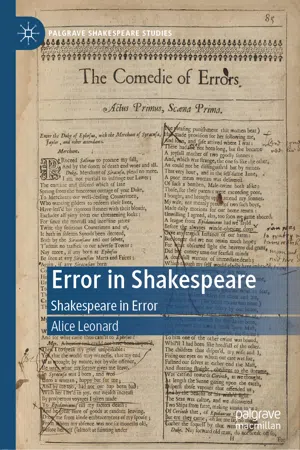
The traditional view of Shakespeare's mastery of the English language is alive and well today. This is an effect of the eighteenth-century canonisation of his works, and subsequently Shakespeare has come to be perceived as the owner of the vernacular. These entrenched attitudes prevent us from seeing the actual substance of the text, and the various types of error that it contains and even constitute it. This book argues that we need to attend to error to interpret Shakespeare's disputed material text, political-dramatic interventions and famous literariness. The consequences of ignoring error are especially significant in the study of Shakespeare, as he mobilises the rebellious, marginal, and digressive potential of error in the creation of literary drama.
- English
- ePUB (mobile friendly)
- Available on iOS & Android
eBook - ePub
About this book
Information
Topic
LiteraturaSubtopic
Crítica literaria europea© The Author(s) 2020
A. LeonardError in ShakespearePalgrave Shakespeare Studieshttps://doi.org/10.1007/978-3-030-35180-9_11. Introduction
‘errors are volitional and are the portals of discovery’1James Joyce‘We have art in order not to die of the truth’2Friedrich Nietzsche
The traditional view that reveres the excellency of Shakespeare’s language and idealises his drama as the perfection of English literature is alive and well today. This is an effect of the canonisation of his works from the eighteenth century, where Shakespeare has become a measure of the English language, ‘the exemplary author of the English canon’, and owner of the vernacular.3 Coleridge famously approached him as a god-like creator of language, the burning genius of the heavens: ‘He goes on kindling like a meteor through the dark atmosphere; yet, when the creation in its outline is once perfect, then he seems to rest from his labour, and to smile upon his work, and tell himself that it is very good’.4 Subsequent centuries of laudation have been conceived as the ‘Shakespeare myth’, that ‘powerful cultural institution, constructed around the figure of Shakespeare, that [can] be analysed to some degree separately from the person of the Elizabethan dramatist, and the texts of his works’.5 Its ideological force shows little sign of diminishing as it is remodelled in response to changes in politics, aesthetics, technology, and contemporary cultural forms.
These entrenched attitudes to Shakespeare prevent us from seeing the actual substance of the text. That substance contains error, is sometimes constrained by it, is sometimes even constituted by it. Error in Shakespeare: Shakespeare in Error proposes, instead, to see Shakespeare as a maker of words marked by error, challenging his cultural hegemony entailed by his perceived linguistic excellence. There has been no study of error, mistake or failure in Shakespeare, or early modern literature, and this monograph fills this critical gap.6 It proposes attention to error as a methodology for interpreting his disputed material text, political-dramatic interventions and famous literariness.
In this context, error is not always wrong; and, indeed, historically, error was a key route to the good and the beautiful. Writing in praise of error, Paul de Man recognises that there is sometimes truth in mistake, ‘as the sun lies hidden within a shadow, or truth within error’.7 De Man argues, with the help of his mistranslation of Nietzsche, that error is the basis of knowledge: ‘Intelligence can only exist in a world in which mistakes occur, in which error reigns’. 8 Error is not something that needs always to be corrected. This follows from the historical sense of error, accounting for the now attenuated early modern meaning of error from errare as ‘wandering’ as well as mistake, which revalues error and suspends the consequent moral judgement of wrongness. In some instances, error should be celebrated, for it reveals not just the unconscious of a writer like Shakespeare but also the historical unconscious of the time: error exposes what the world takes for granted, revealing something of the political unconscious of a moment, how a society orders the world according to right and wrong, and assigns or withholds equivalent value.
The marginalisation of error can be explained through its association with ‘accident’, in that an ‘error’ is an accidental accompaniment or an accessory.9 It is something to be corrected or ignored and therefore questions about its status, function and politics in literature have been mainly unasked. The consequences of ignoring it are all the more significant in the study of Shakespeare, where the energy that comes from its rebellious, marginal, unexpected or digressive potential is mobilised in the creation of literary drama. This book finds that the workings of error are most significant in four areas of Shakespeare: the literary error within figurative language (Chapter 2); political error that challenges the association between error with women (Chapter 3) and foreigners (Chapter 4); and textual error in the transmission and editing of the earliest texts (Chapter 5).
Shakespeare’s use and exploration of literary error conflicts with contemporary theories of language from Renaissance rhetoric, which provided correct rules for usage. The rhetorical training outlined in handbooks such as De duplici copia rerum ac verborum commentarii duo (1512), A Treatise of Schemes and Tropes (1550), The Garden of Eloquence (1577), The Arte of English Poesy (1589) and others, defined thinking about language in the sixteenth century.10 As Peter Mack demonstrates, these ideas flourished between 1460 and 1620 as more than 800 editions of these rhetorical texts were printed all over Europe.11 Renaissance rhetoricians dealt continually with the paradox that figuration was essential to eloquence yet at the same time it was a ‘fault’ of speech.12 Whereas rhetoric aimed to set limits to the faults of language, Shakespeare pushes language further into this type of error, and it is this that makes him one of the most figurative dramatic writers. Shakespeare transgresses rules from Renaissance rhetoric, which sought to regulate language and lead to truth, in his propensity to let error flourish.13 One of the main arguments of this book is that error is not just a signifier of mistake but is rather to be located in the fertile zone between fault and creativity.
Not only does Shakespeare resist the strictures of rhetoric, but also more broadly the Renaissance is marked by an attitude to error and correction which he did not share. It is a period identified by Antony Grafton as being a ‘culture of correction’.14 Erasmus, for example, held high standards of linguistic rectitude and famously complained of the sloppy work and ill-education of those at work in printers’ shops. He declared that books are
published to the world by men so ill-educated that they cannot so much as read, so idle that they are not prepared to read over what they print, and so mercenary that they would rather see a good book filled with thousands of mistakes than spend a few paltry gold pieces on hiring someone to supervise the proof-correcting. And none make such grand promises on the title-page as those who are most shameless in corrupting everything.15
Erasmus, however, demanded standards of rectitude impossible of an early modern print shop, a place David McKitterick describes as a ‘house of error’.16 In the first century of printing, a Humanist attention to correct texts established an attitude towards error which was threatened by the ability of the printing press to multiply error more quickly than ever before. For Henry Barrow, in 1591, print and moral error were intimate...
Table of contents
- Cover
- Front Matter
- 1. Introduction
- 2. Error and Figurative Language
- 3. Error and the Mother Tongue
- 4. Error and the Nation
- 5. Error and the Text
- Back Matter
Trusted by 375,005 students
Access to over 1.5 million titles for a fair monthly price.
Study more efficiently using our study tools.
Frequently asked questions
Yes, you can cancel anytime from the Subscription tab in your account settings on the Perlego website. Your subscription will stay active until the end of your current billing period. Learn how to cancel your subscription
No, books cannot be downloaded as external files, such as PDFs, for use outside of Perlego. However, you can download books within the Perlego app for offline reading on mobile or tablet. Learn how to download books offline
Perlego offers two plans: Essential and Complete
- Essential is ideal for learners and professionals who enjoy exploring a wide range of subjects. Access the Essential Library with 800,000+ trusted titles and best-sellers across business, personal growth, and the humanities. Includes unlimited reading time and Standard Read Aloud voice.
- Complete: Perfect for advanced learners and researchers needing full, unrestricted access. Unlock 1.5M+ books across hundreds of subjects, including academic and specialized titles. The Complete Plan also includes advanced features like Premium Read Aloud and Research Assistant.
We are an online textbook subscription service, where you can get access to an entire online library for less than the price of a single book per month. With over 1.5 million books across 990+ topics, we’ve got you covered! Learn about our mission
Look out for the read-aloud symbol on your next book to see if you can listen to it. The read-aloud tool reads text aloud for you, highlighting the text as it is being read. You can pause it, speed it up and slow it down. Learn more about Read Aloud
Yes! You can use the Perlego app on both iOS and Android devices to read anytime, anywhere — even offline. Perfect for commutes or when you’re on the go.
Please note we cannot support devices running on iOS 13 and Android 7 or earlier. Learn more about using the app
Please note we cannot support devices running on iOS 13 and Android 7 or earlier. Learn more about using the app
Yes, you can access Error in Shakespeare by Alice Leonard in PDF and/or ePUB format, as well as other popular books in Literatura & Crítica literaria europea. We have over 1.5 million books available in our catalogue for you to explore.