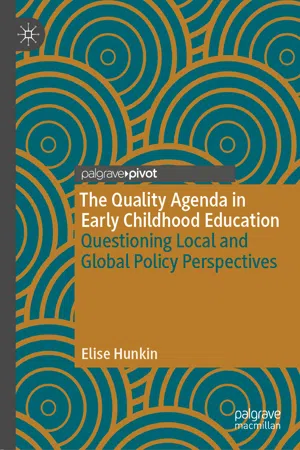
This book investigates notions of 'quality' in early childhood settings both in Australia and globally. After experiencing quality reform as an educator, the author turned to research as a means by which to better understand early childhood quality reform and agenda over time. This book questions how early childhood reform policy and agenda have constructed quality - what it is presumed to be and do - over time and the implications of these 'truths'. Taking a Foucauldian governmentality view of the history of Australian early childhood services, the impetus for the quality reform era, the quality reform policy assemblages and the contemporary post-reform era, this book rigorously examines prevailing policy assumptions, ambitions and deployments of quality, and warns of an emerging ambition for 'only quality' settings in early childhood. This book will appeal to early childhood students and educators, education policy sociologists and all who are interested in reclaiming earlychildhood education and care.
eBook - ePub
The Quality Agenda in Early Childhood Education
Questioning Local and Global Policy Perspectives
- English
- ePUB (mobile friendly)
- Available on iOS & Android
eBook - ePub
The Quality Agenda in Early Childhood Education
Questioning Local and Global Policy Perspectives
About this book
Information
Topic
EducationSubtopic
Early Childhood Education© The Author(s) 2019
E. HunkinThe Quality Agenda in Early Childhood Education https://doi.org/10.1007/978-3-030-31627-3_11. Perspectives of Quality in Early Childhood Settings
Elise Hunkin1
(1)
RMIT Bundoora, Royal Melbourne Institute of Technology, Bundoora, VIC, Australia
Abstract
The introductory chapter explores the author’s context and establishes the scope of the book as providing a response to government assumptions about what constitutes quality in early childhood settings. A post-structural view of policy as value-laden is presented, and linked to the need for early childhood stakeholders locally and globally to engage with the complex policyscape of quality reform. The nature of global policy and policymaking is outlined as well as the Australian early childhood service and policy context to set the scene for the following chapters.
Keywords
Quality reformPolicyPolicy-makingEarly childhoodAustraliaWhose Quality?
This book and the research that it reports began in an early childhood classroom.
I began my career as a kindergarten (prior to school year) director at a time when Australia did not have a National Quality Reform Agenda for early childhood (Council of Australian Governments [COAG] 2009) and consequently, my work was not guided by quality standards and ratings, outcomes or frameworks. When I tell my university students this they are often incredulous but I am not that old. How did you know what to do? they wonder. Later, I spent some time working in the primary sector before transitioning back to kindergarten teaching. There, I found myself adrift in the new discursive and policy landscape of quality that I soon learnt was reflective of global assumptions and conversations taking place far away from educators, families and children. I also learnt that it was not just the Australian government that had identified quality as the foremost reform agenda for early childhood, but also the governments of developed and developing countries alike, informed by influential networks of local and international organisations.
It took me some time to adapt to the new ‘quality’ regime of frameworks, standards and so on, but that wasn’t what concerned me about the new discursivity of early childhood work—my concern was that my practices and pedagogy were mostly unchanged and I was translating them into the new compliance structures. Despite being sympathetic to a quality agenda, I questioned the difference between my practices and training and the new state-regulated quality, since the former seemed more robust than the latter. I wondered if there had been a quality ‘problem’ in Australian early childhood settings as the notion of ‘quality reform’ suggests. Most of all, I wondered how I had not been aware of the changes afoot, since I had only been adjacent to the field, teaching children in their first year of primary school who had graduated early childhood settings mere months earlier.
These questions led me to postgraduate research with the aim to investigate how policy notions of quality in early childhood have emerged and changed over time. I was concerned to find that economic questions and answers frame global policy notions of quality in early childhood settings, creating new ‘experts’ in what constitutes quality in early childhood, and what does not (Hunkin 2018a). Further, that quality reform policies tend to position quality as the site of government investment, rather than service access more broadly conceived (Hunkin 2018b). To say this is concerning draws on a post-structural view of reality that acknowledges societies as places of competing interests and agenda, some of which are privileged by policy and some of which are not (Taylor et al. 1997). Therefore, how can what constitutes ‘quality’ for one family and child also be ‘quality’ for another, in a difference place or time (Dahlberg et al. 2006)? What are the implications for the early childhood sector if governments begin to selectively promote certain parts of early childhood work and settings as ‘quality’ and not others? In the first half of this book I will revisit aspects of this work, outlining how the current policy view of quality has come to be at this point in time and not another, as well as the regime of truth that embeds it (Foucault 1998). I draw on the Australian context that has been my experience but also investigate how local perspectives have increasingly become responsive to global agenda, discourse and targets (Fenwick et al. 2014).
The second half of the book moves into new research as I question the contemporary policyscape, reviewing local and global early childhood policy happenings and knowledge production about quality early childhood settings. I argue that over time the policy view of quality has shifted to promote a troubling new agenda—that only quality early childhood settings are beneficial or worthwhile. I explore how this shift from quality to ‘only quality’ occurred in the Australian policyscape due to changes in governance ideology and also trace local influences into the global policyscape and its key international players, such as the Organisation for Economic Cooperation and Development (OECD 2012, 9). The goal isn’t to prove the existence of a single, unilateral idea or discourse but rather, to look at how the policies and politics of quality reform agenda locally and globally have created the conditions for some truths to dominate and frame our view of children and early childhood services over time, with varied implications. This approach draws on a post-structural view of policy as value-laden process and text that sits within local and global systems of agenda and influence.
Policy-Making in Contemporary Times
Traditional views of policy have often cast it as a rational and value-natural ‘best’ outcome solution to a problem. However, since societies aren’t places where we experience or perceive problems in the same way, the post-structural view is that policy is both process and text—a value-laden non-linear tangle of competing interests and power struggles ultimately made manifest in a product that imbues government agenda. Peck and Theodore (2010) call this a view of policy as a “field of power” (169) which highlights how governments seek to persuade through policy, constructing discourse and text that promote certain truths and ideologies over others to meet their agenda (Osgood 2009).
Discourse is a word that is used often within and across disciplines but in this book refers to Michel Foucault’s (1972) theorisation of discourse as a “collective consciousness” (22). In his use of discourse, Foucault (1972) is referring to the way that populations can broadly understand a certain notion or idea without being told of or having discussed it explicitly—quality in early childhood settings is a good example of this. Discourse is “secretly based on an ‘already said’” (Foucault 1972, 25) which puts analytical emphasis on the conditions in which we consider certain statements the ‘truth’ (Ball 2013). These conditions are always changing because discourse evolves and changes, over...
Table of contents
- Cover
- Front Matter
- 1. Perspectives of Quality in Early Childhood Settings
- 2. ‘For the Little Ones, the Best’: Australian Early Childhood Service and Policy Histories
- 3. ‘There Is a Quantum Difference Between the Provision of Age-Appropriate Play-Based Care and an Early Learning and Care Environment’: The Quality Agenda for Australian Early Childhood
- 4. ‘Early Childhood Education and Care (ECEC) Brings a Wide Range of Benefits… But All These Benefits Are Conditional on Quality’: Questioning the Only Quality Reform Agenda
- 5. ‘Wiping Noses and Stopping Children from Killing Each Other’: Contesting an Only Quality Agenda
- 6. Quality Futures? The Case for Re-democratising Early Childhood Education and Care
- Back Matter
Trusted by 375,005 students
Access to over 1.5 million titles for a fair monthly price.
Study more efficiently using our study tools.
Frequently asked questions
Yes, you can cancel anytime from the Subscription tab in your account settings on the Perlego website. Your subscription will stay active until the end of your current billing period. Learn how to cancel your subscription
No, books cannot be downloaded as external files, such as PDFs, for use outside of Perlego. However, you can download books within the Perlego app for offline reading on mobile or tablet. Learn how to download books offline
Perlego offers two plans: Essential and Complete
- Essential is ideal for learners and professionals who enjoy exploring a wide range of subjects. Access the Essential Library with 800,000+ trusted titles and best-sellers across business, personal growth, and the humanities. Includes unlimited reading time and Standard Read Aloud voice.
- Complete: Perfect for advanced learners and researchers needing full, unrestricted access. Unlock 1.5M+ books across hundreds of subjects, including academic and specialized titles. The Complete Plan also includes advanced features like Premium Read Aloud and Research Assistant.
We are an online textbook subscription service, where you can get access to an entire online library for less than the price of a single book per month. With over 1.5 million books across 990+ topics, we’ve got you covered! Learn about our mission
Look out for the read-aloud symbol on your next book to see if you can listen to it. The read-aloud tool reads text aloud for you, highlighting the text as it is being read. You can pause it, speed it up and slow it down. Learn more about Read Aloud
Yes! You can use the Perlego app on both iOS and Android devices to read anytime, anywhere — even offline. Perfect for commutes or when you’re on the go.
Please note we cannot support devices running on iOS 13 and Android 7 or earlier. Learn more about using the app
Please note we cannot support devices running on iOS 13 and Android 7 or earlier. Learn more about using the app
Yes, you can access The Quality Agenda in Early Childhood Education by Elise Hunkin in PDF and/or ePUB format, as well as other popular books in Education & Early Childhood Education. We have over 1.5 million books available in our catalogue for you to explore.