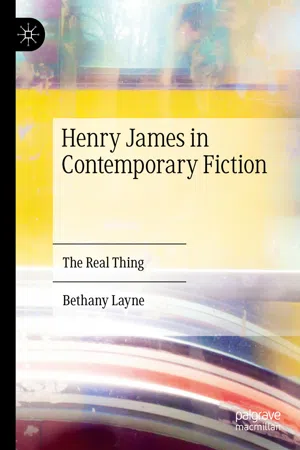
This book explores the extraordinary proliferation of novels based on Henry James's life and works published between 2001 and 2016, the centenary of his death. Part One concentrates on biofictions about James by David Lodge and Colm Tóibín, and those written from the perspective of the key female figures in his life. Part Two explores appropriations of The Portrait of a Lady, The Turn of the Screw, and The Ambassadors. The book articulates the developments in biographical and adaptive writing that enabled millennial writers to engage so explicitly with James, locates the sources of his appeal, and explores the different forms of engagement taken. Layne analyses how these manifestations of James's legacy might function differently for knowing versus unknowing readers, and how they might perform the role of literary criticism. Overarching themes include ideas of queering, the concern with seeking redress, and the frustrated quest for origin, authenticity, or 'the real thing'.
- English
- ePUB (mobile friendly)
- Available on iOS & Android
eBook - ePub
About this book
Information
© The Author(s) 2020
B. LayneHenry James in Contemporary Fictionhttps://doi.org/10.1007/978-3-030-31650-1_11. Introduction
On a bright Saturday afternoon in the late summer of 2002, two men are introduced to each other in the front parlour of Lamb House . That they have both chosen this day for their visit is surprising, but not extraordinary: the National Trust opens Henry James’s home to the public just two afternoons each week, and the writers—for writers they are—have good reason for wanting to make their pilgrimage before the house is closed for the season. What follows is rather more unexpected: the tenant, overhearing their conversation, unhooks the rope at the foot of the staircase and invites the writers to follow (Tóibín 2009b, p. 224). He shows them upstairs to the green room, where the floorboards creak with the ghost of James’s perambulation, and a typewriter sits shrouded in the window. He shows them the bedroom where the Master lay, his nails forming crescent moons in his palm as Heinrik Andersen undressed next door. Or so each writer imagines, making notes that the other pretends not to see (Heyns 2004, n.p.). The tenant has seen this look before. He has given the tour to another writer, just a month earlier (Lodge 2007, p. 18). He senses that it would not be tactful to mention this.
The men scribbling covertly in their notebooks are Michiel Heyns and Colm Tóibín, and their forerunner was David Lodge. At present, only the tenant knows what soon the whole world will know: that all three are writing novels about the house’s former inhabitant, of which two will be published amid a storm of publicity heralding ‘The Year of Henry James’ . For in 2004, Lodge’s Author, Author and Tóibín’s The Master coincided with Alan Hollinghurst’s The Line of Beauty , whose protagonist is a graduate student working on James, and with the paperback reissue of Felony, Emma Tennant’s novella about James and Constance Fenimore Woolson, first published in 2002 (Lodge 2007, pp. 3–4). David Leavitt is rumoured to have abandoned his own novel about James on hearing of Tóibín’s project (Lodge 2007, p. 5), while Heyns, ‘the worst victim of the Henry James skirmishes’ (Thurschwell 2011, p. 4), did not find a publisher for The Typewriter’s Tale until the following year. Edwin Yoder’s Lions at Lamb House appeared two years later. There then followed a period of silence, tempting John Harvey to proclaim the world safe, ‘at least for a few years’, from novels featuring ‘Henry James for their lead character’ (2007, p. 75).
Others thought it unlikely that James, now resurrected, would ‘die quietly’ (Saunders 2008, p. 131), and predicted that his ghost ‘would go on rattling furniture and feelings in the house of literature’ (Kaplan 2007, p. 76). Cora Kaplan’s statement turned out to be eerily prescient, with four more works appearing in 2008. These were Elizabeth Maguire’s The Open Door and Cynthia Ozick’s ‘Dictation’, about James’s relationships with Woolson and Theodora Bosanquet, respectively, Joyce Carol Oates’s short story ‘The Master at St. Bartholomew’s Hospital, 1914–1916’ and Richard Liebmann-Smith’s satirical novel The James Boys. Lynne Alexander’s The Sister followed in 2012, narrating its subject’s life from the perspective of Alice James. Concurrent with these multiplying appropriations of James’s figure was the ongoing production of novels inspired by his fiction, with The Turn of the Screw, The Portrait of a Lady and The Ambassadors being among the most popular source texts. Since the new millennium, these have inspired novels such as A.N. Wilson’s A Jealous Ghost (2005) and John Harding’s Florence and Giles (2010), Colm Tóibín’s Brooklyn (2009) and Kirsten Tranter’s The Legacy (2010), and Cynthia Ozick’s Foreign Bodies (2010) and Michiel Heyns’s Invisible Furies (2012).
This book examines the extraordinary proliferation of James-inspired narratives between the new millennium and the centenary of James’s death. In doing so, I illuminate the reasons behind the novelistic fascination with ‘his figure and fiction’ (Tintner 1998). Such fascination is not solely a contemporary phenomenon: Adeline Tintner has recognised James in fin-de-siecle fiction, tracing his features in the ‘often unprepossessing fictional characters’ created by female writers of his acquaintance, and in the ‘even harsher portraits’ by his male contemporaries (1998, p. 5). Madeleine Danova has also framed the use of his texts ‘as a background for the creation of new fictional worlds’ as a tradition beginning in the early twentieth century (Danova, 2011a, p. 10), with peaks post- World War One and in the 1930s (Tintner 1998, p. 7). But James does not appear as a named figure until the 1970s, his isolated appearances across the following decades paling in comparison to the sustained attention he has received since 2004 (Tintner 1998, pp. 6–7). Nor are the twentieth-century responses to his novels that Tintner discusses as explicit or as self-conscious as the millennial reworkings enumerated above. This study begins where Henry James’s Legacy (1998) ends, sacrificing Tintner’s encyclopaedic breadth for a more detailed and sustained discussion of a number of exemplary texts. I want to start by asking what developments in biographical and adaptive writing enabled millennial writers to engage so explicitly with James? How can we start to explain his appeal for novelists working in these modes? And lastly, what forms have their engagement taken?
As noted by Lodge (2007, p. 8), biographical fiction, or biofiction, became an increasingly popular subgenre at the turn of the twenty-first century, with writers’ lives attracting particular attention. Lodge defines biofiction as a ‘novel which takes a real person and their real history as the subject matter for imaginative exploration, using the novel’s techniques for representing subjectivity rather than the objective, evidence-based discourse of biography’ (2007, p. 8). To this definition, we must append a caveat regarding biofiction’s use of the subject’s real name, a detail by which it distinguishes itself from the more numerous, but less explicit, engagements of roman-à-clef. The use of the real-world proper noun situates biofiction on the ontological frontier between biography and fiction, its position querying Lodge’s separation of the genres into watertight categories. Where, then, did biofiction come from? Or, to be more specific, what cultural conditions enabled the evolution of roman-à-clef into this new and explicit mode of engagement?
Responses to this question have been forthcoming from biofiction’s many practitioners, its few dedicated critics and James scholars touching on the broader context for the novels he inspired. Lodge himself suggests several explanations: biofiction is
Others have framed it in purely literary terms, as an offshoot of historiographic metafiction (Middeke 1999, p. 4), or a symptom of the literary novel’s inclination towards ‘parafiction […] fiction about fictionality’ (Harvey 2007, p. 88). Biofiction has been situated as a response to developments in psychoanalysis (a result of the ‘growing understanding of the subconscious’) (Lackey 2014, p. 14) or trends in popular culture (a sign of the cult of writers) (Perkin 2010, p. 117; Guignery 2007, p. 168). Further explanations have been more rigorously theoretical, framing it as an effect of the ‘linguistic turn’ of the 1960s (Lackey 2014, p. 11) and the ‘incredulity toward metanarratives’ (Lackey 2014, p. 12, citing Zavarzadeh); a reaction against the ‘end of history’, ‘erasure of materiality’ and ‘the dissolution of the subject’ (Savu 2009, p. 242); a sign of the acknowledged imbrication of factual and fictional narratives (Guignery 2007, pp. 161–162; Lackey 2014, p. 2); or a response to the Death of the Author (Scherzinger 2010, p. 15).a symptom of declining faith or loss of confidence in the power of purely fictional narrative, […] a characteristic move of postmodernism—incorporating the art of the past in its own processes through reinterpretation and stylistic pastiche […] a sign of decadence and exhaustion in contemporary writing or […] a positive and ingenious way of coping with the ‘anxiety of influence’. (2007, pp. 9–10)
While each explanation has its rationale, the last two are intrinsic to biofiction. They are suggested within the term itself, which signals both an overlap and a relation of equivalence. On a surface level, the compound noun ‘biofiction’ hints at the similarities between evidence- and invention-based discourses (Kaplan 2007, p. 65), implying, by extension, that ‘all biography is ultimately fiction’ (Malamud, qtd. in Parini 1997, p. 252). Read symbolically, the term also suggests that the biographical subject is a fiction: that the author, after Barthes, has been subsumed into the realm of discourse. These structuring an...
Table of contents
- Cover
- Front Matter
- 1. Introduction
- Part I. Biofictions
- Part II. Appropriations
- Back Matter
Trusted by 375,005 students
Access to over 1.5 million titles for a fair monthly price.
Study more efficiently using our study tools.
Frequently asked questions
Yes, you can cancel anytime from the Subscription tab in your account settings on the Perlego website. Your subscription will stay active until the end of your current billing period. Learn how to cancel your subscription
No, books cannot be downloaded as external files, such as PDFs, for use outside of Perlego. However, you can download books within the Perlego app for offline reading on mobile or tablet. Learn how to download books offline
Perlego offers two plans: Essential and Complete
- Essential is ideal for learners and professionals who enjoy exploring a wide range of subjects. Access the Essential Library with 800,000+ trusted titles and best-sellers across business, personal growth, and the humanities. Includes unlimited reading time and Standard Read Aloud voice.
- Complete: Perfect for advanced learners and researchers needing full, unrestricted access. Unlock 1.5M+ books across hundreds of subjects, including academic and specialized titles. The Complete Plan also includes advanced features like Premium Read Aloud and Research Assistant.
We are an online textbook subscription service, where you can get access to an entire online library for less than the price of a single book per month. With over 1.5 million books across 990+ topics, we’ve got you covered! Learn about our mission
Look out for the read-aloud symbol on your next book to see if you can listen to it. The read-aloud tool reads text aloud for you, highlighting the text as it is being read. You can pause it, speed it up and slow it down. Learn more about Read Aloud
Yes! You can use the Perlego app on both iOS and Android devices to read anytime, anywhere — even offline. Perfect for commutes or when you’re on the go.
Please note we cannot support devices running on iOS 13 and Android 7 or earlier. Learn more about using the app
Please note we cannot support devices running on iOS 13 and Android 7 or earlier. Learn more about using the app
Yes, you can access Henry James in Contemporary Fiction by Bethany Layne in PDF and/or ePUB format, as well as other popular books in Literature & Modern Literary Criticism. We have over 1.5 million books available in our catalogue for you to explore.