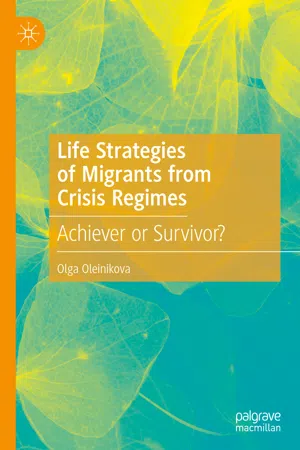
This book offers a profoundly new examination of life strategies of migrants from regimes in crisis. By focusing on the unique paired comparison of two opposing life strategies—the dynamic, risk-taking and future-oriented 'achievement life strategy' and the conservative, risk-minimizing and survival-oriented 'survival life strategy'—this volume takes migration from post-independence Ukraine to Australia as a central case study to show how people shape their lives in response to regime transitions and crises; what life strategies individuals pursue to cope with social change; and why these individuals chose migration to Australia. Ultimately, the book compels us to reassess what we mean by migration and regime crisis in order to adequately respond to the global challenges confronting numerous democracies today. As such, it will appeal to scholars of sociology and politics with interests in migration, political theory and democracy.
- English
- ePUB (mobile friendly)
- Available on iOS & Android
eBook - ePub
About this book
Information
Part IConcepts and Contexts
© The Author(s) 2020
O. OleinikovaLife Strategies of Migrants from Crisis Regimeshttps://doi.org/10.1007/978-3-030-39839-2_11. Life Strategy, Migration and Regime Transition
Olga Oleinikova1
(1)
University of Technology Sydney, Sydney, Australia
1.1 Life Strategy and Migration
In September 2000, Oleh Kotsuba, then 28 years old, came to Sydney, Australia, as a tourist to support Ukrainian athletes in the 2000 Sydney Olympic Games. Oleh was impressed with the Australian lifestyle and decided to stay. He overstayed his tourist visa and following the advice of a migration agent claimed political asylum in Australia. Through friends, he immediately found a job in the construction sector as a painter. Before coming to Sydney and claiming asylum, he had a currency exchange business in Ukraine. In the late 1990s, he was illegally forced to give up his business in favour of local authorities. To survive the economic hardship and conflicts with local authorities, he was forced to leave Ukraine in search of a stable and secure life. Oleh said, “applying for asylum in Australia is a lottery”, and he felt lucky to finally receive permanent residency in Australia through humanitarian migration stream. While he was waiting for his visa to be processed, he was not allowed to leave Australia and for 4 years he hasn’t seen his wife and daughter who stayed in Ukraine. He now lives in Sydney and works as a painter in construction sector.
Panas Zemsky, then 26 years old, came to Australia in 2012 as a skilled migrant. Before coming to Australia, he worked as an IT programmer for different international companies and was part of projects based in Canada, the USA, New Zealand and other countries. He travelled a lot. After his girlfriend (who is also an IT professional) returned to Ukraine from a working trip to Australia, they decided to move to Sydney. The lack of development opportunities, non-competitive salaries in Ukraine and plenty of professional experience pushed them to apply for permanent residence in Australia through skilled migration stream. Panas currently works together with his girlfriend for a foreign IT company in Sydney and is thinking of starting his own IT business.
These are two different life stories by migrants who are both from Ukraine, but who left Ukraine in different times during the post-Soviet transition crisis. The first story is a story of ‘survival’—typical among Ukrainians who came to Australia between 1991 and 2003; the second story—a story of ‘achievement’ found common for Ukrainians who left Ukraine between 2004 and 2016. This book seeks to understand different life strategies of migrants from regimes in transition and in crisis. It does so by offering a profoundly new interpretation of ‘life strategy’ of a migrant, seen as the outcome of personal–structural ties—a combination of personal choices/individual actions with cultural, institutional and structural frames under crisis conditions. By focusing on the unique paired comparison of two opposing life strategies: (1) dynamic, risk-taking and future-oriented ‘achievement life strategy’ and (2) conservative, risk-minimizing and survival-oriented ‘survival life strategy’—the book offers two critical frameworks of personal–structural (agency/structure) ties that empirically prove the assumption that life strategies of survival guide those migrants leaving their country at its peak crisis points.
How do people shape their lives in response to the regime transition and crises? What life strategies do they pursue to cope with social change? And why do they choose migration as a way to realize/implement their life strategies? This book seeks to answer these questions and to understand why some people choose migration to ‘survive’, while others migrate to ‘achieve’.
Through the case study of post-independence Ukrainian migration to Australia, this book investigates the life strategy of a migrant as a key component in understanding the current regime transitions and crises in Europe and the accelerated East European migration to Australia. International migration in post-Soviet Eastern Europe is a striking example of how quickly population processes respond to political and economic transformations. Until the early 1990s, Ukraine, together with other East European Soviet countries, was isolated from other parts of the world through administrative restrictions on foreign travel. The freedom of movement that was reinstated in the region around 1990 led to massive migration. In particular, following Ukraine’s independence in 1991 the number of people who sought emigration rapidly increased (Pyrozhkov et al. 1997).
According to the Ukrainian National Academy of Science, by 2050, the population of Ukraine will decline from the current 46 million to 36 million (Institute of Demography and Social Studies of NAS in Ukraine 2010). The United Nations presents an even more pessimistic figure of 26 million (United Nations Department of Economic and Social Affairs 2010). International migration plays a pivotal role in the population decline. National survey results reveal the number of Ukrainian citizens who travelled abroad for employment at least once between January 2005 and June 2008 reached 1.5 million, or 5.1 per cent of the working-age population (State Statistics Service of Ukraine, 2009, p. 25). Various estimations further show that between 4 and 7 million Ukrainians are migrant workers (Golovakha 2008, p. 63), or 19.5 per cent and 34.1 per cent, respectively, of the economically active population (Malynovska 2011, p. 6). Every tenth Ukrainian family has some experience of migration (Pribytkova 2003). Many of those who have already experienced international migration express a desire to go abroad again in search of a better life (Pribytkova 2003). This global and mass outflow of Ukrainians abroad is caused by the regime transitional crisis and it has shaped the mode of post-independence Ukrainian migration to Australia.
Beyond the specific trends of the post-Soviet East European crisis regimes, international migration is a steadily growing phenomenon worldwide and Australia is one of the largest beneficiaries of these movements of people, cultures and ideas (Bedford et al. 2005; Hugo 2006; Castles and Miller 2009). The countries from which migrants to Australia originated have varied over years. Ukrainians have never comprised a significant proportion of the migrants to Australia historically, although there has been a steady intake over recent years. Given the lack of knowledge and substantive research about Ukrainian migration to Australia and the complete absence of studies about the post-independence Ukrainian migration period, the choice of this case study seemed important. It is driven by the aim to discover and explain qualitative characteristics of post-independence Ukrainian migrants and recent Ukrainian migration trends to Australia.
The migrant experience makes sense only if placed in a comparative perspective. Using the idea of two waves of the post-independence Ukrainian migration to Australia (1991–2003 vs. 2004–2016) and their distinct life strategies, the book analyses the migrants’ lives as they move across two spaces, the sending and receiving countries, and through time, before, during and after migration. This is not a study of migration itself, rather, it examines migration in so far as it provides the context for life strategy implementation in a specific historical period in Ukraine after the collapse of the Soviet Union (referred to in this study as the transition period). To further limit the focus of the discussion, two particular periods of post-independence Ukrainian migration to Australia were examined—1991–2003 and 2004–2016. By incorporating life strategies, post-Soviet regime transition and migration, this book brings the three research fields together in order to examine aspects of the continuity of migrants’ life strategies as they move from Ukraine to Australia in an era of socio-economic and political turbulence in post-Soviet Eastern Europe. This is uncharted scholarly territory. In this sense, the originality of this book is in its approach—one that explores the use of life strategy within the context of migration and which further deploys life strategy in a sociological context rather than within its original psychological focus.
This book started with the hypothesis that representatives of different migration periods implement different life strategies depending on how macro (structure) and micro (agency)-factors combine in their lives. It was hypothesised that different combinations would lead to the formation of different life strategies. The hypothesis was that migrants who emigrated in the 1990s just after the USSR collapsed, would implement a survival life strategy and their decision to come to Australia would be shaped by survival, which is reflected in the micro-factors (values, aims, needs, agency) underpinning their life strategies. Those migrants who migrated to Australia in the mid-2000s had configured their micro-factors differently so that they were focused on achievement and adopted an achievement life strategy. This hypothesis has been confirmed and the details of this argument are woven through the analysis.
Developing the paired comparison further, the book offers a unique integrated life strategy conceptual framework that enables deeper and systematic understanding of the plurality of individual experiences and structural constrains in transition and crisis regimes. Though it is constantly ignored by mainstream post-Soviet regime transition and international migration scholarship, a life strategy approach helps researchers “gai[n] new insights on migrants as social actors” (Geisen 2013, p. 1) in recent migration research and the broader transition scholarship. The post-Soviet transition and migration processes and their impact on individual life strategies were the subject of some sociological research in Western European and North American (hereafter Western sociology). This scholarship tended to privilege economic theories of household strategies and related more to tactics than to the complexity of building and implementing individual life strategies with the help of international mobility. It argued that socio-economic transformations alter the decision-making environment of individuals while also enhancing the role of life strategies to adapt to structural change, notably throug...
Table of contents
- Cover
- Front Matter
- Part I. Concepts and Contexts
- Part II. Leaving Europe
- Part III. Becoming Australian
- Part IV. Achievers Versus Survivors: Comparative Perspective
- Back Matter
Trusted by 375,005 students
Access to over 1.5 million titles for a fair monthly price.
Study more efficiently using our study tools.
Frequently asked questions
Yes, you can cancel anytime from the Subscription tab in your account settings on the Perlego website. Your subscription will stay active until the end of your current billing period. Learn how to cancel your subscription
No, books cannot be downloaded as external files, such as PDFs, for use outside of Perlego. However, you can download books within the Perlego app for offline reading on mobile or tablet. Learn how to download books offline
Perlego offers two plans: Essential and Complete
- Essential is ideal for learners and professionals who enjoy exploring a wide range of subjects. Access the Essential Library with 800,000+ trusted titles and best-sellers across business, personal growth, and the humanities. Includes unlimited reading time and Standard Read Aloud voice.
- Complete: Perfect for advanced learners and researchers needing full, unrestricted access. Unlock 1.5M+ books across hundreds of subjects, including academic and specialized titles. The Complete Plan also includes advanced features like Premium Read Aloud and Research Assistant.
We are an online textbook subscription service, where you can get access to an entire online library for less than the price of a single book per month. With over 1.5 million books across 990+ topics, we’ve got you covered! Learn about our mission
Look out for the read-aloud symbol on your next book to see if you can listen to it. The read-aloud tool reads text aloud for you, highlighting the text as it is being read. You can pause it, speed it up and slow it down. Learn more about Read Aloud
Yes! You can use the Perlego app on both iOS and Android devices to read anytime, anywhere — even offline. Perfect for commutes or when you’re on the go.
Please note we cannot support devices running on iOS 13 and Android 7 or earlier. Learn more about using the app
Please note we cannot support devices running on iOS 13 and Android 7 or earlier. Learn more about using the app
Yes, you can access Life Strategies of Migrants from Crisis Regimes by Olga Oleinikova in PDF and/or ePUB format, as well as other popular books in Social Sciences & Politics. We have over 1.5 million books available in our catalogue for you to explore.