This edited volume explores the relationship between constitutionalism and populism in the Italian context. Italian populism is of interest to comparative lawyers for many reasons. Firstly, the country has a long-lasting tradition of anti-parliamentarism over the course of its history as a unitary state. After the 2018 general election, it has turned into the first European country in which two self-styled populist parties formed a coalition government. Although it collapsed in August 2019, many issues that it had raised remain. Secondly, as Italy is a founding member of the European Communities, the constitutional implications of populist politics have to be considered not only within the national framework but also in a wider context. This book argues that the relationship between populism and constitutionalism should not be seen in terms of mutual exclusion and perfect opposition. Indeed, populism frequently relies on concepts and categories belonging to the language of constitutionalism (majority, democracy, people), offering a kind of constitutional counter-narrative.
eBook - ePub
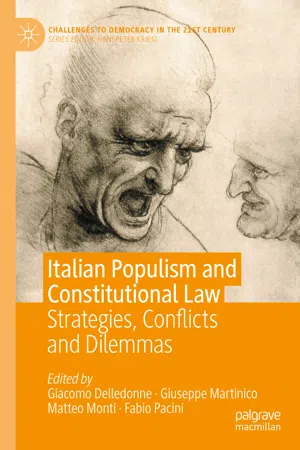
Italian Populism and Constitutional Law
Strategies, Conflicts and Dilemmas
- English
- ePUB (mobile friendly)
- Available on iOS & Android
eBook - ePub
Italian Populism and Constitutional Law
Strategies, Conflicts and Dilemmas
About this book
Information
Subtopic
Derecho público© The Author(s) 2020
G. Delledonne et al. (eds.)Italian Populism and Constitutional LawChallenges to Democracy in the 21st Centuryhttps://doi.org/10.1007/978-3-030-37401-3_11. Introduction: A Constitutional Viewpoint on Italian Populism
Giacomo Delledonne1 , Giuseppe Martinico1 , Matteo Monti1 and Fabio Pacini1
(1)
Scuola Sant’Anna, Pisa, Italy
Keywords
PopulismParliamentsConstitutionalismItalyDemocracyConcept Behind the Book
The aim of this edited volume is to explore the relationship between constitutionalism and populism in the Italian context. The Italian experience with populism is interesting both to domestic and comparative lawyers for many reasons. First, the country has a long-lasting tradition of anti-parliamentarism over the course of its history as a unitary state. In the post-war constitutional setting, dissatisfaction with political parties and their perceived self-serving attitudes (partitocrazia , in Italian) was widespread among scholars and in specific circles. After the end of the Cold War, populism has characterised many of the new parties and movements that have come to the forefront in Italian politics (Tarchi 2015, 2018; Bressanelli and Natali 2019). After the 2018 general election, Italy turned into the first European country in which two self-styled populist parties with very different agendas and voting constituencies formed a coalition government. In this respect, Italy has not only been marked by populist politics for many decades: by that time, it became an experiment of a self-styled populist coalition government. The first Conte government, formed after the 2018 election, resigned in August 2019: however, many issues that it raised are still there.
Second, the Italian case is of the greatest interest because the country is a founding member of the European Communities (now European Union). Therefore, the constitutional implications of populist politics have to be considered not only within the national framework but also in the wider context.
In this book it will be argued that the relationship between populism and constitutionalism should not be seen in terms of mutual exclusion and perfect opposition (Müller 2016). Indeed, it is possible to say that populism frequently relies on concepts and categories belonging to the language of constitutionalism (majority, democracy, people), trying to reshape them and offering a sort of constitutional counter-narrative (Corrias 2016). This kind of approach can be described in the light of two concepts: mimesis and parasitism. Meanwhile, populists do not normally acknowledge the distinction between constitutional and non-constitutional politics, since they do not conceive the constitution as neutral. This reveals a sort of legal scepticism that can be traced back to what Blokker (2019: 548–51) calls “legal resentment”. This element is connected to what Arato (2013: 148) would call the “regeneration of the people” and to the tendency of populism “to occupy the space of the constituent power” (Arato 2017: 5). This also explains why populists tend to perceive limits and procedures as obstacles in the path of establishing the democratic principle. Moreover, populists depict courts and independent agencies as biased and non-neutral since “independent judges and courts are understood as an illegitimate constraint on majority rule, and hence legal means are to be employed to counter this situation” (Blokker 2019: 547). These considerations clarify why populists seem to be on a permanent political campaign. Against this background, present-day populisms do not emerge completely out of the blue, since they are the consequences of long-standing issues that have characterised the political contexts in which they operate.
Building on these ideas, some scholars have drawn a parallel between political constitutionalism and populism, as they both question the political engagement of unaccountable constitutional courts and the status of judicial review (Blokker 2019). Nevertheless, important differences exist between political constitutionalism and populism, as the latter is deeply rooted in a kind of pre-political understanding of the “people”, seen as the direct and automatic source of political truth, and this inevitably results in questioning representative institutions as well. This is an element that does not necessarily characterise political constitutionalism as such.
Structure of the Volume
Bearing in mind this framework, the edited volume develops a comprehensive analysis of constitutional issues related to the rise of Italian populism. In order to do so, we have structured the book in two parts. In the first part, the impact of populist claims on Italian institutions is addressed. The second part, in turn, focuses on the constitutional implications of the populist approach to the elaboration of policies. All chapters consider both recent developments and their long-term antecedents.
The two parts are preceded by an opening essay, in which Paul Blokker considers the weight of populist arguments in the season of constitutional reform in Italy since the early 1990s. His understanding of populism is based on a dualistic perspective, in which democracies are subject to a fundamental tension between constitutionalism and populism. Blokker considers two failed reform projects—respectively undertaken by the Berlusconi government in 2004–6 and the Renzi government in 2014–16—in the light of three typical aspects of the interplay of populism and public law: majoritarianism, instrumentalism, and legal resentment. Those attempts at constitutional reform were unsuccessful; however, a populist attitude seems to have become the prevalent flavour in Italian constitutional politics debates.
The first part includes contributions by Cristina Fasone, Giuseppe Martinico, Pietro Faraguna, Fabio Pacini, Giacomo Delledonne, and Giovanni Boggero.
Cristina Fasone addresses the impact of the populist turn in Italian politics on the non-legislative functions of the Parliament. In her view, the latest wave of populism has contributed to further marginalising the national legislature. However, a number of relevant elements point at continuity with the past: in this respect, some trends that were already in place have escalated. Aside from this, at least three significant shifts are directly related to the spectacular rise of populist parties in the last two legislative terms. First, the contestation of the alleged “privileges” of the members of Parliament may lead to a radical devaluation of the status of MPs. Second, the claim to provide total transparency, coupled with a massive resort to the new media, is intimately at odds with certain distinctive traits of the traditional mission of the Parliament. Third, the spectacularisation of politics, which is an integral part of the populist strategy, has led to an overexploitation of some traditional instruments of parliamentary oversight, like investigating committees and parliamentary questions.
Giuseppe Martinico considers the current Italian debate about direct democracy, in which populist claims play a crucial role. In his chapter, the starting point is a draft constitutional bill introduced by the first Conte government and aiming to enhance direct democracy and to enhance a type of legislative referendum. In the populist discourse, emphasis on direct democracy and referendums generally goes hand in hand with questioning representative democracy and its instruments. In the light of the possible anti-parliamentarian inspiration of referendums, a comparative analysis suggests that constitutional law tends to limit the political risks that are connected to them. In the Italian constitutional order, where referendums have long played an important role, the rationalising function of the case law of the Italian Constitutional Court deserves close attention and provides guidelines for “taming” some of the most controversial aspects of the recent constitutional amendment proposals.
The chapter by Pietro Faraguna explores the relations between populism and constitutional amendment. By analysing the use, misuse, and abuse of constitutional amendment by populists, the chapter argues that populists tend to reject any distinction between “constitutional” and “day-to-day” politics. Therefore, if the notion of constitutional amendment is correctly understood, populists in power usually stay at large from constitutional amendments in a strict sense: they rather prefer constitutional replacement or constitutional sabotage. Subsequently, the chapter explores possible constitutional remedies against the populist use and abuse of constitutional change. Finally, the designed conceptual map is tested on constitutional developments in the never-ending debate on constitutional change in Italy. Apparently, there are some similarities between the populist approach to constitutional change and the Italian debate on constitutional reforms. Nevertheless, the amendment procedure provided for by the Italian Constitution successfully tamed most of the populist impulses.
Fabio Pacini looks into another natural target of populism: law-making processes. Due to its complex structure, the legislature procedure is accused of complicating the decision-making process unduly. However, it is necessary to distinguish between two scenarios, and Italy has given interesting examples of both, depending on whether populist movements are in the opposition or in the majority. In the first case, the opposition (populist) movement tends to exacerbate the use of obstructionism and generally transforms the moment of decision into that of a performance, as the Five Star Movement, the Northern League and the Radical Party did at different stages. However, developments since 2018 have been even more interesting from an Italian perspective in order to study the behaviour of populist movements when they are in the government. In fact, emphasis on performance remains, thus leading to an extreme spectacularisation of the legislative activity, systematically sacrificing its good functioning.
Giacomo Delledonne considers whether and how the Italian executive has been affected by the rise of populist parties and movements or, more broadly, by populist arguments and discourse. The chapter points at an inherent paradox. On the one hand, a strengthened constitutional role of the executive lies at the heart of the populist constitutional project or, less ambitiously, constitutional discourse. On the other hand, the first Conte government, labelled as the first purely populi...
Table of contents
- Cover
- Front Matter
- 1. Introduction: A Constitutional Viewpoint on Italian Populism
- 2. Populism and Constitutional Reform. The Case of Italy
- Part I
- Part II
- Back Matter
Trusted by 375,005 students
Access to over 1.5 million titles for a fair monthly price.
Study more efficiently using our study tools.
Frequently asked questions
Yes, you can cancel anytime from the Subscription tab in your account settings on the Perlego website. Your subscription will stay active until the end of your current billing period. Learn how to cancel your subscription
No, books cannot be downloaded as external files, such as PDFs, for use outside of Perlego. However, you can download books within the Perlego app for offline reading on mobile or tablet. Learn how to download books offline
Perlego offers two plans: Essential and Complete
- Essential is ideal for learners and professionals who enjoy exploring a wide range of subjects. Access the Essential Library with 800,000+ trusted titles and best-sellers across business, personal growth, and the humanities. Includes unlimited reading time and Standard Read Aloud voice.
- Complete: Perfect for advanced learners and researchers needing full, unrestricted access. Unlock 1.5M+ books across hundreds of subjects, including academic and specialized titles. The Complete Plan also includes advanced features like Premium Read Aloud and Research Assistant.
We are an online textbook subscription service, where you can get access to an entire online library for less than the price of a single book per month. With over 1.5 million books across 990+ topics, we’ve got you covered! Learn about our mission
Look out for the read-aloud symbol on your next book to see if you can listen to it. The read-aloud tool reads text aloud for you, highlighting the text as it is being read. You can pause it, speed it up and slow it down. Learn more about Read Aloud
Yes! You can use the Perlego app on both iOS and Android devices to read anytime, anywhere — even offline. Perfect for commutes or when you’re on the go.
Please note we cannot support devices running on iOS 13 and Android 7 or earlier. Learn more about using the app
Please note we cannot support devices running on iOS 13 and Android 7 or earlier. Learn more about using the app
Yes, you can access Italian Populism and Constitutional Law by Giacomo Delledonne, Giuseppe Martinico, Matteo Monti, Fabio Pacini, Giacomo Delledonne,Giuseppe Martinico,Matteo Monti,Fabio Pacini in PDF and/or ePUB format, as well as other popular books in Política y relaciones internacionales & Derecho público. We have over 1.5 million books available in our catalogue for you to explore.