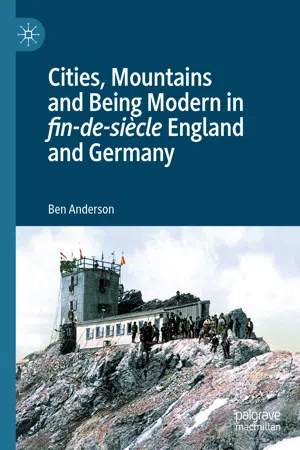
This book is the first transnational history of rambling and mountaineering. Focussing on the critical turn-of-the-century era, it offers new insights into alpine development, attitudes to danger, cultures of time, internationalism and domesticity in the outdoors. It charts an emerging group of mass tourist activities, and argues that these thousands of walkers and climbers can only be understood within the context of the urban cultures from which most of them came. In doing so, it offers a fresh perspective on the relationship of alpinists and countryside enthusiasts to the modern world. Instead of an escape from or rejection of modernity, it finds that upland trampers and climbers contested what it meant to be modern, used those modern identities to make political claims on rural space and rural people, and sought to define what a more modern future society should be like.
- English
- ePUB (mobile friendly)
- Available on iOS & Android
eBook - ePub
Cities, Mountains and Being Modern in fin-de-siècle England and Germany
About this book
Information
© The Author(s) 2020
B. AndersonCities, Mountains and Being Modern in fin-de-siècle England and Germanyhttps://doi.org/10.1057/978-1-137-54000-3_11. Introduction
Ben Anderson1
(1)
Keele University, Department of History, Keele, UK
In 1908 and 1909, the East-End railway engineer and one of the great eccentrics of pre-war mountaineering, Oscar Eckenstein (1859–1921), published his improved design for crampons —metal foot-spikes for crossing ice—in the Oesterreichische Alpenzeitung.1 He began his articles with a comment on the state of ‘Ice-craft’:
Eckenstein was born to German émigré parents in London in 1859, but retained strong links to German culture, both as a well-known railway innovator and as a member of a European climbing network centred around meetings at Pen-y-pas in Wales , Courchevel in Italy, Zermatt in Switzerland and Vienna in Austria.3 Excluded from climbing elites in London because of his social background, controversial techniques and relationship with the ‘founder of modern magick’ and ‘Great Beast 666’ Aleister Crowley (1875–1947), Eckenstein found a place amongst the emerging avant garde of European climbers based in Vienna, Munich and the cities of Northern England.4 He has been credited with inventing a new, more gymnastic technique of ‘balance’ climbing in the 1890s, along with advice on knots common to other European elite mountaineering circles, and the improved designs for ice-climbing equipment which accompanied this article and others.5 Eckenstein’s apparently innocuous justification of his new crampon designs, and their accompanying techniques, summarised a new relationship between mountains, mountaineers and modernity which this group had been developing for the previous three decades. For Eckenstein, ‘progress’ in the mountains—he used the German term Fortschritte—was not synonymous with first ascents, or gaining a ‘summit position’ from which to exert personal or group sovereignty, as Peter Hansen has so carefully elucidated.6 His version of what it meant to be modern instead involved traversing the mountains more quickly, gracefully or efficiently, using improvements to equipment and body alike. Like many ‘haptic’ alpinists and rock climbers, he saw the mountains not primarily as a series of unclimbed peaks nor as a succession of vistas, but as a series of technical, psychological and kinetic barriers that could be overcome by ‘mountaincraft’—equipment, thought, training and knowledge, all of which Eckenstein advocated in the subsequent article, and all of which he knowingly presented as evidence of his own status as a ‘modern’ individual, whose movements would be improved by his own control over innovation, technology and landscape.7More than 30 years have passed since I first went to the Alps, and in this time, Alpinism has in some ways made quite enormous progress. Compare, for instance, today’s knowledge of rock and rock-climbing technique to that of before! It is therefore all the stranger to me, that there are areas in which Alpinism, generally, remains almost at the same level as it was 50 years ago. This is particularly true of ice-technique, and everything related to it.2
This book is about how urban Europeans found new ways to be modern in the rising uncertainty about the future that characterised the decades before 1914.8 It concentrates on a disparate but loosely connected group of mountain enthusiasts like Eckenstein, ranging in social background from ‘mill girls’, clerks and salesmen to political and administrative elites in cities like Manchester, Munich and Vienna. Despite their varied social background, these women and men shared a commitment to cultural and behavioural norms that demanded that leisure should be socially and culturally productive. They took part in a Europe-wide debate about the meanings of concepts such as progress, civilisation and ‘modern’ life, concepts which had long provided an epistemological basis for imperial, capitalist and liberal discourse, but whose application increasingly focused on the imagination and experience of industrial, urban life.9 Yet while mountain leisure participants engaged with these broader currents of cultural criticism, and structured their activities accordingly, their modernity was as much about practices, material cultures and sensory experiences which were embedded in their interactions with urban and mountain environments alike. What Rudy Koshar has described as a ‘selective appropriation of modernity’ was a process of bodily practice, material interaction and affective understanding including but not reducible to representation, discourse and language, and enmeshed within the historical processes from which it claimed to stand apart.10 By interrogating not merely how contemporaries imagined and defined ‘nature’, but also the agency of material environments in the production of ideas like ‘progress’ and ‘modernity’, this book examines ways in which cultural criticism, and activities such as rambling and mountaineering, might be understood as integral, indeed quintessential parts of modern life in the decades around 1900.
Critically Modern
As men and women left their cities to walk, climb and ski in hills, moorlands and mountains, they contested the value of urban life in languages and practices that were common to many types of life-reform or body-management movements of the period.11 ‘So-called cultured-people’ and ‘“civilised”’ men and women, Eckenstein wrote in his article about crampon s, did not walk so much as ‘waddle’.12 As a result of poorly fitting shoes, posture-deforming corsets and a fashion for pointing toes outwards, he claimed ‘not only do most whites have a poor walk, but also have no hope of gaining a good one’.13 Eckenstein was too much the rational pragmatist to offer the crampon as a cure for his diagnosis of ‘Europeans’, but the diagrams he used to illustrate crampon technique compared the directionless, inefficient walk of ‘civilised’ men and women to the direct, straight line of walking in crampon s; his new design literally offered an improved Fortschritte to the directionless stride of the apparently civilised, but—in his view—unnaturally deformed human.
What German historians often term ‘cultural criticism’ was a guiding rationale for physical culture movements across Europe and America as they proliferated between the 1880s and 1914.14 Like Eckenstein, many involved in gymnastics , body-building, sport and cycling, or rambling, mountaineering and skiing, adopted sceptical attitudes to the ability of urban life to improve society, or lead to human progress. How to analyse these debates has proven a difficult question for historians ever since. For those working within the boundaries of ‘modernisation theory’ in the 1960s and 1970s, these movements and their criticisms of modernity provided clues as to the apparent deviations of states from the pre-ordained path of modernisation, leading automatically to increasing democratisation, bourgeois authority, economic expansion, scientific advance and rising living standards.15 Criticising modernity, for these scholars, was irrational in its ‘anti-modern’ attitude, and was indicative of a general tendency away from the rational thought that is still widely held to have underpinned modernisation since the Enlightenment. Historians such as Georg Mosse, Fritz Stern and Martin Wiener incorporated ‘life-reform’, preservationist, ruralist or ‘nature’ movements into explanations for British industrial decline in the twentieth century, or German National Socialist disaster.16 Historical changes within some nation-states that did not fit the rational structure of modernisation could be explained away as deviations inspired by irrationally ‘anti-modern’, culturally critical movements and ideologies. These theories have received a sustained critique since the early 1980s, as the problems of nationally focused histories of ‘modernisation’ have been identified, the open-ended multiplicity of globally connected modernities h...
Table of contents
- Cover
- Front Matter
- 1. Introduction
- 2. Mountaineers in the City
- 3. Mountaineers Against the City
- 4. Constructing the Alps
- 5. Time
- 6. Risk and Danger
- 7. Beyond the Nation
- 8. The Indoors in the Outdoors
- 9. Conclusion
- Back Matter
Trusted by 375,005 students
Access to over 1.5 million titles for a fair monthly price.
Study more efficiently using our study tools.
Frequently asked questions
Yes, you can cancel anytime from the Subscription tab in your account settings on the Perlego website. Your subscription will stay active until the end of your current billing period. Learn how to cancel your subscription
No, books cannot be downloaded as external files, such as PDFs, for use outside of Perlego. However, you can download books within the Perlego app for offline reading on mobile or tablet. Learn how to download books offline
Perlego offers two plans: Essential and Complete
- Essential is ideal for learners and professionals who enjoy exploring a wide range of subjects. Access the Essential Library with 800,000+ trusted titles and best-sellers across business, personal growth, and the humanities. Includes unlimited reading time and Standard Read Aloud voice.
- Complete: Perfect for advanced learners and researchers needing full, unrestricted access. Unlock 1.5M+ books across hundreds of subjects, including academic and specialized titles. The Complete Plan also includes advanced features like Premium Read Aloud and Research Assistant.
We are an online textbook subscription service, where you can get access to an entire online library for less than the price of a single book per month. With over 1.5 million books across 990+ topics, we’ve got you covered! Learn about our mission
Look out for the read-aloud symbol on your next book to see if you can listen to it. The read-aloud tool reads text aloud for you, highlighting the text as it is being read. You can pause it, speed it up and slow it down. Learn more about Read Aloud
Yes! You can use the Perlego app on both iOS and Android devices to read anytime, anywhere — even offline. Perfect for commutes or when you’re on the go.
Please note we cannot support devices running on iOS 13 and Android 7 or earlier. Learn more about using the app
Please note we cannot support devices running on iOS 13 and Android 7 or earlier. Learn more about using the app
Yes, you can access Cities, Mountains and Being Modern in fin-de-siècle England and Germany by Ben Anderson in PDF and/or ePUB format, as well as other popular books in History & British History. We have over 1.5 million books available in our catalogue for you to explore.