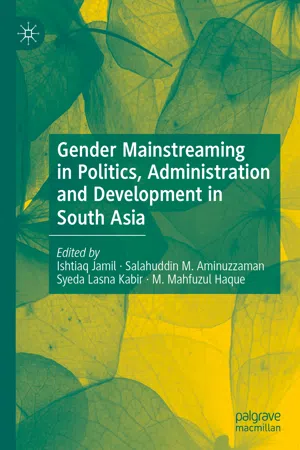
This book explores and analyzes gender mainstreaming in South Asia. Gender mainstreaming as a concept is about removing disparities between men and women – about equal access to resources, inclusion and participation in the public sphere, representation in government, and empowerment, all with the aim of achieving equal opportunities for men and women in family life, society, administration, politics, and the economy. The challenges of gender mainstreaming in South Asia are huge, especially in the contexts of patriarchal, religious, and caste-based social norms and values. Men's dominance in politics, administration, and economic activities is distinctly visible. Women have been subservient to the policy preferences of their male counterparts. However, in recent years, more women are participating in politics at the local and national levels, in administration, and in formal economic activities. Have gender equality and equity been ensured in South Asia? This book focuses on how gender-related issues are incorporated into policy formulation and governance, how they have fared, what challenges they have encountered when these policies were put into practice, and their implications and fate in the context of five South Asian countries. The authors have used varied frameworks to analyze gender mainstreaming at the micro and macro levels. Written from public administration and political science perspectives, the book provides an overview of the possibilities and constraints of gender mainstreaming in a region, which is not only diverse in ethnicity and religion, but also in economic progress, political culture, and the state of governance.
eBook - ePub
Gender Mainstreaming in Politics, Administration and Development in South Asia
- English
- ePUB (mobile friendly)
- Available on iOS & Android
eBook - ePub
Gender Mainstreaming in Politics, Administration and Development in South Asia
About this book
Information
© The Author(s) 2020
I. Jamil et al. (eds.)Gender Mainstreaming in Politics, Administration and Development in South Asiahttps://doi.org/10.1007/978-3-030-36012-2_11. Introduction: Gender Mainstreaming in Politics, Administration, and Development in South Asia
Ishtiaq Jamil1 , Salahuddin M. Aminuzzaman2 , Syeda Lasna Kabir3 and M. Mahfuzul Haque2
(1)
University of Bergen, Bergen, Norway
(2)
South Asian Institute of Policy and Governance (SIPG), North South University, Dhaka, Bangladesh
(3)
Department of Public Administration, University of Dhaka, Dhaka, Bangladesh
Salahuddin M. Aminuzzaman
Syeda Lasna Kabir
M. Mahfuzul Haque
Keywords
Gender mainstreamingWomen in development (WID)Women and development (WAD)Gender and development (GAD)Gender planningGovernance challengesSouth AsiaIntroduction
Gender mainstreaming is about removing disparities between men and women—about equal access to resources, inclusion and participation in the public sphere, representation in government, and empowerment, all with the aim of achieving equal opportunities for men and women in family life, society, administration, politics, and the economy. Gender mainstreaming does not refer only to women (Monsen, 2010, p. 2). It means that all social and development-related policies must reflect on gender and consider it as an essential element in the policy formulation process. Gender mainstreaming is also about institutionalizing gender equality in development (Mukhopadhyay, 2013), in other words, to provide equitable as well as equal opportunities for people of different genders, classes, castes, and ethnicities, and to validate their sexual diversity. Gender mainstreaming is thus closely linked with gender equality (Walby, 2005). It recognizes that men and women have different needs and priorities and therefore may requires different treatment, but that opportunities should be equal for all, so that men and women can lead equally meaningful lives (Monsen, 2010, p. 8).
The concept of gender mainstreaming was coined by feminist development practitioners in the 1970s and eventually became a prominent concept and strategy to advance the topic of gender in development discourses (Walby, 2005). The UN Fourth World Women’s Conference in Beijing (1995) was the occasion that set the agenda for gender mainstreaming through achieving gender equality and the empowerment of women (Moser & Moser, 2005). Since then, it has become a focal point in socio-economic development programs, not only in the West but also in the developing world. It has now become a “policy frame” through which gender issues, especially those related to women, are incorporated into policies and given due attention. An example is the issue of political and administrative recruitment and the selection process through which a woman can gain a decision-making position in an organization. According to Hafner-Burton and Pollack (2002, p. 2), “The concept of gender mainstreaming promises a revolutionary change in the international and domestic policy process, in which gender issues become a core consideration not simply for specific departments or ministries dealing with women, but rather for all actors across a range of issue-areas and at all stages in the policy process from conception and legislation to implementation and evaluation.”
However, along with the concept’s advancement and current center-stage position, it has also attracted much debate and controversies on how to incorporate gender issues in development policies and practices, both from theoretical and from practical standpoints (Warren, 2007). According to Walby (2005, p. 321), gender mainstreaming, being a contested concept and practice, “involves the reinvention, restructuring, and rebranding of a key part of feminism in the contemporary era.” It therefore requires theory development as a strategy and a practice, in order to promote gender equality .
The dynamic relations between gender and governance have been broadly ignored in mainstream development discourses. In most societies, women’s roles are seen as existing mostly in the “private” realm, while men’s roles are in the “public” realm (Nussbaum, Basu, Tambiah, & Niraja, 2003). Drawing on global experiences, Brody (2009) observers that women have been treated unequally in all forms of formal and informal processes. He specifically observes that (a) women are unequally treated in the institutions in which they are involved; (b) institutions, in general, fail to acknowledge the “double burden” on women; (c) institutional policies usually fail to recognize gender issues and the nature of the needs of men and women, causing inequalities in decision-making; and (d) the absence of institutional accountability breeds inequality and the violation of women’s rights.
Gender Mainstreaming and Its Origin
The concept of gender mainstreaming as a strategy and policy process has undergone several stages of development and conceptualization. Understanding these stages requires a discussion on women in development (WID), women and development (WAD), and gender and development (GAD). The different connotations of these three themes illustrate varying assumptions in the stages of conceptualization, policy agendas, and research issues relating to gender mainstreaming.
Women in Development (WID)
WID started gaining prominence in the 1970s and 1980s and was used actively by American liberal feminists. Their concern was women’s economic emancipation, which was essential for gender mainstreaming. To end discrimination against women and increase their participation in the economic sector, policies and practices needed to change. In this regard, WID came to be associated with modernization, industrialization, and urbanization—the major post-colonial policy agenda in developing countries in the 1950s. It was expected that modernization, with emphasis on education, would create a modern workforce that would benefit men and women equally. However, modernization and its promise of women’s emancipation were highly criticized in the 1970s, as modernization had not led to women’s advancement. To the contrary: women’s position was downgraded. Agriculture is a case in point: processes of mechanization ended up favoring men more than women, whereas in traditional forms of agriculture, women play a larger role. In addition to criticism associated with modernization, other critics of WID pointed to the problems of “quick” or “single fix” approaches to women’s empowerment . Examples here are to give women access to appropriate technology, offer income-generating activities, or give women access to skills and education. The problem is that such measures, in isolation, do not take into account the contexts in which women live—their class, religion, caste, race, and culture. If these contexts do not support women’s increased empowerment, then technological innovations, work, educational opportunities, and so forth are easily appropriated by other social and family actors such as male family members. Women usually have no defense against such social action (Rathgeber, 1990, pp. 491–492).
Women and Development (WAD)
Against the backdrop of criticism of WID, the concept of WAD evolved in the mid-1970s. Because it combined Marxist and feminist perspectives, it was termed as a neo-Marxist feminist approach (Rathgeber, 1990, p. 493). WAD’s major argument is that women have always been an essential part of the economy; they are not newcomers, as WID claims, and their work inside and outside the ho...
Table of contents
- Cover
- Front Matter
- 1. Introduction: Gender Mainstreaming in Politics, Administration, and Development in South Asia
- 2. Gendered Electoral Financing: Two Approaches Toward Funding as an Affirmative Action Measure
- 3. How Policy Folds Back Before Implementation: A Study on Unequal Inheritance Right in Bangladesh
- 4. Gender-Based Harassment and Violence in Higher Educational Institutions: A Case from Sri Lanka
- 5. ‘Through the Glass Ceiling, over the Glass Cliff?’ Women Leaders in Bangladeshi Public Administration
- 6. Emerging Leadership Roles of Women in Rural Local Government: Experiences from Bangladesh
- 7. Gender Budgeting and Governance Challenges: A Case Study of Bangladesh
- 8. Empowering Women Through e-Governance in the Indian Province of Odisha: Capacity Building as an Enabling Measure
- 9. A Paradigm Shift in Women’s Turnout and Representation in Indian Elections
- 10. Achievements and Challenges for Gender Mainstreaming in the Employment Sector of the Maldives
- 11. Caught in the Cross-Fire of Religion, Culture, and Politics: Women’s Sexual and Reproductive Health and Rights in Pakistan
- Back Matter
Trusted by 375,005 students
Access to over 1.5 million titles for a fair monthly price.
Study more efficiently using our study tools.
Frequently asked questions
Yes, you can cancel anytime from the Subscription tab in your account settings on the Perlego website. Your subscription will stay active until the end of your current billing period. Learn how to cancel your subscription
No, books cannot be downloaded as external files, such as PDFs, for use outside of Perlego. However, you can download books within the Perlego app for offline reading on mobile or tablet. Learn how to download books offline
Perlego offers two plans: Essential and Complete
- Essential is ideal for learners and professionals who enjoy exploring a wide range of subjects. Access the Essential Library with 800,000+ trusted titles and best-sellers across business, personal growth, and the humanities. Includes unlimited reading time and Standard Read Aloud voice.
- Complete: Perfect for advanced learners and researchers needing full, unrestricted access. Unlock 1.5M+ books across hundreds of subjects, including academic and specialized titles. The Complete Plan also includes advanced features like Premium Read Aloud and Research Assistant.
We are an online textbook subscription service, where you can get access to an entire online library for less than the price of a single book per month. With over 1.5 million books across 990+ topics, we’ve got you covered! Learn about our mission
Look out for the read-aloud symbol on your next book to see if you can listen to it. The read-aloud tool reads text aloud for you, highlighting the text as it is being read. You can pause it, speed it up and slow it down. Learn more about Read Aloud
Yes! You can use the Perlego app on both iOS and Android devices to read anytime, anywhere — even offline. Perfect for commutes or when you’re on the go.
Please note we cannot support devices running on iOS 13 and Android 7 or earlier. Learn more about using the app
Please note we cannot support devices running on iOS 13 and Android 7 or earlier. Learn more about using the app
Yes, you can access Gender Mainstreaming in Politics, Administration and Development in South Asia by Ishtiaq Jamil, Salahuddin M. Aminuzzaman, Syeda Lasna Kabir, M. Mahfuzul Haque, Ishtiaq Jamil,Salahuddin M. Aminuzzaman,Syeda Lasna Kabir,M. Mahfuzul Haque in PDF and/or ePUB format, as well as other popular books in Politics & International Relations & Comparative Politics. We have over 1.5 million books available in our catalogue for you to explore.