eBook - ePub
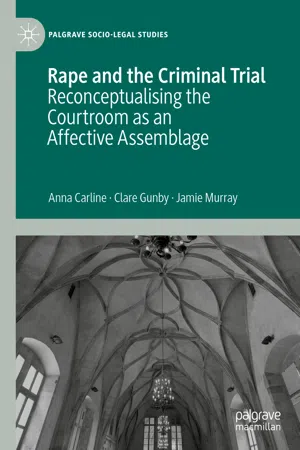
Rape and the Criminal Trial
Reconceptualising the Courtroom as an Affective Assemblage
- English
- ePUB (mobile friendly)
- Available on iOS & Android
eBook - ePub
Rape and the Criminal Trial
Reconceptualising the Courtroom as an Affective Assemblage
About this book
This book explores the shortcomings of the criminal justice system's response to sexual violence. Despite a plethora of legal and policy reforms, concerns remain regarding the conviction rates for rape and the extent to which cases fall out of the system. Ample research has highlighted the ongoing impact of 'rape myths' and the presence of an 'implementation gap' whereby policies, provisions and measures — proposed in order to improve the system's response — are frequently not brought into practice, nor utilised as expected. Rape and the Criminal Trial proposes a move beyond representational theory and towards New Materialism and affects, a school of thought which emphasises the importance of embodiment and the ontological intensive regime as necessary in order to generate radical new approaches for understanding this problematic status quo, and in order to move forward to the production of more effective solutions.
Information
© The Author(s) 2020
A. Carline et al.Rape and the Criminal TrialPalgrave Socio-Legal Studieshttps://doi.org/10.1007/978-3-030-38684-9_11. Introduction
Anna Carline1 , Clare Gunby2 and Jamie Murray3
(1)
University of Liverpool, Liverpool, UK
(2)
Institute for Applied Health Research, University of Birmingham, Birmingham, UK
(3)
Liverpool Hope University, Liverpool, UK
Abstract
The unique argument developed in this book is that the criminal courtroom, specifically in rape cases, needs to be reconceptualised as a complex system and an ‘affective assemblage’. We argue, for the first time, that a move beyond representational theory and towards new materialism and affects, which emphasises the importance of the ‘ontological intensive regime’, enables a more informed and realistic understanding of courtroom dynamics and the practices of barristers. This, in turn, impacts upon the implementation and utilisation of well-meaning reform measures and policies. In this first chapter, we introduce the philosophical framework and key concepts, which synthesises the work of Deleuze, Deleuze and Guattari and complexity science and theory. Thereafter, we set out the empirical and theoretical methodologies and briefly explain the criminal justice, law and policy context as it relates to rape.
Keywords
Reconceptualising the courtroomNew materialism and affect theoryAffective assemblageMethodologiesProblem field and phase spaceCriminal justice responses to rape1.1 Reconceptualising the Courtroom
The aims of this book revolve around three key themes. First, it sets out a novel theoretical and methodological approach for understanding and responding to social and legal problematics. Second, it develops new insights into criminal justice responses to sexual violence—with a focus on rape trials. Third, it calls for an essential re-orientation of criminal justice, criminology and legal studies, in light of the arguments progressed. Indeed, the overall argument developed is that the criminal courtroom needs to be reconceptualised as a complex system and an ‘affective assemblage’. This, we maintain, enables a more informed and realistic understanding of courtroom dynamics and the practice of barristers, which in turn, impacts upon the implementation of measures and policies which aim to improve the criminal justice response to rape cases. In developing this argument, we recognise that the courtroom is a dramaturgical problem space, but one that involves non-representational drama.
Why make this argument? The first is the widely accepted assessment of the failure of existing criminal justice responses to rape and sexual violence (Lees 1997; HMCPSI and HMIC 2002, 2007; Kelly et al. 2005; Stern 2010; Cook 2011; HMIC and HMCPSI 2012) and the continued existence of an ‘implementation gap’ (Kelly et al. 2005; Stern 2010; Brown 2011; Cook 2011; Westmarland 2011; Smith 2018), whereby well-meaning measures are either not utilised or produce unanticipated results (see e.g. Carline and Gunby 2017). More radical and progressive work is therefore undoubtedly required to advance the area and to improve the experience of victims. Second, this book was conceived in the light of empirical work focused on barristers’ perceptions and practices in relation to criminal justice responses to rape (see Gunby et al. 2010; Carline and Gunby 2011, 2017, 2019; Gunby and Carline 2019; Carline et al. in press). What brought this project together was the realisation that advocates’ views and approaches to the courtroom revealed a legal world—a courtroom assemblage—which was very different from the doctrinal/socio-legal and representational model of that world. The data revealed that barristers lived and worked in a primarily material, affective and non-representational legal world, where orthodox understandings of law played at very best, a marginal role.
Thus, with reference to the three key themes we develop in this book, we maintain that it is not possible to devise effective criminal justice responses to rape until a thorough reconceptualisation of the criminal courtroom, as a complex system and an affective assemblage, has taken place. This reconceptualisation, in line with the legal world presented in barristers’ interviews, is of the criminal courtroom as a matter of pragmatics, deployment and marshalling of affects, sense-making and the production of emergent truths.
In developing our key themes, there are a number of ramifications, implications, supplementary arguments and theoretical concepts to set out here, prior to elaboration in later chapters. First, there exists what is known as an ‘intensive ontological register’ to the social field and this book emphasises the necessity of taking up a Deleuzian ontology. This involves understanding the criminal courtroom as having a double existence. Namely, it exists on two very different but adjacent and interacting levels: one which is actual and extensive (which is ontology as we conventionally understand it) and the other which is real but intensive, concepts we explain in detail in Chaps. 2 and 6. Second, we argue that barristers, and indeed many court protagonists, intuitively operate in this intensive ontological field and have a rich appreciation and experience of working this register of the courtroom. Third, to our knowledge, there has been no utilisation of an ambitious theoretical framework like this to understand the courtroom as an intensive ontological field, or of how legal actors might intuitively work within this field. Relatedly, there has been no empirical exploration to date of how barristers’ self-reflections on their professional practice evidence an intuitive understanding and participation within the intensive courtroom. Fourth, we maintain that the approach adopted in this book will improve our understanding of practitioners’ perspectives and practices on the implementation of measures introduced to improve criminal justice responses to rape and sexual violence. Finally, there are significant methodological implications stemming from the approach developed here. These pertain to the adoption of a theoretical methodology of problem space, problematics and phase space, for thinking and working with affective assemblages, as well as the utilisation of a discursive empirical methodology for conducting and analysing the barrister interviews. This chapter will briefly introduce these methodologies.
To review, the overall aim of the book is to reconceptualise the criminal courtroom as a complex system and an affective assemblage. In so doing, we focus in particular on the changes to the substantive law introduced by the Sexual Offences Act 2003 (specifically, the consent definition, presumptions and reformed mens rea), the introduction of judicial directions on ‘mistaken assumptions’ and the implementation of ‘special measures’—provisions which aim to support and protect the complainant during the trial process. Our reconceptualisation drives the development of a reflexive set of pragmatic and speculative techniques for examining, participating and intervening in...
Table of contents
- Cover
- Front Matter
- 1. Introduction
- 2. Mapping the Theory and the Conviction Rate Attractor
- 3. Courtroom Expressions: The Intermingling of the Semiotic and Material Regimes
- 4. Courtroom Performances: Drama, but not Representational Drama
- 5. Deleuze’s Materialist Philosophy of Affect and Sense
- 6. Complexity Theory, Deleuze and Guattari’s Affective Assemblage Theory and the Courtroom as Affective Assemblage
- 7. Conclusion: Techniques of Affect and Adaptive Management
- Back Matter
Trusted by 375,005 students
Access to over 1.5 million titles for a fair monthly price.
Study more efficiently using our study tools.
Frequently asked questions
Yes, you can cancel anytime from the Subscription tab in your account settings on the Perlego website. Your subscription will stay active until the end of your current billing period. Learn how to cancel your subscription
No, books cannot be downloaded as external files, such as PDFs, for use outside of Perlego. However, you can download books within the Perlego app for offline reading on mobile or tablet. Learn how to download books offline
Perlego offers two plans: Essential and Complete
- Essential is ideal for learners and professionals who enjoy exploring a wide range of subjects. Access the Essential Library with 800,000+ trusted titles and best-sellers across business, personal growth, and the humanities. Includes unlimited reading time and Standard Read Aloud voice.
- Complete: Perfect for advanced learners and researchers needing full, unrestricted access. Unlock 1.5M+ books across hundreds of subjects, including academic and specialized titles. The Complete Plan also includes advanced features like Premium Read Aloud and Research Assistant.
We are an online textbook subscription service, where you can get access to an entire online library for less than the price of a single book per month. With over 1.5 million books across 990+ topics, we’ve got you covered! Learn about our mission
Look out for the read-aloud symbol on your next book to see if you can listen to it. The read-aloud tool reads text aloud for you, highlighting the text as it is being read. You can pause it, speed it up and slow it down. Learn more about Read Aloud
Yes! You can use the Perlego app on both iOS and Android devices to read anytime, anywhere — even offline. Perfect for commutes or when you’re on the go.
Please note we cannot support devices running on iOS 13 and Android 7 or earlier. Learn more about using the app
Please note we cannot support devices running on iOS 13 and Android 7 or earlier. Learn more about using the app
Yes, you can access Rape and the Criminal Trial by Anna Carline,Clare Gunby,Jamie Murray in PDF and/or ePUB format, as well as other popular books in Social Sciences & Criminology. We have over 1.5 million books available in our catalogue for you to explore.