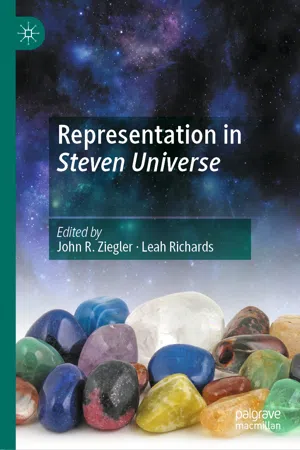
This book assembles ten scholarly examinations of the politics of representation in the groundbreaking animated children's television series Steven Universe. These analyses address a range of representational sites and subjects, including queerness, race, fandom, colonialism, and the environment, and provide an accessible foundation for further scholarship. The introduction contextualizes Steven Universe in the children's science-fiction and anime traditions and discusses the series' crucial mechanic of fusion. Subsequent chapters probe the fandom's expressions of queer identity, approach the series' queer force through the political potential of the animated body, consider the unequal privilege of different female characters, and trace the influence of anime director Kunihiko Ikuhara. Further chapters argue that Ronaldo allows satire of multiple media forms, focus on Onion as a surrealist trickster, and contemplate cross-species hybridity and consent. The final chapters concentrate on background art in connection with ecological and geological narratives, adopt a decolonial perspective on the Gems' legacy, and interrogate how the tension between personal and cultural narratives constantly recreates memory.
eBook - ePub
Representation in Steven Universe
- English
- ePUB (mobile friendly)
- Available on iOS & Android
eBook - ePub
Representation in Steven Universe
About this book
Information
© The Author(s) 2020
J. R. Ziegler, L. Richards (eds.)Representation in Steven Universehttps://doi.org/10.1007/978-3-030-31881-9_11. Introduction
John R. Ziegler1 and Leah Richards2
(1)
English Department, Bronx Community College, CUNY, Bronx, NY, USA
(2)
English Department, LaGuardia Community College, CUNY, Long Island City, NY, USA
On July 6, 2018, two female-presenting aliens, one wearing a wedding dress and one a tuxedo, who had been in a committed relationship for 5750 years (and 8 months) that involved living as one body with two consciousnesses, married one another on a beach in what has been widely discussed as the first same-sex wedding in an American animated children’s television show.1 This unique union occurred in Cartoon Network’s series Steven Universe (2013–), and whatever one’s position in debates over same-sex marriage and homonormativity, these particular nuptials undeniably mark a milestone for queer representation. Created by Rebecca Sugar, an alum of Adventure Time (2010–2018), another Cartoon Network series that pushes the boundaries both formally and politically of what American animated television for children can be, Steven Universe holds the distinction of being the first Cartoon Network property created solely by a woman, and an openly queer woman at that: Sugar has publicly acknowledged her bisexuality and, more recently, her identification as gender non-binary .2
The show, set in fictional east-coast Beach City, Delmarva (a combination of Delaware, Maryland, and Virginia), centers on the title character, Steven Universe, a fourteen-year-old boy who physically appears to be more like eight (“Steven’s Birthday”) and whose father is aging rocker and car-wash owner Greg Universe, né DeMayo. Accounting for the disjunction between his appearance and age is the fact that his mother, Rose Quartz, was one of a species of aliens called Gems, who sacrificed her physical form to create Steven. Thousands of years in the past, Rose also led a rebellion against the genocidal colonization of Earth by her own species, and Garnet, Amethyst, and Pearl, a trio of her fellow alien rebels, known collectively as the Crystal Gems, now serve as surrogate parents to Steven (Greg participates in Steven’s life but does not cohabitate with Steven and the Gems) as he negotiates not only his personal life but also remaining and future threats from the Gem Homeworld.
Key to the conception of the Gem species is that their bodies, and therefore their race, gender, and sex, are merely projections of the gemstones from which the individual characters take their names, which are simultaneously the names of all other individuals in that class of Gem (i.e., the Pearl who lives with Steven is one of the innumerable Pearls). Sugar has underlined in an interview the representational significance of this conception for denaturalizing dominant ideas of gender and for providing points of identification for those who exist outside of those ideas:
One of the things that’s really important to me about the show is that the gems are all non-binary women…[and are] coming from a world where they don’t really have the frame of reference. They’re coded female, which is very important, and them being coded female, I was really excited because I felt like I had not seen this. … They wouldn’t think of themselves as women, um, but they’re fine with being interpreted that way amongst humans. Um, and I am also a non-binary woman, which is, it’s been really great to express myself through these characters because it’s very much how I have felt throughout my life. (Sugar 2018)
The gems’ projected bodies, including but not only their apparent gender, are malleable, a quality that they share with animated bodies more broadly, and can be temporarily destroyed or “poofed” without damaging the gems in which the individual self appears to reside, but the gems themselves can be corrupted, rendering the individual monstrous, or shattered, killing the individual permanently.3 This mode of embodiment allows for a narratively and thematically central mechanic called fusion, in which two or more bodies can physically merge into a new, single being. Fusion usually occurs between or among Gems, but Gem–human hybrid Steven has at different times fused with Amethyst and with the human Connie Maheswaran; additionally, it is seen by the majority of Gem society as acceptable only for work or battle, but a minority, including the Crystal Gems , also employ it for affective purposes. Fusion thus functions as a libidinal act in the series, and it is often achieved through dance, itself long a site for the expression of desire. Ruby and Sapphire, for example, the two Crystal Gems who marry, live their lives as a fusion named Garnet, and Steven, the officiant, describes Garnet during the wedding as “their love, given form” (“Reunited”).
Gem embodiment, and fusion in particular, unsettles boundaries of self (an individual self and body are not coterminous), biological sex (the Gems have none), gender (male Steven and female Connie fuse into Stevonnie, who is either both genders or neither, or both and neither), and even species (Gems and humans can fuse or, as Steven’s existence suggests, seemingly produce hybrid offspring). Given such undermining of normative categories, queerness unsurprisingly figures prominently in the attention paid to Steven Universe by professional and academic writers and by fans.4 Eli Dunn (2016) writes, “Not only is Steven Universe [sic] perhaps the queerest children’s show, it may be the most gender-progressive show on television” (55), and this assessment dovetails with supervising director Joe Johnston’s description of one of Sugar’s goals for the series: “Something that Rebecca has said time and time again is that we want the show to be ‘subversive in a positive way ’” (McDonnell 2017, 224). Ruby and Sapphire’s marriage , for instance, can be read as subversive in the unapologetic queerness not only of its subject matter but of its presentation: The scene includes a passionate kiss between the female-presenting partners; the more traditionally feminine Sapphire, wearing male-coded clothing, literally sweeping the more traditionally masculine Ruby, wearing female-coded clothing, off of her feet; their fusion into Garnet; and then a shot of two flowers, each colored like one of the brides, washing up on the beach and sparkling with drops of moisture in what can be seen as overtly vaginal imagery .
The refrain of the song that Steven sings while preparing for the wedding—“There’s an awful lot of awful things we could be thinking of / But for just one day, let’s only think about love”—could function as a kind of mission statement for the show. However, while the representations of gender and sexuality are important foci of that mission (Christian Ravela [2017], in fact, notes that the “many musical segments…, like in musicals, break the narrative and become a vehicle for expression of desire, especially queer desire” [390]), the “love” invoked is not restricted to those areas but often functions to resolve a variety of conflicts, and those awful things that Steven references also point us toward the nuanced and progressive handling of interpersonal relationships and sociopolitical issues that are as significant to the show as its sporadic musical interludes. As Steven Universe writer Matt Burnett puts it, “[I]t can’t hurt to shade the world a little grayer for kids” (McDonnell 2017, 225), and Steven here is using the song and the wedding itself, in part, to avoid thinking about, among other disturbing concerns, the recent revelation of his mother and Pearl’s long-standing deception regarding Rose’s identity: Pearl, who both acts as a surrogate parent and was also in love with Rose, concealed for millennia that Rose Quartz was actually Pink Diamond, one of the quartet of diamonds who ruled the Gem Homeworld and who had been given Earth as her own colony, faking her death and adopting a new identity in order to lead her rebellion. The episode thus “shades[s] the world a little grayer” in a manner representative of the series as a whole, by mixing the joyousness of the occasion with multiple instances of parental betrayal and connecting all of it to further sociopolitical questions. Ravela, who sees Steven as embodying “non-toxic masculinity” (392), usefully summarizes this approach :
Importantly, this celebration and thoughtful exploration of queer intimacy and masculinity is embedded in the series’s larger postcolonial narrative. This placement is not incidental but actually central to fusion’s other valence, specifically its narrative role in contrasting the Crystal Gem home world to the human world of Earth. As the series develops through its first three seasons, we learn that the Crystal Gem home world is a static, hierarchically stratified and instrumentally organized totalitarian society. Each Gem is born into a specific labouring class under the Diamond Authority and must forever live within this caste system . (392)
Under the umbrella of this postcolonial or, as Mandy Elizabeth Moore argues in Chapter 10, decolonial narrative arise considerations including but not limited to class, race, and the environment.
The recent episode “Together Alone” handily demonstrates this...
Table of contents
- Cover
- Front Matter
- 1. Introduction
- 2. Queer Transformation, Contested Authorship, and Fluid Fandom
- 3. Drawing Queerness Forward: Fusion, Futurity, and Steven Universe
- 4. “I Am a Conversation”: Gem Fusion, Privilege, and Intersectionality
- 5. Globalizing Fandoms: Envisioning Queer Futures from Kunihiko Ikuhara to Rebecca Sugar
- 6. “Truth Is a Feeling in Your Gut”: Ronaldo Fryman, Conspiracy Theories, and Media Satire
- 7. Pungent Silence: Encounters with Onion
- 8. Contact Zone Earth: Power and Consent in Steven Universe and Octavia Butler’s Lilith’s Brood
- 9. Growing up in the Crystallocene: How Steven Universe Teaches Compassion for Broken Worlds
- 10. Off-Color, Off-Center: Decolonizing (in) Steven Universe
- 11. Change Your Mind: Cultural Memory and Reconciliation
- Back Matter
Trusted by 375,005 students
Access to over 1.5 million titles for a fair monthly price.
Study more efficiently using our study tools.
Frequently asked questions
Yes, you can cancel anytime from the Subscription tab in your account settings on the Perlego website. Your subscription will stay active until the end of your current billing period. Learn how to cancel your subscription
No, books cannot be downloaded as external files, such as PDFs, for use outside of Perlego. However, you can download books within the Perlego app for offline reading on mobile or tablet. Learn how to download books offline
Perlego offers two plans: Essential and Complete
- Essential is ideal for learners and professionals who enjoy exploring a wide range of subjects. Access the Essential Library with 800,000+ trusted titles and best-sellers across business, personal growth, and the humanities. Includes unlimited reading time and Standard Read Aloud voice.
- Complete: Perfect for advanced learners and researchers needing full, unrestricted access. Unlock 1.5M+ books across hundreds of subjects, including academic and specialized titles. The Complete Plan also includes advanced features like Premium Read Aloud and Research Assistant.
We are an online textbook subscription service, where you can get access to an entire online library for less than the price of a single book per month. With over 1.5 million books across 990+ topics, we’ve got you covered! Learn about our mission
Look out for the read-aloud symbol on your next book to see if you can listen to it. The read-aloud tool reads text aloud for you, highlighting the text as it is being read. You can pause it, speed it up and slow it down. Learn more about Read Aloud
Yes! You can use the Perlego app on both iOS and Android devices to read anytime, anywhere — even offline. Perfect for commutes or when you’re on the go.
Please note we cannot support devices running on iOS 13 and Android 7 or earlier. Learn more about using the app
Please note we cannot support devices running on iOS 13 and Android 7 or earlier. Learn more about using the app
Yes, you can access Representation in Steven Universe by John R. Ziegler, Leah Richards, John R. Ziegler,Leah Richards in PDF and/or ePUB format, as well as other popular books in Social Sciences & Film & Video. We have over 1.5 million books available in our catalogue for you to explore.