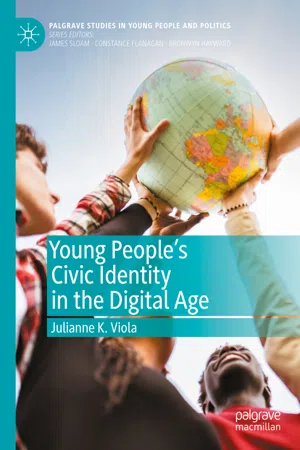
This book explores young people's civic experiences in contemporary American society, and how they navigate the political world in an era defined by digital media. Drawing on the experiences of young people before they have reached voting age, the book provides vital perspectives on citizenship and civic engagement of a part of the population that is often overlooked. The author engages with the tensions young people encounter in their everyday personal and civic lives, particularly in their understanding and experience of civic identity in ways that are shaped by society's (mis)perceptions of youth. The book introduces a new framework of civic identity that has been directly informed by the lived civic experiences of young people themselves. The findings will be of great interest to researchers and students working in political science, sociology, youth studies, education studies, and media studies, as well as policy-makers, practitioners, and parents of young people.
- English
- ePUB (mobile friendly)
- Available on iOS & Android
eBook - ePub
Young People's Civic Identity in the Digital Age
About this book
Information
© The Author(s) 2020
J. K. ViolaYoung People's Civic Identity in the Digital AgePalgrave Studies in Young People and Politicshttps://doi.org/10.1007/978-3-030-37405-1_11. Introduction: The Need to Investigate the Civic Experiences of American Young People
Julianne K. Viola1
(1)
Centre for Higher Education Research and Scholarship, Imperial College London, London, UK
Keywords
CitizenshipYoung peopleYouth civic engagementCivic identity framework1.1 Motivation for Research
For better or worse, the contemporary society we live in is often characterized by widespread digital media use. Social media use is nearly universal among young people, with 97 percent of 13- to 17-year-olds active on at least one of seven major social media platforms, and 16 percent of 13- to 17-year-olds saying that social media is useful for accessing news and current events (Anderson & Jiang, 2018). A 2017 national survey of 10- to 17-year-olds in the United States found that among social media users, 76 percent turn to Facebook and YouTube for their news information (Robb, 2017). It is therefore not surprising that young people are receiving messages from people beyond their immediate social circles about their place in society as young people and how they might engage in the public sphere. In particular, young people’s understandings of citizenship and their place in the world have been shaped by the messages they receive from the adults around them (that they are “just children” and that they should “stay out of politics”) and the political messages they absorb through digital outlets, like Twitter (where anti-immigrant rhetoric has played the largest role).
Young people, particularly those between the ages of 14 and 17 years old, have a low sense of efficacy and feel that their voices will not be heard, because adults in their lives and politicians alike do not take young people seriously. Young people are often excluded from the political process because they are perceived as disengaged and disinterested (Pickard, 2019). However, a growing body of research demonstrates that young people care deeply about the hot-button issues (and crises) of the day (Pickard & Bessant, 2017), and wish to make a positive impact. Young people now have access to open source tools and social networking platforms, which they can use to address political and social issues directly (Benkler, 2006; Coleman, 2008). Young people now turn to more accessible forms of engagement (Delgado & Staples, 2007; Ginwright, 2009), which are often digitally mediated and accepted as non-traditional means of engagement (Henn & Foard, 2012). Rather than waiting until they reach voting age (Earl & Schussman, 2008; Kawashima-Ginsburg, 2011; Soep, 2015; Weinstein, Rundle, & James, 2015), young people find ways to demonstrate that they care about their communities (Kahne & Westheimer, 2006). Young people sign petitions, interact with elected officials on social media, access information from news alerts on their smartphones, and read blog posts on Tumblr to negotiate others’ opinions and develop their own (Barrett & Zani, 2014).
This book is about young people’s civic experiences in contemporary American society, and how young people navigate the political world in an age defined by experiences that are digitally mediated . Many contemporary studies focus on young voters (ages 18 through 25 or ages 18 through 30) in America and other democracies; this book draws on the experiences of young people in the United States before they have reached voting age , providing vital perspectives on citizenship and civic engagement by young people, who are so often overlooked or ignored by adults in their lives and in society. This book rests in the intersection where media studies, youth studies, and civic studies meet, and addresses the paucity of literature around the lived citizenship experiences of young people. By focusing on the experiences of young people living in the United States at a unique time in the nation’s democratic history, this book is timely and relevant to the current political and social context in which young people are coming of age. This book not only highlights the changing nature of youth civic and political engagement, but it deeply explores the lived citizenship of young people.
In contemporary society, the meaning of citizenship and what it means to be civically engaged is shaped by individuals’ experiences of citizenship. However, for decades, research on the meaning of citizenship has been based in theoretical understandings of adults’ conceptualizations and experiences of citizenship, a concept that has always consisted of multiple meanings and understandings (Ellis, Hálfdánarson, & Isaacs, 2006). Citizenship includes legal and social components (Marshall & Bottomore, 1992; Osler & Starkey, 2006, 2018): the rights, duties, and privileges within a political collective (Olsen, 2012), and a sense of belonging (Flanagan, 2013) and the privilege connected with that belonging (Bellamy, 1998). These theories of understanding citizenship have led researchers to further develop models and styles of citizenship to include membership and participation (Bennett, 2008; Kerr & Cleaver, 2009; Thun, 2016).
Despite this widespread understanding that adults understand citizenship in these thematic areas, there is limited empirical research examining the themes and theories of citizenship as it is experienced and conceptualized by young people before they reach adulthood, especially in contemporary society. Today, young people are experiencing the world in a more digitally mediated manner than previous generations, and scholars have described changes in citizenship alongside how technology is involved in civic engagement (Bennett, 2008; Schudson, 1998). The most recent and relevant studies of the civic experiences of young people took place in the early 2000s (Bennett, Wells, & Freelon, 2011; Lister, Smith, Middleton, & Cox, 2003). Lister et al. (2003) conducted an empirical study of how young people in a British city perceive citizenship and their own transitions as citizens. Lister et al. (2003) presented a framework for understanding how young people between the ages of 16 and 23 conceptualize citizenship, but did not address civic engagement or technology; their study was conducted prior to the introduction of social media and other technologies into daily life. Contemporary society is marked by a culture of digitally sharing our lives and opinions with others (Watkins, 2009), and has been well documented (boyd, 2007; Ito et al., 2010; Lenhart et al. 2015; Xenos & Foot, 2008). While young people in the United States consume and create digital content (Coleman & Rowe, 2005; Lenhart & Madden, 2005), most often, young people are using technology to interact with their friends, with 72 percent of young people ages 13 through 17 communicating with their friends through social media (Lenhart, 2015).
With the understanding that experiences are increasingly digitally mediated , Bennett et al. (2011) conducted an analysis of United States-based web sites operated by a diverse set of civic and political organizations to assess styles of citizenship on civic websites (Bennett, 2008). Bennett et al.’s (2011) study focused on the investigation of youth-focused civic websites, their site traffic, and potential civic learning opportunities embedded in the sites, rather than focusing on the civic experiences of young people themselves. This provided me with the impetus to learn the experiences of young people through empirical research, which would contribute an up-to-date understanding of citizenship and civic engagement that includes the direct experiences of young people in contemporary society. As Lister et al.’s (2003) work is most closely related to this aim, I will draw on their work on citizenship throughout this book. Citizenship and civic engagement are the two key components of civic identity, which refers to how we share aspects of ourselves with others, and how we interact with each other and with political leaders. While there is no single agreed-upon definition of civic eng...
Table of contents
- Cover
- Front Matter
- 1. Introduction: The Need to Investigate the Civic Experiences of American Young People
- 2. Where Technology, Youth, and Civics Meet: A Springboard for Understanding Civic Identity
- 3. Presentations of the Adolescent Self in Contemporary Society
- 4. Civic Identity
- 5. Engaging in the Political World
- 6. Conclusion: Youth Voice in Contemporary Society
- Back Matter
Trusted by 375,005 students
Access to over 1.5 million titles for a fair monthly price.
Study more efficiently using our study tools.
Frequently asked questions
Yes, you can cancel anytime from the Subscription tab in your account settings on the Perlego website. Your subscription will stay active until the end of your current billing period. Learn how to cancel your subscription
No, books cannot be downloaded as external files, such as PDFs, for use outside of Perlego. However, you can download books within the Perlego app for offline reading on mobile or tablet. Learn how to download books offline
Perlego offers two plans: Essential and Complete
- Essential is ideal for learners and professionals who enjoy exploring a wide range of subjects. Access the Essential Library with 800,000+ trusted titles and best-sellers across business, personal growth, and the humanities. Includes unlimited reading time and Standard Read Aloud voice.
- Complete: Perfect for advanced learners and researchers needing full, unrestricted access. Unlock 1.5M+ books across hundreds of subjects, including academic and specialized titles. The Complete Plan also includes advanced features like Premium Read Aloud and Research Assistant.
We are an online textbook subscription service, where you can get access to an entire online library for less than the price of a single book per month. With over 1.5 million books across 990+ topics, we’ve got you covered! Learn about our mission
Look out for the read-aloud symbol on your next book to see if you can listen to it. The read-aloud tool reads text aloud for you, highlighting the text as it is being read. You can pause it, speed it up and slow it down. Learn more about Read Aloud
Yes! You can use the Perlego app on both iOS and Android devices to read anytime, anywhere — even offline. Perfect for commutes or when you’re on the go.
Please note we cannot support devices running on iOS 13 and Android 7 or earlier. Learn more about using the app
Please note we cannot support devices running on iOS 13 and Android 7 or earlier. Learn more about using the app
Yes, you can access Young People's Civic Identity in the Digital Age by Julianne K. Viola in PDF and/or ePUB format, as well as other popular books in Politics & International Relations & Educational Policy. We have over 1.5 million books available in our catalogue for you to explore.