eBook - ePub
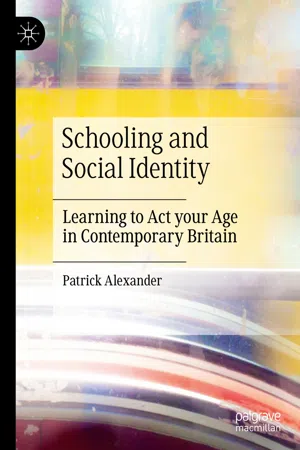
Schooling and Social Identity
Learning to Act your Age in Contemporary Britain
- English
- ePUB (mobile friendly)
- Available on iOS & Android
eBook - ePub
About this book
This book examines the nature of age as an aspect of social identity and its relationship to experiences of formal education. Providing a new and critical approach to debates about age and social identity, the author explores why age remains such an important aspect of self-making in contemporary society. Through an ethnographic account of a secondary school in the south-east of England, the author poses three principal questions. Why are schools in English organised according to age? How do pupils and teachers learn to 'act their age' while at school? Ultimately, why does age remain such an important and complex organising concept for modern society? Cutting across lines of class and gender, this timely book will be of interest to students and scholars of self-making and identity in educational contexts, and others interested in how schooling socialises young people into categories of age as the foundational building blocks of modern society.
Information
Topic
EducationSubtopic
Adult Education© The Author(s) 2020
P. AlexanderSchooling and Social Identityhttps://doi.org/10.1057/978-1-137-38831-5_11. Age in Society: Framing Social Structure
Patrick Alexander1
(1)
School of Education, Oxford Brookes University, Oxford, UK
Patrick Alexander
Introduction: Blurred Lines
What does the pop star Miley Cyrus have in common with William Shakespeare? This is only sort of a joke. Picture, if you will, a young, peroxide-blonde pop starlet, onstage in front of millions of children and young people, dressed in skimpy hot pants and surrounded by giant teddy bears, tongue hanging out, twerking1 up against a man almost two decades her senior, singing a song with explicit, misogynist sexual content, entitled Blurred Lines. This is the iconic scene from American singer Miley Cyrus’s 2013 Video Music Awards performance alongside singer Robin Thicke, the content of which sent the global media into paroxysms of salacious anxiety about the declining moral values of modern children and youth, and the sexualisation of young women. Cyrus’ performance was particularly scandalous because she had formerly portrayed the quintessentially innocent children’s TV character Hannah Montana and was seen as a role model for pre-teen girls worldwide. Her 2013 performance and subsequent sexualised reincarnations as an adult pop icon have wrecked this image of innocence, arousing much popular outcry and hand-wringing, not least among the parents of her current and former fans. Now picture Jacques, wistfully lamenting in As You Like It that ‘all the world’s a stage’ upon which we transition from ‘infant’ to ‘schoolboy’, ‘lover’, ‘soldier’, ‘justice’, ‘pantaloon’ and finally to ‘second childishness… and oblivion’ in our journeys through life. Each of these rather incongruous texts have served as weathervanes for popular anxiety about age. The latter has invited centuries of readers to ponder the cruel inevitability of the linear ageing process. While the former is now already gathering dust in the public consciousness, the case of Miley Cyrus more recently provoked millions, in contrast, because of what it suggests about the precariousness and changing significance of age categories. Specifically, Cyrus and Thicke laid bare the ‘troubled’ sanctity of childhood and the implications that this has for the increasingly blurred lines of contemporary adulthood. The yawning centuries between these texts are littered with examples from popular discourse of our preoccupation either with the inevitable nature of the life course, or the prospect that age categories—and particularly childhood and youth—are inevitably not what they ‘used to be’. This is evidenced as much in the popular impact of the writings of Locke, Hobbes, Rousseau, Durkheim, Piaget, Erisken, Hall, and Freud as it is public and political outcry about delinquent child criminals on the streets of Victorian London, ‘penny dreadful’ magazines, mods and rockers of 1960s Britain (Cohen 1972), 1990s gangsta rap (Springhall 1998), ‘hoodies’, paedophilia, the negative impact of new digital technologies on contemporary children’s brains (Greenfield 2014) or the more recent moral panic about knife crime. The tension between inevitable structure and the inevitable decay of structure is of profound importance to recent social constructions of age as an aspect of the human condition.
Shakespeare’s Seven Ages of Man is an all-too-common starting point for historical reflections on the seemingly eternal nature of age and the life course, experienced through discrete stages (see, e.g. James 2004). Whatever the veracity of the ages that Shakespeare presents, we are broadly familiar with contemplating our social, intellectual, moral, spiritual and psychic development alongside the growth and decay of our bodies in this kind of way. It seems reasonable to presume that a temporal reckoning of the person, alongside the institution of some system of organisation that makes this temporal reckoning socially meaningful, is a relatively common (if not necessarily universal) human practice. Age, in its many manifestations, can be related to shifting social status and shifts in standing and power within a society, often enacted through ritual activity and performance, and crystallised in relation to age grades, age sets and generations (Van Gennep 1960; Mannheim 1952 [1923]). Reproducing these transitions through age-related statuses provides a framework for other forms of social and cultural reproduction. Indeed, conceptions of age underpin in a profound way how we make sense of how culture ‘works’ over time—how it is transmitted, produced and reproduced from one generation to the next. As Ingold has suggested (2017), a ‘genealogical’ model pervades how we think about learning as the process through which culture is inscribed, and culture is in this sense inherently ‘aged’ because age categories often shape how one’s education into culture is enacted. Nowhere is this more evident than in schools. In a genealogical framing, knowledge is in its essence a matter of transferring skills, values, beliefs, morality, rights and obligations from one older group to a younger one. However, it is not the case that all people everywhere imagine and make sense of age (or culture, or time, or how knowledge ‘transfers’, for that matter) in the same genealogical terms—even if many Western scientists and social scientists have done so for more than a century. On the contrary, cross-cultural comparisons highlight a rich diversity of ways to configure age (and, therefore, culture), each the product of making human existence meaningful within a given social and cultural context. The fact that culture, as a process, remains dynamic and prone to change also means that the categories used to define age are also likely to shift within cultural contexts (Anderson-Levitt 2012). And yet, as in the case with Miley Cyrus’ and Robin Thicke’s Blurred Lines performance, the troubling of age categories can in turn lead to widespread social outcry because, somewhat ironically, this inevitable process of shift also implies the decay of seemingly foundational and unshakeable social structures.2
It is the aim of this book to better understand the above tension as it relates to schooling in contemporary British society. With this in mind, it is important to begin this chapter by interrogating the recent origins of Western ideas about age, beginning with a few big questions: Why is it that we think about and make sense of age and the ageing process in the way that we do? What are the recent historical, philosophical and sociological premises for the way that we think about age in Western societies? How might we start to think about age differently? In Part I, I begin to explore these questions by untangling a few of the intellectual threads that combine to give structure to contemporary Western notions of ‘age’ as an aspect of human social life, starting with the proposition that age acts as an organising concept of sum importance to the project of modernity. I briefly examine how different scientific, political, sociological, psychological and philosophical traditions coalesced during the twentieth century to cement a particularly linear notion of how age figures as an aspect of the human condition. This narrative is linked to changing social constructions of the concept of childhood in Western society; to patterns of mass consumption; and, crucially, to the encroachment of the modern nation-state and its disciplinary institutions (Foucault 1977) into the lives of children and young people. An important part of this encroachment—mass education—is given its own due in the following chapter. In Part II, I continue by reviewing sociological and anthropological thinking about age, with particular reference to childhood, youth and education. This review sets the scene for the concept of age imaginaries that I elaborate in Chap. 2.
Part I: The Modern Age
Defining ‘Age’ as a Term of Analysis
It is important to start by noting that ‘age’ is a sphere of social inquiry claimed by diverse and sometimes disparate traditions across the social sciences, not to mention its various interpretations across medicine, the biological sciences, experimental psychology—and the list goes on. As a result, age has been understood from a range of epistemological and theoretical perspectives. What each has in common, however, is the notion that our present linear, chronological framing of age is an inevitable feature of human life, as much in our biology as in our forms of social organisation. The current dominant notion of linear age is, I argue, the grandest of all narratives: it serves as the trellis against which to train the many vines of human life that flourish under the guise of modernity. Taking age as an a priori starting point for inquiry across diverse disciplines has helped to cement the normality of the age categories against which modern society is organised—from physical and cognitive development, to moral and intellectual growth, to civic responsibility and legal culpability. Age is at the heart of modern personhood, literally from the moment of conception.
It is the very centrality of age to the project of modernity that makes its interrogation as an organising concept for social life seem unnecessary, or even facile. Within the social sciences, age is employed in multiple ways, often by proxy, as a backdrop for making sense of other aspects of social life. The quiet ubiquity of age as a backdrop in social science research in this sense means that it is particularly difficult to pin down as a discrete field of study. Indeed, it is perhaps better to see ‘age’ currently existing at the crossroads of multiple fields of inquiry, rather than as a field in its own right. This is made even more apparent by the fact that studies dealing with ‘age’ frequently focus on one particular stage or time of life, in terms of childhood, youth, adolescence, adulthood, old age and so on, rather than dealing with ‘age’ more broadly defined. More often than not, purported studies of age are in fact studies of ageing. This also means that there exist fewer theoretical accounts that present a coherent and critical picture of age as a broader continuum, particularly in terms of its significance as a marker of identity or self-making (Hockey and James 2003; Pilcher 1995; Thorne 2004). As Pilcher suggests, ‘theorizing on age…is underdeveloped and limited, in that there is no one overarching theory. Rather, there is a somewhat heterogeneous bundle of theories, each with a variety of concerns, strengths and weaknesses’ (1995: 16). More recently, renewed interest in age as a broad field of inquiry has signalled a shift towards more holistic considerations of how age ‘works’ in society (Cote 2000; Furlong 2009; Thorne 2004). However, there remains scant research that takes as its focus age broadly defined. This is telling of the taxonomic power that age-based categories impose on the study of age itself, and of the potentially homogenising effect that age-related categories can have on the carving out of different imaginings of age within specific disciplines. Or to put it another way, the existence of discrete fields of inquiry into stages of life itself reinforces the logic of linear age as a means of understanding human experience. The division of age-related fields of study into different temporal, theoretical and disciplinary niches also means that studies of age, more broadly defined, are made unusual by their inability to adhere to particular, specific age/stage-based areas of inquiry. One is obliged to transgr...
Table of contents
- Cover
- Front Matter
- 1. Age in Society: Framing Social Structure
- 2. The Concept of Age Imaginaries
- 3. An Archaeology of the Recent Past: Age and Schooling in Historical and Contemporary Social Context
- 4. Learning to Act Your Age in the Classroom
- 5. Learning to Act Your Age in the Playground: Age and the Social Lives of Secondary School Students
- 6. Learning to Act Your Age in the Staffroom: Age Imaginaries in the Lives of ‘Younger Teachers’
- Back Matter
Trusted by 375,005 students
Access to over 1.5 million titles for a fair monthly price.
Study more efficiently using our study tools.
Frequently asked questions
Yes, you can cancel anytime from the Subscription tab in your account settings on the Perlego website. Your subscription will stay active until the end of your current billing period. Learn how to cancel your subscription
No, books cannot be downloaded as external files, such as PDFs, for use outside of Perlego. However, you can download books within the Perlego app for offline reading on mobile or tablet. Learn how to download books offline
Perlego offers two plans: Essential and Complete
- Essential is ideal for learners and professionals who enjoy exploring a wide range of subjects. Access the Essential Library with 800,000+ trusted titles and best-sellers across business, personal growth, and the humanities. Includes unlimited reading time and Standard Read Aloud voice.
- Complete: Perfect for advanced learners and researchers needing full, unrestricted access. Unlock 1.5M+ books across hundreds of subjects, including academic and specialized titles. The Complete Plan also includes advanced features like Premium Read Aloud and Research Assistant.
We are an online textbook subscription service, where you can get access to an entire online library for less than the price of a single book per month. With over 1.5 million books across 990+ topics, we’ve got you covered! Learn about our mission
Look out for the read-aloud symbol on your next book to see if you can listen to it. The read-aloud tool reads text aloud for you, highlighting the text as it is being read. You can pause it, speed it up and slow it down. Learn more about Read Aloud
Yes! You can use the Perlego app on both iOS and Android devices to read anytime, anywhere — even offline. Perfect for commutes or when you’re on the go.
Please note we cannot support devices running on iOS 13 and Android 7 or earlier. Learn more about using the app
Please note we cannot support devices running on iOS 13 and Android 7 or earlier. Learn more about using the app
Yes, you can access Schooling and Social Identity by Patrick Alexander in PDF and/or ePUB format, as well as other popular books in Education & Adult Education. We have over 1.5 million books available in our catalogue for you to explore.