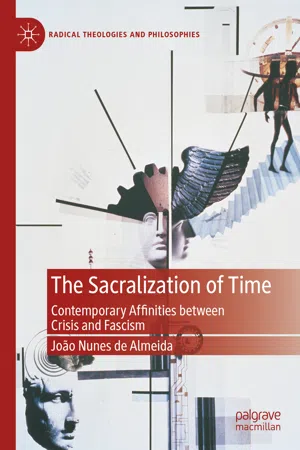
In this book, João Nunes de Almeida rethinks the relationship between crisis and fascism in today's liberal democratic societies. Arguing that fascism has adapted to a post-modern idea of endless crisis, Almeida challenges one of the strongest liberal myths in western politics, namely that fascism and liberal democracy have different roots. Fascism, in Almeida's view, is at the center of the very production of social relations in western capitalist societies, and is the result of the very desire to be saved from crisis underlying liberal democracy. It draws on stormy examples from Portugal's contemporary history, with a particular focus on its fascist past and revolution, to explore affinities between crisis and fascism in other spatial and historical contexts. João Nunes de Almeida concludes that refusing to be saved from crisis becomes the refusal of any form of fascism in a more global context.
eBook - ePub
The Sacralization of Time
Contemporary Affinities between Crisis and Fascism
- English
- ePUB (mobile friendly)
- Available on iOS & Android
eBook - ePub
About this book
Information
Topic
Teología y religiónSubtopic
Historia europea© The Author(s) 2020
J. Nunes de AlmeidaThe Sacralization of TimeRadical Theologies and Philosophieshttps://doi.org/10.1007/978-3-030-46543-8_11. Introduction
Keywords
CrisisSacralizationProfanationCapitalismReligionPortugalWriting on crisis is writing without a narrative. Crises are often signposts for writing narratives but writing exclusively about crisis as such is a hard task. One can write and read about modernity thanks to revolutionary crises but it is particularly difficult to write about time in a revolutionary crisis. When writing about crisis offers crystal-clear narratives of certainty, writing of crisis is usually missing. As soon as we start investigating a crisis event, the very borders of the disciplines that we are familiar with seem insufficient to grasp at least a part of what happens in crisis. Researching crisis thus requires not only interdisciplinary work but also openness to creatively problematizing the very epistemological boundaries that guide our investigations.
This book reflects the pursuit of embracing rather than denying the uncertainty of crisis. It started from a particular interest in discourses of exception and the impacts of the 2007 financial crisis in Portugal. However, it became evident along the years that this research could not rely in one single episteme, let alone a case study. Moreover, mere procedural empiricism could not even do justice to that case study. The more one writes about crisis, the more one sees relations between phenomena and concepts that are constantly effaced by the idle talk on crisis. Thirteen years ago, when the 2007 financial crisis was discursively announced in the media, an army of liberal economists were ready to explain it to the ignorant masses that were too dull to understand the wonders of the capitalist system. As it always happens with liberal civil disobedience, it is just a question of time until that same system gets reformed. So, in these times of financialization, the system had to be reformed by critical economists (See Lapavitsas 2012). However, no major reform of capitalism has been achieved so far. Critical social sciences risk falling into the reformism of “crisis prevention” (Toscano 2014: 1026).
The explanations of crisis offered by these critical economists thus seemed to have missed the very crude experience of sacrifice that was being demanded from the sinful humans. In countries such as Portugal that experience of sacrifice was suffocating not only because of the generalized impoverishment of the population but also due to the ascetic practices imposed on the ones who lived in the sin of living above their needs—the debtors (see Stimilli 2017). Thus, debt collection became the disciplinary exercise of a social totality. Marxian-oriented research (see Mattick 2011; Varoufakis 2011; Seymour 2014), for instance, was important to demystify discourses of debt during the financial crisis but it hardly touched on the critique of capitalism as a critique of religion (which Marx himself did). Moreover, this form of reasoning is still marginal in the analysis of the 2007 financial crisis. Capitalism and religion continue to appear as two unrelated phenomena, religion being too off-topic to the all too serious political economic analyses. Nevertheless, genealogical work about the 2007 financial crisis as a debt crisis started to make its way to the public sphere and academia and the analysis of capitalism as religion regained its relevance again (see Lazzarato 2012; Graeber 2011; Stimilli 2017). Interestingly enough, canonical works in social sciences could never dispense with such an elective affinity between those domains (see Weber 1992; Löwy 1992). This book thus grounds itself in the elective affinity between capitalism and religion, understanding capitalism not as a secularized form of religion but as religion itself. In other words, the present investigation privileges Benjamin’s fragment Capitalism as Religion (Benjamin 1997) rather than Weber’s Protestant Ethic of Capitalism (Weber 1992) and sociology of religion in general. This means that the sacralization of capital rather than the secularization of religion will methodologically guide this book (see Diken 2016).
While exploring relations between capitalism and religion in the light of the 2007 crisis, the response of Portugal’s governments during the crisis led me to an increasing problematization of the potential relations between crisis and forms of authoritarianism. Writing on crisis is a hard task but it gives a privileged insight to long forgotten or effaced analogies between not so pleasant ideas. If something became visible during the debt crisis, it was the authoritarian character of debt collection in southern European countries. Consequently, it was unsurprising that the Portuguese Constitution became central to the political stage during the Troika1 bailout (Ferreira and Pureza 2013: 250). Governmental policies started to be scrutinized by Portugal’s Constitutional Court. And as soon as the question of the exceptionality of the Troika bailouts became interrelated with the debt crisis, the contemporary political myth portraying authoritarian forms of rule as extraneous to the normal functioning of western liberal democracies started to collapse. The research problem of this project is then here formulated: to what extent does crisis, as a temporality, relate to fascism? Thus, this book explores the affinities between the concepts of crisis and fascism. It does this through the comparison of distinct historical paradigms of crisis, namely the Portuguese fascist reaction to a regime crisis in the early twentieth century and the contemporary liberal responses to the 2007 financial crisis.
In this book, however, the relations between fascism and crisis do not resonate immediately from the suspension of constitutional rights or lawless repression. Rather, the conceptual history of crisis already reveals that crisis, in its juridical sense, is foremost about salvation (Koselleck 2006: 359). For instance, fascist leaders were aware of this aspect as their national messianism promised salvation from crisis. In other words, economic crises, but also broader civilizational and moral crises, could be overcome as long as the ideal of a purified nation was accepted and pursued by the population. However, it becomes problematic to make sense of national salvation in post-war crises of liberal democratic regimes. Moreover, how can such an idea of national salvation, dear to the brutal fascist regimes of the past, still be tolerated by the population and actively promoted by liberal democratic states? This question thus requires a reconceptualization of crisis but also of fascism after the catastrophic national salvations of interwar and post-war fascisms.
In other words, fascism was hardly conceived as an alien phenomenon to bourgeois liberal society except for left-wing reformism (Rodrigues 2008). The liberal myth of conceiving fascism as a barbarian ideology at the gates of the Empire is all too convenient for governments that rule by abruptly cutting salaries, increasing homelessness, brutally repressing demonstrations and attacking workers’ rights. As long as the portrait of the stereotypical fascist leader addressing the masses could be recalled, liberal governments could present themselves as democrats. It then becomes an intolerable taboo to question the myth of fascism as something alien to the normal functioning of liberal democracies. Such conception of fascism as an evil that breeds outside the borders of liberal democracies is primarily caused by an understanding of fascism as ideology. Defining fascism as ideology interprets fascism at the level of political representation and identity. In this project, however, the relation between crisis and fascism is not explored in a way that understands fascism only as ideology. Although fascism is revisited in the historical and ideological variety of Portuguese fascism, this project privileges an understanding of fascism less as a historical and ideological phenomenon and more as a permanent phenomenon that permeates and constitutes the very social life of capitalist societies (Evans and Reid 2013: 3). In this respect, Deleuze and Guattari’s (2014) understanding of fascism decisively addresses how human desire for repression produces the capitalist social formation. Deleuze and Guattari approach fascism from the perspective of human desire and, in this process, they do not see it as alien to liberal democracies.
In this understanding of fascism, humans are not seen as the passive and immediate victims of external repression. Quite the contrary, following Deleuze and Guattari’s (idem) micro-politics a...
Table of contents
- Cover
- Front Matter
- 1. Introduction
- 2. Theology of Crisis
- 3. Politics of Crisis
- 4. Language of Crisis
- 5. Experience of Crisis
- 6. Refusal of Crisis
- 7. Conclusion
- Back Matter
Trusted by 375,005 students
Access to over 1.5 million titles for a fair monthly price.
Study more efficiently using our study tools.
Frequently asked questions
Yes, you can cancel anytime from the Subscription tab in your account settings on the Perlego website. Your subscription will stay active until the end of your current billing period. Learn how to cancel your subscription
No, books cannot be downloaded as external files, such as PDFs, for use outside of Perlego. However, you can download books within the Perlego app for offline reading on mobile or tablet. Learn how to download books offline
Perlego offers two plans: Essential and Complete
- Essential is ideal for learners and professionals who enjoy exploring a wide range of subjects. Access the Essential Library with 800,000+ trusted titles and best-sellers across business, personal growth, and the humanities. Includes unlimited reading time and Standard Read Aloud voice.
- Complete: Perfect for advanced learners and researchers needing full, unrestricted access. Unlock 1.5M+ books across hundreds of subjects, including academic and specialized titles. The Complete Plan also includes advanced features like Premium Read Aloud and Research Assistant.
We are an online textbook subscription service, where you can get access to an entire online library for less than the price of a single book per month. With over 1.5 million books across 990+ topics, we’ve got you covered! Learn about our mission
Look out for the read-aloud symbol on your next book to see if you can listen to it. The read-aloud tool reads text aloud for you, highlighting the text as it is being read. You can pause it, speed it up and slow it down. Learn more about Read Aloud
Yes! You can use the Perlego app on both iOS and Android devices to read anytime, anywhere — even offline. Perfect for commutes or when you’re on the go.
Please note we cannot support devices running on iOS 13 and Android 7 or earlier. Learn more about using the app
Please note we cannot support devices running on iOS 13 and Android 7 or earlier. Learn more about using the app
Yes, you can access The Sacralization of Time by João Nunes de Almeida in PDF and/or ePUB format, as well as other popular books in Teología y religión & Historia europea. We have over 1.5 million books available in our catalogue for you to explore.