eBook - ePub
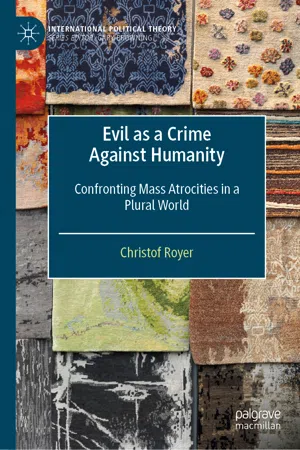
Evil as a Crime Against Humanity
Confronting Mass Atrocities in a Plural World
- English
- ePUB (mobile friendly)
- Available on iOS & Android
eBook - ePub
About this book
This book seeks to reimagine why and how to confront mass atrocities in world politics. Drawing on Hannah Arendt's conception of evil, it interprets and understands mass atrocities as 'evil' in an 'Arendtian' sense, that is, as crimes against human plurality and, thus, crimes against humanity itself. This understanding of mass atrocities paves the way for reframing responses to mass atrocities as attempts to confront evil. In doing so, the book focuses on military intervention under the banner of the Responsibility to Protect (R2P) and judicial intervention by the International Criminal Court (ICC) and reframes them as tools to protect human plurality from evil. Furthermore, the book looks at the place and the role of R2P and the ICC in the changing landscape of world order. It argues that the protection of humanity from evil can serve as a legitimate Grundnorm (basic norm) around which a global constitutional order in an inherently pluralistic world can be constructed.
Information
© The Author(s) 2021
C. RoyerEvil as a Crime Against HumanityInternational Political Theoryhttps://doi.org/10.1007/978-3-030-53817-0_11. Imagination and Reality
Christof Royer1
(1)
University of Hong Kong, Hong Kong, Hong Kong
Keywords
ImaginationRiftAlternative pictureEvilArendtA picture held us captive. And we could not get outside it, for it lay in our language and language seemed to repeat it to us inexorably. (Wittgenstein 1973: §115)‘Imagination’ is the word that cannot be avoided. (Hampshire 1989: 125)
In December 2016, the Syrian army tightened its iron grip on Aleppo. What was once Syria’s largest city had been under siege by government troops, supported by Russia and Iran, for almost four years. In many respects, of course, ‘the battle of Aleppo ’ (as the siege was often called) had become a microcosm of the Syrian conflict. It exposed the tactical and military weaknesses of both government and non-government troops, it made the immense difficulties for international negotiators to broker a peace agreement plainly obvious and it demonstrated the repeated failure of the international community to protect civilians. But now the anti-government forces were pushed back and thousands of civilians were trapped in the remaining few neighbourhoods held by the rebels.1 Artillery, rockets and missiles were raining down on them; summary executions and atrocities against women and children were reported; and, as the media began to draw comparisons with Stalingrad, Srebrenica or Rwanda, the desperation of international observers mounted: ‘Every hour, butcheries are carried out’, the Syrian Observatory for Human Rights reported. France’s ambassador to the UN warned that ‘the worst humanitarian tragedy of the twenty-first century is unfolding before our eyes’ (Wright 2016: para. 5). And Ban Ki-moon , remarkably enough, in his final press conference as UN Secretary-General, asserted that Aleppo had become ‘a synonym for hell’ (United Nations 2016).
Perhaps the most interesting display of differing positions on the situation, however, took place during a UN Security Council Emergency Meeting on 13 December.2 Samantha Power, then US ambassador to the UN, unleashed a scathing attack on the Syrian regime and its allies:
To the Assad regime, Russia, and Iran—three Member States behind the conquest of and carnage in Aleppo—you bear responsibility for these atrocities. By rejecting UN-ICRC evacuation efforts, you are signaling to those militia who are massacring innocents to keep doing what they are doing…Aleppo will join the ranks of those events in world history that define modern evil, that stain our conscience decades later. Halabja, Rwanda, Srebrenica, and, now, Aleppo.To the Assad regime, Russia, and Iran, your forces and proxies are carrying out these crimes. Your barrel bombs and mortars and airstrikes have allowed the militia in Aleppo to encircle tens of thousands of civilians in your ever-tightening noose. It is your noose. Three Member States of the UN contributing to a noose around civilians.
But, quite predictably, the Russian ambassador Vitaly Churkin was not stumped for an answer:
I wouldn’t want to remind this Western trio [France, US, UK] which called for today’s meeting and carried it out in a raised voice, about your role in the creation of ISIS as a result of US and UK intervention in Iraq.I don’t want to remind these three countries about their role in unwinding the Syrian crisis, which led to such difficult consequences, and let terrorists spread in Syria and Iraq.The weirdest speech to me was the one by the US representative which built her statement as if she is Mother Teresa herself. Please, remember which country you represent. Please, remember the track record of your country.
It might be said, of course, that this is overblown and histrionic rhetoric—hardly worth serious political and moral consideration. However, what I find interesting about this diplomatic skirmish is that it brings to the fore several aspects of, and positions in, world politics that I will explore in this book: the complex relationship between politics and morality, the charge of arrogant (and hypocritical) moral posturing that often goes by the name of ‘moralism’, the seemingly perpetual problem of how to confront mass atrocities in a plural world and the moral and political reality of evil. These, as I say, are the themes that I will try to elucidate. For now, however, let me emphasise that Aleppo is, of course, only one episode of a conflict that is, at the time of writing this Introduction, well into its tenth year.3 While the exact death toll is, as a New York Times article puts it, lost in ‘the fog of war’ (Specia 2018), it is estimated that the conflict has claimed between 400,000 and 600,000 lives.4 The United Nations High Commissioner for Refugees (UNHCR) states that over 5.6 million people have fled Syria since 2011 and that 6.6 million have become internally displaced (2020). It is certainly true, then, that the categorical promise ‘never again’—the rallying cry of the ‘anti-atrocity movement—has long been washed away by ‘this immense tidal wave of bloodshed and atrocity’ (United Nations 2017). ‘Never again’ has been unmasked as what it always has been: an empty slogan. And it must sound like a mockery to the Syrian people.
In her sensitive, yet insightful, reportage of the lives of ordinary Syrians in the shattered country, Rania Abouzeid (2018) vividly describes how the population struggles not only to survive but also to retain hope amidst the violence, the horrors and the loss they are faced with on an almost daily basis. ‘These things happened’, she writes. ‘These things continue to happen. Some of these things should never happen again’ (2018: xii). And who in this world could disagree with her? Yet, despite the massive toll that the conflict has exacted on the population, it is important (as I will try to demonstrate in this book) that Syria is not ‘only’ a humanitarian catastrophe. ‘The destruction of whole societies in the Middle East’, Madeleine Albright rightly reminds us (US Institute of Peace 2015), ‘is not a regional problem, but a global crisis… And it is a crisis that is not only a humanitarian … but also a political emergency’. Syria, then, is a global political as much as it is a humanitarian disaster. And it is a cautionary tale that the perpetration of harrowing mass atrocities is a very concrete phenomenon of ethical and political life. Even, and perhaps especially, in the globalised world of the twenty-first century.5
1.1 The Rift and the Alternative
It is not surprising, therefore, that the Syrian conflict has created a palpable sense of disillusionment among many scholars and practitioners of international politics.6 After all, there are existing international tools to combat mass atrocities. Two particularly prominent ones are the Responsibility to Protect (R2P)—a universally endorsed international mechanism to prevent and respond to genocide, crimes against humanity , war crimes and ethnic cleansing; and the International Criminal Cour...
Table of contents
- Cover
- Front Matter
- 1. Imagination and Reality
- 2. Evil as a Crime Against Humanity
- 3. A Responsibility to Protect Humanity from Evil
- 4. The International Criminal Court as a Bulwark Against Evil
- 5. Evil and World Order: Towards an Agonistic Global Constitutionalism
- 6. Tragedy and Hope
- Back Matter
Trusted by 375,005 students
Access to over 1.5 million titles for a fair monthly price.
Study more efficiently using our study tools.
Frequently asked questions
Yes, you can cancel anytime from the Subscription tab in your account settings on the Perlego website. Your subscription will stay active until the end of your current billing period. Learn how to cancel your subscription
No, books cannot be downloaded as external files, such as PDFs, for use outside of Perlego. However, you can download books within the Perlego app for offline reading on mobile or tablet. Learn how to download books offline
Perlego offers two plans: Essential and Complete
- Essential is ideal for learners and professionals who enjoy exploring a wide range of subjects. Access the Essential Library with 800,000+ trusted titles and best-sellers across business, personal growth, and the humanities. Includes unlimited reading time and Standard Read Aloud voice.
- Complete: Perfect for advanced learners and researchers needing full, unrestricted access. Unlock 1.5M+ books across hundreds of subjects, including academic and specialized titles. The Complete Plan also includes advanced features like Premium Read Aloud and Research Assistant.
We are an online textbook subscription service, where you can get access to an entire online library for less than the price of a single book per month. With over 1.5 million books across 990+ topics, we’ve got you covered! Learn about our mission
Look out for the read-aloud symbol on your next book to see if you can listen to it. The read-aloud tool reads text aloud for you, highlighting the text as it is being read. You can pause it, speed it up and slow it down. Learn more about Read Aloud
Yes! You can use the Perlego app on both iOS and Android devices to read anytime, anywhere — even offline. Perfect for commutes or when you’re on the go.
Please note we cannot support devices running on iOS 13 and Android 7 or earlier. Learn more about using the app
Please note we cannot support devices running on iOS 13 and Android 7 or earlier. Learn more about using the app
Yes, you can access Evil as a Crime Against Humanity by Christof Royer in PDF and/or ePUB format, as well as other popular books in Politics & International Relations & International Law. We have over 1.5 million books available in our catalogue for you to explore.