eBook - ePub
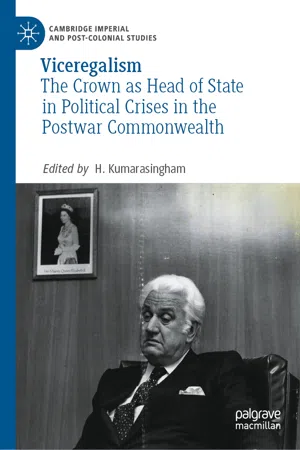
Viceregalism
The Crown as Head of State in Political Crises in the Postwar Commonwealth
- English
- ePUB (mobile friendly)
- Available on iOS & Android
eBook - ePub
Viceregalism
The Crown as Head of State in Political Crises in the Postwar Commonwealth
About this book
This book examines how the Crown has performed as Head of State across the UK and post war Commonwealth during times of political crisis. It explores the little-known relationships, powers and imperial legacies regarding modern heads of state in parliamentary regimes where so many decisions occur without parliamentary or public scrutiny. This original study highlights how the Queen's position has been replicated across continents with surprising results. It also shows the topicality and contemporary relevance of this historical research to interpret and understand crises of governance and the enduring legacy of monarchy and colonialism to modern politics. This collection uniquely brings together a diverse set of states including specific chapters on England, Scotland, Northern Ireland, Sri Lanka, Malaysia, Brunei, Ghana, Nigeria, Zimbabwe/Rhodesia, Australia, Tuvalu, and the Commonwealth Caribbean. Viceregalism is written and conceptualised to remind that the Crown is not just aceremonial part of the constitution, but a crucial political and international actor of real importance.
Information
© The Author(s) 2020
H. Kumarasingham (ed.)ViceregalismCambridge Imperial and Post-Colonial Studies Serieshttps://doi.org/10.1007/978-3-030-46283-3_11. Viceregalism
H. Kumarasingham1
(1)
University of Edinburgh, Edinburgh, UK
Introduction
The anthem ‘God Save the Queen’ has many verses that are seldom used today. Among lines rarely sung are those that implore God to ‘scatter’ the sovereign’s enemies and help to
‘Confound their politics,Frustrate their knavish tricks,On thee our hopes we fix’
These lines link to the idea that the Head of State has a role in politics and has powers too. For those that study and live in the contemporary age there has been a near uniform approach to consign monarchy in any study of British parliamentary democracy to a purely ceremonial role, if indeed, the monarchy is mentioned at all. Part of the reason for this is that the Head of State in parliamentary systems, as the lines above imply, only gain political focus when a crisis or unorthodox situation arises. The political position of a Head of State in parliamentary systems is governed by convention not statute. This convention holds that in parliamentary systems the Head of State keeps out of politics, which is the domain of elected and accountable representatives. This does not mean, however, that Heads of State in parliamentary systems are without mandated constitutional power or are politically quarantined.
This chapter is concerned with how Heads of State act during political crises. Viceregalism is conceptualised to comprehend the under researched position of Heads of State in parliamentary systems that derive from the British or colonial experience. It is used to describe, using recent British and Commonwealth history, the circumstances in which Heads of State act during political crises. Viceregalism is also conceived to make us look more closely at the vital relationship between Head of State and Head of Government, and see through history and design the former’s part in politics, not just ceremony. While this chapter mostly covers states and episodes where there is a monarch or their representative the analysis can also be extended to republican Heads of State within such parliamentary systems. This is not a legal study of the powers of the Head of State in Westminster systems, which has most recently been done with extensive and deep expertise by Anne Twomey.1 Neither is it about cataloguing ‘episodes’ though it openly builds on the earlier insightful and invaluable work of D. A. Low and David Butler in this area.2 The objective of this chapter is instead to look at the Head of State as a political actor during crises. Walter Bagehot in 1867 considered the British monarch to have three key rights: to be consulted, to warn and to encourage. It is worth reformulating Bagehot and developing a way to understand the roles and rights of a Head of State during political crises in modern parliamentary systems. Using examples and ideas from Britain and the postcolonial world this chapter puts forward three related rights and options open to a Head of State during a political crisis: the right to rule, the right to uphold and the right to oblige. These collectively show the critical role of Heads of State as political actors. By using this framework, we can better understand the importance of this neglected position in world politics and global history.
The position of Head of State is one drawn clumsily from historical and constitutional evolution as well as pragmatic, contextual and unintended factors. The political ambiguity of the office is one that allows multiple and often contradictory interpretations as will be discussed below. Common political terms for Heads of State like the Queen include ‘Non-Executive Head of State’, but this term is inadequate, since there are times, as will be shown, when such Heads of State in fact exercise executive power. For similar reasons ‘Ceremonial Head of State’ is inapt, as it implies no political role whatsoever. ‘Constitutional Head of State’ is an insufficient term to understand what type of regimes it covers, due to its plain generality. It is more appropriate to label Heads of State in Westminster-style democracies as ‘Parliamentary Heads of State’. This is especially due to the classic concept of Westminster, of the ‘Queen-in-Parliament’, which holds that whenever the Houses of Parliament and the Head of State agree law is made. The British Constitution, as Vernon Bogdanor puts it, can be described in eight words ‘What the Queen in Parliament enacts is law’.3 Max Weber also appreciated the symbiotic relationship between parliament and monarchy. In 1922, he described the British form of constitutional monarchy as ‘parliamentary kingship’. While not fully adhering to his famous ‘charismatic authority’ typology, the ‘parliamentary kingship’ had leadership potential in Weber’s analysis, despite the limitations of sharing power with politicians. Weber believed that this ‘English’ type of monarchy meant a ‘selective admission to actual power for that monarch that qualifies as a statesman’. However, any ‘misstep’ at home or abroad, or ‘the raising of pretentions that do not correspond with his personal abilities and prestige, may cost him his crown’.4
It is useful to see Viceregalism in the context of the antecedents of contemporary Heads of State, when monarchs and proconsuls claimed and exercised substantial executive power by right. It is easy to forget how difficult the path from a ruling monarchy to a ‘parliamentary monarchy’ was; history is littered with both bloody and mundane examples where such attempts to preserve monarchy in a responsible parliamentary regime ended in abject failure. Yet, the process either way is of fundamental importance to contemporary governance.5 Ultimately, as many observed, the key to survival of positions that so clearly derived from a pre-democratic age was to work within the system rather than against it. As that famed American constitutional designer, Alexander Hamilton, observed over two centuries ago, in the English system the Sovereign while having many formal powers, often saw greater utility in exercising the influence ‘he draws from a thousand sources’, over brute executive action. The monarch would ‘hesitate’ to exercise a veto against parliamentary opinion, but ‘would not fail to exert the utmost resources of that influence to strangle a measure disagreeable to him…to avoid being reduced to the dilemma of permitting it to take effect, or of risking the displeasure of the nation…’.6 Hamilton’s interpretation links to the power of influence inherent in a position drawing from antiquity. Sir Ronald Syme wrote in his great 1939 study of the rise and conception of Roman imperial power that the principle of auctoritas invested great eminence upon Augustus. Syme defined auctoritas as ‘the influence that belonged, not by law, but by custom of the Roman constitution’ to the high institutions and senior offices of the state.7 The customs of the Crown are more critical politically than the legal powers it possesses. Advancing the ideas of the early English legal theorist Henry of Bracton, Charles Howard McIlwain’s 1940 study of constitutionalism argues that there was a critical distinction in a monarch’s range of powers: between jurisdictio and gubernaculum, which corresponded largely between powers defined and restricted by law and the others that did not. Gubernaculum allows the king the potential of ‘an autocratic and irresponsible authority’, since in this sphere, unlike jurisdictio, ‘no act can be illegal, because within it his discretionary power is legitimate, complete and shared by none’.8 This echoed the famed constitutional law scholar A. V. Dicey’s contention that discretionary powers are those that can be taken legally by the Crown without parliamentary application. For Dicey, ‘prerogative’—a term he believed that ‘has caused more perplexity to students than any other expression referring to the constitution’—was essentially, historically and factually, ‘nothing else than the residue of discretionary or arbitrary authority’ that remains with the Crown.9
In the main, however, with the advent of parliamentary democracy it is the Head of Government that seeks to exercise the discretions held formally by the Head of State. Few prime ministers as Heads of Government have afforded their nominal superior, as Head of State, any real political or constitutional status that diminishes their own. While there is much study of the power of parliament (and the government formed within it), there remains a lack of understanding around the Head of State’s part in Westminster systems. Walter Bagehot observed in 1867 that the ‘House of Commons has inquired into most things, but has never had a committee on “the Queen”. There is no authentic bluebook to say what she does’.10 Likewise, while there have been examinations by parliament of the monarchy since that time, especially into the Crown’s finances, there remains very little direct political or legislative scrutiny of its powers and functions.11 Harold Laski argued in 1938 that the ‘metaphysics of monarchy…do not easily lend themselves to critical discussion. On no element in the Constitution is our knowledge so inexact’.12
During the great constitutional crises of 1913, when the House of Lords rejected the Home Rule Bill from the House of Commons, there was significant discussion on whether the monarch should intervene to resolve it. Two towering British constitutional authorities wrote to The Times to give their opinion that the Crown’s reserve powers very much existed during political crises, despite having been in abeyance for so long. The respected scholar-politician Sir William Anson believed the monarch had a role to play, especially if the political conflict led to civil war.
Our only safeguard against such disaster is to be found in the exercise of the prerogatives of the Crown. I am not ready to admit that, under such circumstances, these prerogatives have been atrophied by disuse; but, on the other hand they can...
Table of contents
- Cover
- Front Matter
- 1. Viceregalism
- 2. The Crown and Conservative Party Leadership: The Political Crisis of 1963 in Britain
- 3. Sovereigns, Sovereignties and the Scottish Question: Identities and Constitutional Change
- 4. A ‘Supreme and Permanent Symbol of Executive Authority’: The Crown and the Governorship of Northern Ireland in an Age of ‘Troubles’
- 5. Viceregal Crises in Nkrumah’s Ghana
- 6. ‘A Quaint and Unimportant Anachronism’? The Office of Governor General and Constitutional Controversies in the Commonwealth Caribbean
- 7. The Radical Nationalist as Constitutional Head of State: Nigeria, 1960–66
- 8. The Queen of Rhodesia Versus the Queen of the United Kingdom: Conflicts of Allegiance in Rhodesia’s Unilateral Declaration of Independence
- 9. The Eastminster Viceroy and the Republican Monarch: The Sri Lankan Head of State and the 2018 Constitutional Crisis in Historical Context
- 10. The Rulers and the Centrality of Conventions in Malaysia’s ‘Eastminster’ Constitution
- 11. Kerr’s Ghost: The Office of Governor-General in Australia After 1975
- 12. The Struggle to Reform Brunei’s Monarchy: The Sultan and the British
- 13. The Race to the Palace from Tuvalu: What Happens When a Prime Minister and a Governor-General Try to Dismiss Each Other?
- 14. Viceregalism at Westminster: The Role and Powers of the Queen in the 2019 Brexit Constitutional Crises
- Back Matter
Trusted by 375,005 students
Access to over 1.5 million titles for a fair monthly price.
Study more efficiently using our study tools.
Frequently asked questions
Yes, you can cancel anytime from the Subscription tab in your account settings on the Perlego website. Your subscription will stay active until the end of your current billing period. Learn how to cancel your subscription
No, books cannot be downloaded as external files, such as PDFs, for use outside of Perlego. However, you can download books within the Perlego app for offline reading on mobile or tablet. Learn how to download books offline
Perlego offers two plans: Essential and Complete
- Essential is ideal for learners and professionals who enjoy exploring a wide range of subjects. Access the Essential Library with 800,000+ trusted titles and best-sellers across business, personal growth, and the humanities. Includes unlimited reading time and Standard Read Aloud voice.
- Complete: Perfect for advanced learners and researchers needing full, unrestricted access. Unlock 1.5M+ books across hundreds of subjects, including academic and specialized titles. The Complete Plan also includes advanced features like Premium Read Aloud and Research Assistant.
We are an online textbook subscription service, where you can get access to an entire online library for less than the price of a single book per month. With over 1.5 million books across 990+ topics, we’ve got you covered! Learn about our mission
Look out for the read-aloud symbol on your next book to see if you can listen to it. The read-aloud tool reads text aloud for you, highlighting the text as it is being read. You can pause it, speed it up and slow it down. Learn more about Read Aloud
Yes! You can use the Perlego app on both iOS and Android devices to read anytime, anywhere — even offline. Perfect for commutes or when you’re on the go.
Please note we cannot support devices running on iOS 13 and Android 7 or earlier. Learn more about using the app
Please note we cannot support devices running on iOS 13 and Android 7 or earlier. Learn more about using the app
Yes, you can access Viceregalism by H. Kumarasingham in PDF and/or ePUB format, as well as other popular books in History & British History. We have over 1.5 million books available in our catalogue for you to explore.