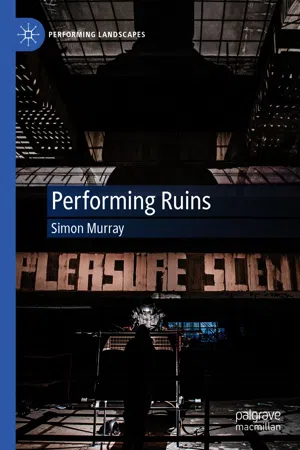
This book engages with the relationship between ruins, dilapidation, and abandonment and cultural events performed within such spaces. Following the author's fieldwork in the UK, Bosnia Herzegovina, Poland, Germany, Greece, and Sicily, chapters describe, investigate, and reflect upon live performance events which have taken place in sites of decay and abandonment. The book's main focus is upon modern economic ruins and ruins of warfare. Each chapter provides several case studies based upon the author's own site visits and interviews with actors, directors, producers, curators, writers, and other artists. The book contextualises these events within the wider framework of Ruin Studies and provides brief summaries of how we might understand the ruin in terms of time, politics, culture, and atmospheres. The book is particularly preoccupied with artists' reasons and motivations for placing performance events in ruined spaces and how these work dramaturgically.
eBook - ePub
Performing Ruins
About this book
Information
Subtopic
Performing Arts© The Author(s) 2020
S. MurrayPerforming RuinsPerforming Landscapeshttps://doi.org/10.1007/978-3-030-40643-1_11. Introduction: Ruining the Project, Subjectivities, Fields and Methods
Keywords
SebaldBeckettForced EntertainmentRuinEthnographyStructure of feelingEuropeIf everything is lost, what is this thing we are left with? Ruins are what we are left with when everything is lost, but this is far from nothing. (Etchells 2018, n.p.)
I come to ruins through the fictions of J.G. Ballard and W.G. Sebald; through the writing and performance practices of Samuel Beckett and Forced Entertainment; through a post-war childhood growing up in the 1950s near London and sometimes playing on bombsites amongst Rosebay Willowherb (fireweed) and Buddleia; through media exposure to the war ruins of Oradour-sur-Glane, Hanoi, Kosovo, Damascus, Sarajevo, Aleppo and many, many more; through the abandoned steelworks, pitheads and engineering works of Tyneside, Teesside, Glasgow and North Lanarkshire; through an abundance of contemporary performance work sited outwith the proscenium arch or black box studio; through growing old(er) and through a sometimes acute sense of a lived body pursuing an inexorable pathway towards ruination. Somewhere in all this, I am propelled, too, by a childhood memory of perplexing clarity from exploring a deserted and derelict farmhouse with my family in rural Sussex when I was about six years old in the early 1950s. We were poking around in the upstairs rooms when my mother announced quite sharply that we should leave at once because this was an ‘unhappy’ house and she felt ill at ease. My mum was not given to psychic outbursts such as this and I can’t remember whether the rest of the family felt similarly disquieted. However, this was certainly my first encounter with a sense of the uncanny (Das Unheimliche), defined loosely as that blend of the familiar and unfamiliar which is experienced as being peculiar, mysterious and unsettling. Much later I was to learn that this was a common trope of described sensations when encountering ruined sites. For Freud, when in the presence of the Acropolis in 1904, the ruin activated a strong sense of the uncanny which in turn provoked repressed schoolboy memories that he attributed to oedipal guilt (Lavery and Gough 2015, p. 2). In his elegant book, The Last of the Light: About Twilight, Peter Davidson evidently encountered similarly abandoned post-war houses. He writes:
In blue and green landscapes, drained of their nature by winter dusk, remote abandoned buildings, shuttered against the season, feel as if they are summoning shadow inhabitants to people them. In those days, there were still empty and partly ruinous houses far into the foggy fields, open to our rash exploration. Almost everywhere still there was the post-war sense of places abandoned, remote even then in what seemed a deserted landscape, one that now seems intensely crowded. (Davidson 2015, p. 92)
What kind of book have I written? One which, I hope, responds sensitively and creatively to the aims and ambitions of the Performing Landscapes series by engaging with the micro and macro landscapes—both material and metaphorical—of ruination, the agencies and ecologies of performance in ruined locations and which helps to trace the nature/culture dynamics of derelict sites. However, it is not quite the book I had planned when I first embarked on its writing. In some crucial respects, I have at least partially ruined the structure and the edifice of the book I originally proposed. This was not a wilful or perverse act of destruction, rather through an emerging sense of (a) the danger of producing a reductive, baggy and sprawling volume largely based on secondary research materials, which tried to cover too much ground and therefore lacked focus and coherence; (b) an awareness that the discoveries you make as a creative venture unfolds often invite the project to follow new and perhaps unanticipated directions, moods and dispositions; and (c) a sharpening clarity around what species of writer I am and what sort of writing I am capable of. The ‘sprawling bagginess’ issue generated an ever-sharper awareness that I had to identify an appropriate set of contours and constraints in the construction of the book. ‘Discoveries’ in this context are always a mixed blessing, inviting appetite and excitement on the one hand and, on the other, a cautionary awareness that unearthing unanticipated new materials, ideas and investigations may encourage too much departure from the core concerns of the original project. The issue of the texture, form and function of my writing became a preoccupation as I began to carve out the chapters you see before you. A perplexing mix of feeling pleased (enough) with the ‘how’ and ‘what’ of my writing and sometimes incapacitating anxieties that what I was producing was inadequate for an academic volume. I return to this below.
In the following chapter I provide an overview of the field of Ruin Studies, but suffice it to say at this juncture—and over the last two decades—these have become popular and crowded meadows indeed. My initial research swiftly revealed that multiple lenses were being applied to ruin and ruination through the often-overlapping perspectives of archaeology, urban studies, literature, cultural geography, social history, visual arts, cultural studies, heritage, photography and film. Curiously, theatre and performance studies seemed conspicuously absent from this busy landscape, an exception being in and around the territories of site-sensitive or site-specific practices where performance (in all its manifestations) has, with increasing enthusiasm, abandoned the habitual limitations of the proscenium arch and the black box studio. Here, examined in more detail later, the work and writings of Mike Pearson (Pearson and Shanks 2001; Pearson 2006, 2010; Pearson and Turner 2018) are particularly salient. Reasons for this attention—a turn or a moment—to ruin, dereliction and abandonment perhaps merit works of sociology or cultural studies in their own right. A significant feature of this turn, manifested particularly in my book, is the preoccupation with contemporary rather than ancient ruins. Less a re-visiting of Tintern Abbey, Machu Picchu, the Roman Agora, Pompeii, the Acropolis and Gothic castles, much more a passionate engagement with the ruins and detritus of warfare and those left—directly or indirectly—in the wake of an endlessly restless capital seeking new markets and enhanced profitability.
Throughout the five-year lifespan of preparing this book, I would regularly reflect on the question of why this particular period (late twentieth/early twenty-first century) has spawned such interest in ruins. Of course, ‘interest’—often a far too benign term—begins, on the one hand, with those people whose homes have been destroyed through warfare, political agency or apparent ‘acts of God’ such as earthquakes, floods, tsunamis and hurricanes and, on the other, with those whose livelihoods have been ruined by the exigencies of economic change and industrial decline. Beyond the painful histories of people who have had such a raw investment in these sites before they were destroyed or abandoned into dereliction, there are significant constituencies of interest whose business it has become to excavate ruins for what they can afford or enable in terms of either intellectual labour or as material sites to be visited as tourist and heritage locations, and as—sometimes illicit—spaces of adventure, trespass, play and love-making. And beyond these typologies of investment in ruins, there are the multiple engagements of artists, filmmakers, photographers and performance makers, and, of course, herein lies the field of enquiry for this project. Linking many of these constituencies are the shape-shifting behaviours and purposes of activism and protest. Here, the ruined site in question can absolutely be the object and subject of dissent and action, or a kind of spatial surrogate for other furies, causes and missions.
Ruination as Structure of Feeling
In an issue of the Performance Research journal On Ruins and Ruination (2015), editors Carl Lavery and Richard Gough respond to their own question as to what explains the recent resurgence of interest in ruins and their meanings. They write:
It is surely no coincidence that the new fascination with ruins should arise at a moment of profound ontological and epistemological uncertainty, a period in which the temporal horizons that defined modernity in the West are under threat as a result of human-induced climate change, economic transformation and ‘crisis’, terrorist attacks, a quasi-permanent state of global warfare, digital technologies and renewed fears about nuclear destruction. (Lavery and Gough 2015, p. 1)
If this is an astute distillation of the temper of the times which frames our current preoccupations with ruin (concrete noun) and ruination (abstract noun), it is not a formulation which only applies to academic and intellectual pursuits. Much more than this, I take Lavery and Gough’s words to suggest a pervasive ‘structure of feeling’1 (Williams 1997) produced by many strata and interests within Western societies. Although, of course, it was never articulated as ‘ontological and epistemological uncertainty’, time and again during my fieldwork excursions I would hear artists, performers, activists or curators express a mood or experience of ruination beyond, or separate from, the material ruin in question. Often, I encountered an elision between ruin (concrete noun), ruin (verb) and ruination (abstract noun). The material ruin, it seemed, was often difficult to discuss or understand without slipping into wider feelings and states of apprehension and uneasiness about economic decay, political disillusion and a tangible waning of optimism. In my conversations with Phil Smith,2 he talked about ‘living through a sense of end times’ and the ‘beginning of the end of post-war optimism’ (Smith 2018), and these feelings were further contextualised by the all-encompassing frame of living through the Anthropocene and environmental catastrophe. For Smith, however, and like others I encountered, ruins are ‘not ends when stories have ended, but dynamic sites, full of layers, all talking to each other, always agendive’. He went on, ‘enter a ruin as if you were meeting it, expect ruins to be active, rude, pulling rank, not speaking’ (Ibid). These propositions are revisited later in the book, particularly in relation to Chap. 5 on the St Peter’s/NVA (nacionale vitae activa) Seminary project.
For Raymond Williams, ‘structure of feeling’ offers a form of thinking which invites an interweaving relationship between the social and the personal, the structural and the experiential, and the macro perspective with the micro. Cultural theorist, Stuart Hall, offers a complementary construct with which one could frame this sense of ruination. In the context of this book, Hall, reformulating both Gramscian notions of hegemony and Williams’ ‘structure of feeling’ might have put it something like this: ‘what is the “present conjuncture” that drives us to become acutely sensitised to ruin and ruination?’ In a conversation with political activist and cultural geographer, Doreen Massey, Hall says:
It’s partly about periodization. A conjuncture is a period during which the different social, political, economic and ideological contradictions that are at work in society come together to give it a specific and distinctive shape. (Hall and Massey 2010, p. 57)
The ‘present conjuncture’ seems to provide us with a diagnostic set of tools with which to identify and grapple with current calamities and discontents. The term and mode of thinking, or analysis, not only offers up ruination as a productive lens to examine the material and social world, it also obliges us, in a way that has perhaps never been the case in other epochs, to engage with the force fields of ecology and environmental catastrophe. Antonio Gramsci’s description of the 1930s might be appropriate for Hall’s ‘present conjuncture’ when he wrote, ‘the crisis consists precisely in the fact that the old is dying and the new cannot be born; in this interregnum a great variety of morbid symptoms appear’ (Gramsci 1971, pp. 275–6). A mood echoed and reconstituted by performance maker, Tim Etchells3 quoted at the beginning of this chapter when, in a programme note for an installation, he writes that ‘Ruins are what we are left with when everything is lost, but this is far from nothing’ (Etchells 2018, n.p.). It is the territory of the ‘far from nothing’ which this book occupies.
In addition to the idiosyncratic lineage which I have with ruins—articulated in the opening paragraph of this chapter—I have also found myself drawn strongly to the thoughts articulated above by the likes of Lavery, Gough, Smith and Etchells, who together identify a structure of feeling where a sense of ruination is palpable. For myself, and these performance makers, artists and writers, coming to terms with and understanding ruins requires not only a perpetual awareness of context but also an approach which does not presume a single angle of incidence into the ruin—an approach which necessarily embraces the instability (literally and figuratively) of the ruin, which re...
Table of contents
- Cover
- Front Matter
- 1. Introduction: Ruining the Project, Subjectivities, Fields and Methods
- 2. Ruins in Context: Context in Ruins
- 3. Performing the Antiquary: Classical Ruins in the Greek Imaginary
- 4. Nature’s Ruins: Gibellina–A Dream in Progress
- 5. Dissonance and Contestation: Ruining Heritage and Its Alternatives
- 6. Legacies of War: Performing Balkan Ruins
- 7. Ruins of Capital
- 8. After Communism and the Cold War: A Ruined Inheritance
- 9. Conclusion: Ruining the Ruin or Pausing at a Partial View
- Back Matter
Trusted by 375,005 students
Access to over 1.5 million titles for a fair monthly price.
Study more efficiently using our study tools.
Frequently asked questions
Yes, you can cancel anytime from the Subscription tab in your account settings on the Perlego website. Your subscription will stay active until the end of your current billing period. Learn how to cancel your subscription
No, books cannot be downloaded as external files, such as PDFs, for use outside of Perlego. However, you can download books within the Perlego app for offline reading on mobile or tablet. Learn how to download books offline
Perlego offers two plans: Essential and Complete
- Essential is ideal for learners and professionals who enjoy exploring a wide range of subjects. Access the Essential Library with 800,000+ trusted titles and best-sellers across business, personal growth, and the humanities. Includes unlimited reading time and Standard Read Aloud voice.
- Complete: Perfect for advanced learners and researchers needing full, unrestricted access. Unlock 1.5M+ books across hundreds of subjects, including academic and specialized titles. The Complete Plan also includes advanced features like Premium Read Aloud and Research Assistant.
We are an online textbook subscription service, where you can get access to an entire online library for less than the price of a single book per month. With over 1.5 million books across 990+ topics, we’ve got you covered! Learn about our mission
Look out for the read-aloud symbol on your next book to see if you can listen to it. The read-aloud tool reads text aloud for you, highlighting the text as it is being read. You can pause it, speed it up and slow it down. Learn more about Read Aloud
Yes! You can use the Perlego app on both iOS and Android devices to read anytime, anywhere — even offline. Perfect for commutes or when you’re on the go.
Please note we cannot support devices running on iOS 13 and Android 7 or earlier. Learn more about using the app
Please note we cannot support devices running on iOS 13 and Android 7 or earlier. Learn more about using the app
Yes, you can access Performing Ruins by Simon Murray in PDF and/or ePUB format, as well as other popular books in Media & Performing Arts & Performing Arts. We have over 1.5 million books available in our catalogue for you to explore.