This book discusses current issues in literacy teacher education and illuminates the complexity of supporting self-efficacious educators to teach language and literacy in the twenty-first century classroom. In three sections, chapter authors first detail how teacher education programs can be revamped to include content and methods to inspire self-efficacy in pre-service teachers, then reimagine how teacher candidates can be set up for success toward obtaining this. The final section encourages readers to ruminate on the interplay among teacher candidates as they transition into practice and work to have both self- and collective- efficacy.
eBook - ePub
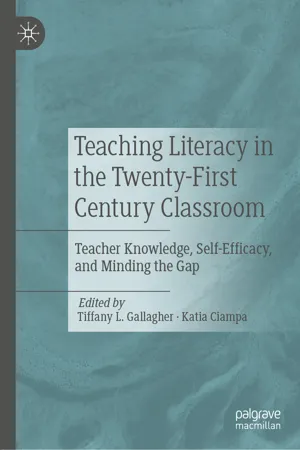
Teaching Literacy in the Twenty-First Century Classroom
Teacher Knowledge, Self-Efficacy, and Minding the Gap
- English
- ePUB (mobile friendly)
- Available on iOS & Android
eBook - ePub
Teaching Literacy in the Twenty-First Century Classroom
Teacher Knowledge, Self-Efficacy, and Minding the Gap
About this book
Information
Topic
EducationSubtopic
Educational Psychology© The Author(s) 2020
T. L. Gallagher, K. Ciampa (eds.)Teaching Literacy in the Twenty-First Century Classroomhttps://doi.org/10.1007/978-3-030-47821-6_11. Introduction
Tiffany L. Gallagher1 and Katia Ciampa2
(1)
Educational Studies, Brock University, St. Catharines, ON, Canada
(2)
Literacy Education, Widener University, Chester, PA, USA
If I have the belief that I can do it, I shall surely acquire the capacity to do it even if I may not have it at the beginning. —Mahatma Gandhi (1962)
Isn’t becoming literate all about the student’s skills and ability to master a complex process of decoding, making meaning, and producing text? So, why is this book about teachers’ literacy knowledge and self-efficacy so important? There is an inexplicable connection among what the teacher knows about teaching literacy, how confident and affirmed the teacher feels about teaching literacy, and how well the students are performing. Therefore, in this era of heightened educational accountability to ensure that all learners are literate, the relatively recent pursuit of understanding the perspectives of teacher candidates’ and teachers’ self-efficacy and beliefs to teach literacy, as well as the collective efficacy to impact literacy achievement, is essential.
Teachers are a critical factor in K-12 students’ literacy performance. The quality of a teacher’s instruction has the greatest effect on students’ literacy achievement outcomes and is critical to their development of essential literacy skills (Moats, 2014). All children have a right to well-prepared teachers who provide literacy instruction that meets their individual needs (International Literacy Association & National Council of Teachers of English, 2017). According to the 2015 Programme for International Student Assessment (PISA) results in reading performance, on average across the Organisation for Economic Co-operation and Development (OECD) countries, students’ mean reading proficiency has not improved since 2000. Among the 42 countries/economies with valid data in at least five rounds of PISA, 12 saw an improving trend in performance, six observed a declining trend, and the remaining 24 experienced a non-significant improvement or deterioration in performance. Furthermore, on average across OECD countries with comparable results across all six PISA assessments since 2000, students’ mean reading proficiency has remained flat. Demand for reading skills and significant investment in education have not (yet) been followed by improvements in students’ results, on average across countries. This issue is exacerbated by aging policy documents that inform literacy curricula. As both the twenty-first-century literacy demands within our society and the diverse needs of students increases, it is critical that our teacher candidates are effectively prepared and our in-service teachers are professionally supported to be highly effective and efficacious literacy teachers. In accordance with the Clinical Practice Commission (American Association of Colleges for Teacher Education, 2018, p. 12), teacher candidates are “individuals enrolled in teacher preparation programs.”
Since colleges and universities prepare 80% of today’s teachers, increased attention to the formal training of teacher candidates in the area of literacy is crucial (National Center for Educational Statistics, 2013). Accordingly, examining the quality and content of teacher preparation programs that prepare literacy teachers is an increasingly relevant area of study. It is important to note, however, that content knowledge acquisition and a college degree does not necessarily equate to a highly effective literacy teacher who has the requisite knowledge and skills to perform a task successfully (Bandura, 1986). What is often overlooked is the interaction between teacher candidates’ literacy content knowledge and their beliefs about literacy instruction. There is a dearth of research that examines teacher candidates’ self-efficacy beliefs, especially in the specific area of literacy instruction (e.g., Clark, 2016; Helfrich & Clark, 2016; Leader-Janssen & Rankin-Erickson, 2013). Furthermore, previous studies are single-country or single-program studies, most of which have been carried out in the USA (e.g., Clark, 2016; Helfrich & Clark, 2016). Complementing this, there needs to be an ongoing examination of teachers’ professional learning to ensure that practicing teachers are supported in delivering evidenced-based literacy instruction. Taken together, this is the integral knowledge that teachers need to continue to build into their practice.
This book turns the spotlight on a less than the concrete aspect of teacher candidates’ and teachers’ practice: their self-efficacy or confidence in their effect to promote students’ literacy learning. “Self-efficacy is the belief in one’s capabilities to organize and execute the sources of action required to manage prospective situations” (Bandura, 1986, p. 21). Unlike pedagogical or content knowledge for language instruction that presents as tangible, perhaps even quantifiable, self-efficacy is a malleable construct that ironically has the greatest impact of all factors (according to effect sizes) on student learning (Hattie, 2009). This is what is both compelling and urgent to appreciate in the study of teacher education.
Teachers’ sense of efficacy has proven to be a powerful construct, related to teachers’ motivation and behavior in the classroom as well as contributing to important student outcomes. Next to affecting the classroom quality, teacher self-efficacy has been found to exert influence over students’ academic achievement, motivation, as well as their self-efficacy (Zee & Koomen, 2016). Positive teacher self-efficacy beliefs have been demonstrated to result in teachers’ improved psychological well-being in terms of higher levels of job satisfaction and commitment and lower levels of stress and burnout (Aloe, Amo, & Shanahan, 2014). Teacher efficacy is often asserted as a situation-specific and even subject-specific construct (Bandura, 1986; Cakiroglu, 2008; Enochs, Smith, & Huinker, 2000). Given that literacy instruction is a multifaceted and important responsibility (Moats, 2000) and arguably, all teachers support students’ literacy skills, it is not surprising that to be effective in literacy instruction, teachers must hold a sense of confidence in their own knowledge and ability to do so (Tschannen-Moran & Johnson, 2011).
There is power in the confidence that one holds to make a positive difference. This strength and optimism is what inherently buoys teachers. Teachers are in the profession of making a difference in the lives of their learners. This is often one of the reasons that beginning teachers cite as guiding their decision to pursue the profession of education. With reference to the quote above from Mahatma Gandhi (1962), the belief and determination to be the best teacher possible will guide educators through the early stages of learning their craft and challenges they incur along the way. At all career stages, teachers need to reflect on their self-efficacy and intentions to optimistically pursue how to sustain it.
Research has examined the effects of efficacy beliefs on teaching and learning in general as well as in selected subject areas. Yet, little research into teacher candidates’ and teachers’ literacy self-efficacy and collective efficacy beliefs for literacy instruction has been published. Moreover, there is little empirical evidence about how to cultivate stronger teacher self-efficacy beliefs for literacy instruction. This timely and significant edited chapter book will explore potential antecedents of teacher candidates’ and teachers’ self-efficacy beliefs in the realm of twenty-first-century literacy instruction that is culturally responsive and multimodal in nature. The chapter authors provide suggestions for the design of teacher preparation courses and programs, as well as in-service professional development for literacy instruction. This book also includes chapters on revised and validated measures of teacher candidates’ and teachers’ sense of efficacy for literacy instruction that reflect the changing definition of literacy in the twenty-first century. Herein, the chapter authors provide other researchers, teacher educators, teachers, professional learning facilitators, and school leaders with discussions about current issues in literacy teacher education that illuminate the complexity of supporting self-efficacious teachers to teach language and literacy in the 21st classroom. As well, chapter authors spotlight the transition between teacher candidates’ and teachers’ practice, the vulnerability of literacy teachers’ self-efficacy, and the interplay between teachers’ individual and collective self-efficacy for literacy instruction.
Researchers Answer the Call
We sent out a call to contemporary researchers to glean the perspectives of international scholars from the United Kingdom, Australia, Canada, Columbia, and USA who are using a range of methodological and theoretical approaches to study literacy teacher self-efficacy and beliefs in twenty-first-century literacy instruction. We noted that this volume would aim to fill the gaps in the literature by providing further understandings on the following aspects, but not limited to:
- Teacher candidates’ and teachers’ self-efficacy and collective efficacy for literacy instruction
- The connection between teacher candidates’ and teachers’ content knowledge in: reading, writing, multimodal literacies, diversity (culturally responsive pedagogy), and oral communication.
This co-edited text includes a collection of writings (e.g., literature reviews, case studies, empirical studies) that shed light on the self-efficacy and beliefs that teacher candidates and teachers hold with respect to teaching English language arts and literacy in the twenty-first century. There is a selection of chapters in section “Structure of the Sections” dedicated to practical applications to engage teacher candidates and teachers in their own professional learning. Most anticipated is the discussion on teachers’ collective efficacy and its impact on literacy teaching and learning. We believe that this text provides readers with a contemporary and comprehensive understanding of this topic at an international level. It is worth noting that while chapter authors represent only a cross-section of international scholars, they provide fulsome background on the teacher candidates’ and in-service teachers’ realities related to teaching literacy to diverse populations. This is discussed at length by the editors in the final chapter, “Concluding Thoughts.”
Structure of the Sections
This text is structured into three sections that buttress each other. Part I, Knowledge and Measuring of Literacy Teachers’ Self-Efficacy, provides four chapters that deal with the tension of what is necessary knowledge for teachers to hold to teach English language arts and literacy and how might we evaluate teachers’ perceptions and beliefs of their knowledge and skills to do so. This is not an exact science. Over the past few decades, tools have been developed in education broadly (e.g., Tschannen-Moran, Woolfolk Hoy, & Hoy, 1998), the...
Table of contents
- Cover
- Front Matter
- 1. Introduction
- Part I. Knowledge and Measuring of Literacy Teachers’ Self-Efficacy
- Part II. Practices to Build Literacy Teachers’ Self-Efficacy
- Part III. In-Service Literacy Teachers’ and Collective Efficacy
- Back Matter
Trusted by 375,005 students
Access to over 1.5 million titles for a fair monthly price.
Study more efficiently using our study tools.
Frequently asked questions
Yes, you can cancel anytime from the Subscription tab in your account settings on the Perlego website. Your subscription will stay active until the end of your current billing period. Learn how to cancel your subscription
No, books cannot be downloaded as external files, such as PDFs, for use outside of Perlego. However, you can download books within the Perlego app for offline reading on mobile or tablet. Learn how to download books offline
Perlego offers two plans: Essential and Complete
- Essential is ideal for learners and professionals who enjoy exploring a wide range of subjects. Access the Essential Library with 800,000+ trusted titles and best-sellers across business, personal growth, and the humanities. Includes unlimited reading time and Standard Read Aloud voice.
- Complete: Perfect for advanced learners and researchers needing full, unrestricted access. Unlock 1.5M+ books across hundreds of subjects, including academic and specialized titles. The Complete Plan also includes advanced features like Premium Read Aloud and Research Assistant.
We are an online textbook subscription service, where you can get access to an entire online library for less than the price of a single book per month. With over 1.5 million books across 990+ topics, we’ve got you covered! Learn about our mission
Look out for the read-aloud symbol on your next book to see if you can listen to it. The read-aloud tool reads text aloud for you, highlighting the text as it is being read. You can pause it, speed it up and slow it down. Learn more about Read Aloud
Yes! You can use the Perlego app on both iOS and Android devices to read anytime, anywhere — even offline. Perfect for commutes or when you’re on the go.
Please note we cannot support devices running on iOS 13 and Android 7 or earlier. Learn more about using the app
Please note we cannot support devices running on iOS 13 and Android 7 or earlier. Learn more about using the app
Yes, you can access Teaching Literacy in the Twenty-First Century Classroom by Tiffany L. Gallagher, Katia Ciampa, Tiffany L. Gallagher,Katia Ciampa in PDF and/or ePUB format, as well as other popular books in Education & Educational Psychology. We have over 1.5 million books available in our catalogue for you to explore.