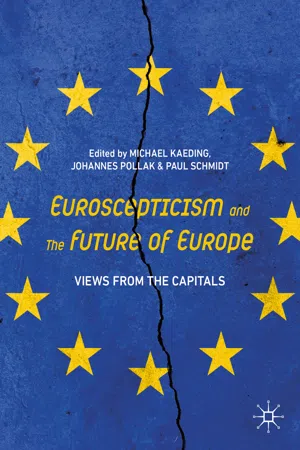
Euroscepticism and the Future of Europe
eBook - ePub

Euroscepticism and the Future of Europe

Views from the Capitals

  1. English
  2. ePUB (mobile friendly)
  3. Available on iOS & Android
eBook - ePub

Euroscepticism and the Future of Europe

Views from the Capitals

About this book

"The European Parliament elections in May 2019 did not bring about the rise of populism in Europe that had been feared by many. Instead, while populism was contained, a broad pro-European majority emerged that today carries the new European Commission with its ambitious green, digital and geopolitical agenda.  However, Euroscepticism remains a significant force to be reckoned with in national and EU-policy making. The present book offers a better understanding of the different types of Euroscepticism that exist across Europe. It also shows that Euroscepticism is best addressed by understanding well the often valid concerns that are at the origins of Eurosceptic forces. If this is done in time, Euroscepticism is not something to be afraid of. It is part of a vibrant European democracy that is resilient enough to embrace those who criticise the reality of the European project with good arguments; and that stands ready to develop and improve day by day to become a more perfect Union."
- Martin Selmayr, Head of the European Commission's representation in Austria

"This book comes at the right time. European integration seems more contested than ever, but is it really? This book answers this question by probing into 40 shades of Euroscepticism, within and beyond the EU Member States. It is a must read for academics and practitioners alike."
- Christine Neuhold, University of Maastricht, The Netherlands

"With this book, the authors offer readers of European politics a treasure trove, with valuable insights into the variety of populist and nationalist forces that oppose mainstream European integration. Faced with such a jumble of eurosceptic parties pursuing narrow and in many cases reactionary agendas, the need for proper federal political parties becomes self-evident. Only then will the diverse interests and aspirations of citizens be given realistic expression at the EU level."
- Andrew Duff, President, The Spinelli Group

This book sheds light on how the increasing prominence of Eurosceptic and nationalist parties is having an impact on the thinking of mainstream parties, their representatives in the European Parliament, and the future of Europe. It is timed to coincide with the strategic vision of Council, Commission, and Parliament, as well as the next phase of Brexit negotiations. The book provides perspectives on the future of the European project from authors in all the EU Member States, as well as neighboring European countries and potential applicant nations. Furthermore, it includes a Foreword by the Vice-president of the European Parliament.

With many Eurosceptic parties now in national government, or winning European elections and thus exerting influence over the national debate, this book maps and analyses the nature and impact of Euroscepticism—and new nationalist tendencies—in the different party systems of Europe.

As national political parties are the gatekeepers of the process of political representation, they play a pivotal role in mobilizing civil society and in setting the political agenda. They shape politics at a national level, but also determine the way in which Europe plays out—or does not play out—as a political issue. Thus, it is from the national capitals that the very future of Europe emerges.

Trusted by 375,005 students

Access to over 1.5 million titles for a fair monthly price.

Study more efficiently using our study tools.

Information

Year
2020
Print ISBN
9783030412715
eBook ISBN
9783030412722
Editors
Michael Kaeding, Johannes Pollak and Paul Schmidt

Euroscepticism and the Future of Europe

Views from the Capitals

1st ed. 2021
Editors
Michael Kaeding
University of Duisburg-Essen, Duisburg, Germany
Johannes Pollak
Webster Vienna Private University, Vienna, Austria
Paul Schmidt
Austrian Society for European Politics (ÖGfE), Vienna, Austria
ISBN 978-3-030-41271-5e-ISBN 978-3-030-41272-2
https://doi.org/10.1007/978-3-030-41272-2
The European Commission’s support for the production of this publication does not constitute an endorsement of the contents, which reflect the views only of the authors, and the Commission cannot be held responsible for any use which may be made of the information contained therein.
© The Editor(s) (if applicable) and The Author(s), under exclusive license to Springer Nature Switzerland AG 2021
This work is subject to copyright. All rights are solely and exclusively licensed by the Publisher, whether the whole or part of the material is concerned, specifically the rights of translation, reprinting, reuse of illustrations, recitation, broadcasting, reproduction on microfilms or in any other physical way, and transmission or information storage and retrieval, electronic adaptation, computer software, or by similar or dissimilar methodology now known or hereafter developed.
The use of general descriptive names, registered names, trademarks, service marks, etc. in this publication does not imply, even in the absence of a specific statement, that such names are exempt from the relevant protective laws and regulations and therefore free for general use.
The publisher, the authors and the editors are safe to assume that the advice and information in this book are believed to be true and accurate at the date of publication. Neither the publisher nor the authors or the editors give a warranty, expressed or implied, with respect to the material contained herein or for any errors or omissions that may have been made. The publisher remains neutral with regard to jurisdictional claims in published maps and institutional affiliations.
Cover illustration: Zbitnev
This Palgrave Macmillan imprint is published by the registered company Springer Nature Switzerland AG.
The registered company address is: Gewerbestrasse 11, 6330 Cham, Switzerland
Foreword
In May 2019, over 200 million Europeans elected 751 Members of European Parliament . With more than 50 percent , the turnout was the highest it has ever been in the past 25 years and represents an increase of 8.3 percentage points from the previous election in 2014. To illustrate, more citizens were entitled to vote at the European elections than the United States has inhabitants as a whole.
In contrast to certain predictions made by political commentators and spectators, the election result gives a clear pro-European mandate for more European engagement, more European solutions and more cooperation on a European level. Citizens voted because they want to see Europe taking action on a range of crucial issues from climate, jobs and the economy, to migration , security and defense.
Today, more citizens approve of the European Union than in previous decades. This is a direct result of multiple advantages, which have often become a matter of course on the one hand, such as the ability to easily work or study in another EU country. Political developments such as Brexit have tested and ultimately strengthened citizens commitment to the European Union. With the Brexit process slowly ending, the imperative lessons to be learned from this is that politics must be centered on compromise and cooperation instead of unconditional enforcement of political opinion or will. However, at the same time the Union also faces more challenges.
When looking beyond the borders , it becomes evident that peace, freedom, democracy and prosperity cannot be taken for granted. Even in Europe, war is still a daily occurrence when looking to Eastern Ukraine . In some EU Member states, liberal, parliamentary democracy is questioned and fundamental rights such as the rule of law are trampled on. Thirty years after the end of the unjust regimes in Eastern Europe and the fall of the Iron Curtain and the Berlin Wall, many citizens are concerned that the rule of law and liberal democracy are endangered.
There is one major lesson from the fall of communism. Regimes, which do not respect the rule of law , human and fundamental rights, can never ensure trust , freedom and fairness in a society. A country that does not have an independent judiciary that suppresses civil society and media freedom, and denies its citizens a fair living environment will fail to establish a relationship of trust .
A changing world also leads to rising pressures from inside and outside the Union. On the one hand, nationalists and populists seek to weaken or partially destroy the EU. On the other, world leaders such as President Trump challenge the global order by withdrawing from international treaties, expanding protectionism and questioning multilateralism. To withstand these developments, we need to make Europe stronger, more capable and more efficient.
We have to deal with populist and nationalist forces through substantial debates and practice oriented approaches in order to expose their dangerous ignorance.
They claim that taking back power from Brussels to the capitals through a Europe of Nations will subsequently solve all issues. Equally, they assert that Europe can be sustained with a halved or even abolished European Parliament . However, the terrifying reality behind these claims is a weakened Europe of uncoordinated small-scale states. More isolation, more nationalism , more demarcation and less cooperation and cohesion at European level. This would lead to economic decline and in particular the decline of the middle class, as well as the global insignificance of Europe. Europe is too valuable to be torn apart by populist and nationalist forces. On the contrary, we must work together to strengthen the Union and intensify cooperation. Together we must tackle issues like the fight against tax havens and money laundering, security policy , climate and environmental protection, investments, research and development as well as the competitiveness of small and medium-sized enterprises.
Thankfully, the tactics of populists, who play on feelings of insecurity, fear and blame, did not succeed at a European level during the 2019 elections . The majority of citizens throughout Europe realized that falling into populist traps would be contrary to the reality of what they were really voting for. To fulfil the expectations and deliver on the promises made, we have to develop the democratic decision-making mechanisms further. Only then, we will be able to improve efficiency, build our capacity to find solutions and take action on the issues most important to citizens.
This means that we must abolish the practice of unanimous voting in the Council with regard to certain decisions taken by Member States. This practice leads to unnecessary blockades, blackmail and the total incapacity of the EU to act even when action is urgently needed. We fare much better wherever the co-decision procedure applies, and the European Parliament and the Council are on equal footing in terms of deciding on EU legislation. There is a stark difference between policy areas where co-decision applies and those where the EU is paralysed by unanimous decisions to be taken by all Member States .
This means that instead of the unanimity of Member States, there must be majority decisions in all policy areas. A simple majority in the European Parliament and a “double majority” of the Member States. Meaning a majority of Member States representing the majority of the European population. This would be more democratic, more transparent and more efficient.
The idea of Europe will only have a bright future if the EU-citizens are part of it. Today, hundreds of millions of citizens feel at home across national borders . We live in the largest shared economic area in the world driven by the freedom of movement, the free movement of goods, services and capital. Let us allow our citizens to be a stronger part of the political process on the European level.
The European Parliament is a reflection of European society. Trust , fairness, freedom, prosperity and cooperation mutually exclude populism and nationalism and can therefore not coexist within the same train of political thought an argumentation. That is why we need a Conference on the future of Europe . We need a strong partnership with the EU citizen’s apart from party politics. Let us put the future of Europe and the role of the European Union in the world above party lines. The future needs dialogue, European awareness and joint action.
Othmar Karas
Why This Book?
Michael Kaeding
Johannes Pollak
Paul Schmidt
Europeans no longer tacitly approve of European integration because of its positive effects on w...

Table of contents

  1. Cover
  2. Front Matter
  3. Albania: Will the EU’s Ambiguity Lead to Euroscepticism?
  4. Austria: Taking a Walk on the Wild Side
  5. Belgium: Breaking the Consensus? Eurosceptic Parties
  6. Bosnia and Herzegovina: Ethnopolitics and Hopeful Euroscepticism—No Light at the End of the European Tunnel?
  7. Bulgaria: Creeping EU-Scepticism—The Tacit Consent that Fuels Populism
  8. Croatia: The Government Should Take Citizens Seriously
  9. Cyprus: A Pro-European Attitude, but Scepticism Still Holds Strong
  10. Czechia: Who Is the Most Eurosceptic of Them All? The Eurosceptic Race to the Bottom
  11. Denmark: Ambivalence Towards the EU—From Foot-Dragging to Pacesetters?
  12. Estonia: Challenges with the Popularity of Right-Wing Radicalism
  13. Finland: A Meaningful EU Debate Is Needed to Regain Ground from Populist Framing
  14. France: When Euroscepticism Becomes the Main Credo of the Opposition
  15. Germany: Eurosceptics and the Illusion of an Alternative
  16. Greece: The Remarkable Defeat of Euroscepticism
  17. Hungary: Euroscepticism and Nationalism
  18. Iceland: Hard-Line Eurosceptics Clash with Eurosceptics
  19. Ireland: ‘A Rising Tide Lifts All Boats’—A Unique Situation on Countering Euroscepticism
  20. Italy: Has Salvini Saved the Country from Himself? Not Yet
  21. Kosovo: Moonwalking Towards the European Union
  22. Latvia: Euroscepticism—Between Reason and Treason
  23. Liechtenstein: Euroscepticism Yes and No!
  24. Lithuania: Euroscepticism—Present on the Margins
  25. Luxembourg: Make Europe Work Better in the Greater Regions
  26. Malta: Bucking the Trend—How Malta Turned its Back on Euroscepticism
  27. Montenegro: A Great Bargain Between the European Union Optimism and Real Euroscepticism
  28. North Macedonia: The Name in Exchange for European Union Membership?
  29. Norway: Outside, But 

  30. Poland: Economic Enthusiasts, Value Adversaries
  31. Portugal: Something Old, Something New and Everything Blue
  32. Romania: Euroscepticism—Contamination of the Mainstream Parties, Limited Support Among the Citizens
  33. Serbia: Our Greatest Fear—An Empty Country, Pawn in the Hands of Great Powers on the “Periphery of the Periphery”
  34. Slovakia: Euroscepticism as a Changing Notion in Electoral Campaigns
  35. Slovenia: Extremes Are Attractive Only to the Media
  36. Spain: The Risk of Too High Expectations on the EU’s Role as a Problem Solver
  37. Sweden: Battling for Values
  38. Switzerland: A Vital Relationship in the Stranglehold of Euroscepticism
  39. The Netherlands: Playing with Fire? Dutch Political Parties Between Reluctant and Pragmatic Pro-Europeanism
  40. Turkey: A Vicious Cycle of Euroscepticism?
  41. UK: Brexit—The Car That Keeps on Crashing
  42. Ukraine: The Progress of (Euro) Populism in Postmodern Age
  43. Back Matter

Frequently asked questions

Yes, you can cancel anytime from the Subscription tab in your account settings on the Perlego website. Your subscription will stay active until the end of your current billing period. Learn how to cancel your subscription
No, books cannot be downloaded as external files, such as PDFs, for use outside of Perlego. However, you can download books within the Perlego app for offline reading on mobile or tablet. Learn how to download books offline
Perlego offers two plans: Essential and Complete
  • Essential is ideal for learners and professionals who enjoy exploring a wide range of subjects. Access the Essential Library with 800,000+ trusted titles and best-sellers across business, personal growth, and the humanities. Includes unlimited reading time and Standard Read Aloud voice.
  • Complete: Perfect for advanced learners and researchers needing full, unrestricted access. Unlock 1.5M+ books across hundreds of subjects, including academic and specialized titles. The Complete Plan also includes advanced features like Premium Read Aloud and Research Assistant.
Both plans are available with monthly, semester, or annual billing cycles.
We are an online textbook subscription service, where you can get access to an entire online library for less than the price of a single book per month. With over 1.5 million books across 990+ topics, we’ve got you covered! Learn about our mission
Look out for the read-aloud symbol on your next book to see if you can listen to it. The read-aloud tool reads text aloud for you, highlighting the text as it is being read. You can pause it, speed it up and slow it down. Learn more about Read Aloud
Yes! You can use the Perlego app on both iOS and Android devices to read anytime, anywhere — even offline. Perfect for commutes or when you’re on the go.
Please note we cannot support devices running on iOS 13 and Android 7 or earlier. Learn more about using the app
Yes, you can access Euroscepticism and the Future of Europe by Michael Kaeding, Johannes Pollak, Paul Schmidt, Michael Kaeding,Johannes Pollak,Paul Schmidt in PDF and/or ePUB format, as well as other popular books in Politics & International Relations & European Politics. We have over 1.5 million books available in our catalogue for you to explore.