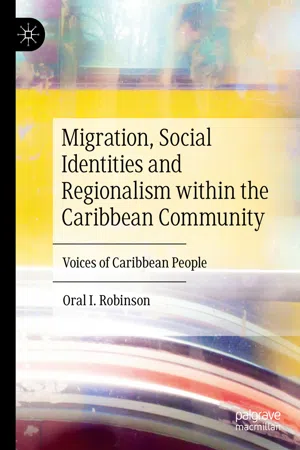
eBook - ePub
Migration, Social Identities and Regionalism within the Caribbean Community
Voices of Caribbean People
- English
- ePUB (mobile friendly)
- Available on iOS & Android
eBook - ePub
Migration, Social Identities and Regionalism within the Caribbean Community
Voices of Caribbean People
About this book
This book offers a theoretical and substantive analysis of intra-Caribbean migration, perception of regionalism, and the construction of identities among Caribbean nationals. Through a multi-methods study in the 15 member countries of the Caribbean community, Oral Robinson explores how intra-Caribbean migrants experience living within different member countries, and how these experiences and perceptions influence ideas about citizenship, belonging, and identity. Responding directly to the lack of scholarship on how Caribbean nationals feel about integration and/or free movement within their own countries and other Caribbean countries, this volume attempts to understand Caribbean societies historically, theoretically, and methodologically; proposes bases of social identities in the Caribbean; and examines how intra-Caribbean migrants negotiate their identities and narrate their lived experiences as intra-Caribbean migrants. The book offers policy solutions based upon its findings, reconciling practice, theory, and migration policies in the Caribbean.
Information
Topic
Scienze socialiSubtopic
PoliticaPart IUnderstanding Caribbean Societies Historically, Theoretically and Methodologically
© The Author(s) 2020
O. I. RobinsonMigration, Social Identities and Regionalism within the Caribbean Communityhttps://doi.org/10.1007/978-3-030-47745-5_11. Introduction: The Caribbean Community (CARICOM)—Integration, Intra-Regional Migration and Identities
Oral I. Robinson1
(1)
Department of Sociology, University of British Columbia, Vancouver, Canada
Keywords
Regional identityIntegrationIntra-regional migrationCARICOM1.1 Regional Integration: Rationales for Deepening and Widening
The Caribbean Community (CARICOM),1 whose objectives are to integrate the economies of its 15 member states and pursue functional cooperation and foreign policy coordination, has recently been deepening relations among its members while simultaneously expanding membership to countries in Latin America and the non-English-speaking Caribbean (Lewis, Gilbert-Roberts, & Byron, 2017). There are two prominent reasons for this: (a) integration is seen as a strategic response to the changing global political economy and (b) there are widespread beliefs among political leaders that there are cultural, social and historic similarities that bind the region with a common identity. Regional integration is seen as a natural outcome given these circumstances.
The changing international political economy since the 1980s is of concern to CARICOM because its members comprise a third of countries recognized by the United Nations as Small Island Developing States (SIDS). The international political economy has undergone significant change with the acceleration of globalization, neoliberalization and the shift in power from nation-states to transnational corporations and other market forces. These changes have made integration an attractive remedy to counteract the negative impacts from changing economic tides for SIDS. From this view, Caribbean countries individually (and collectively) are believed to have deficiencies or vulnerabilities which would weaken their already small positions in the global marketplace. These vulnerabilities include:
There is a general consensus that these vulnerabilities can be overcome through the deepening of integration, particularly, the realization of a Single Market and Economy (CSME). Deepening is expected to help member countries increase their global influence, benefit from economies of scale, promote social cohesion internally and ultimately remain viable in the global sphere (Downes, 2008; Hall & Chuck-A-Sang, 2012; Lewis, 2016; Rosewarne, 2010; Strachan & Vigilance, 2011; UWI Centre for Environment & Development, 2002). Similarly, the widening project is believed to give the region greater leverage in global affairs and expand economies through intra-regional trade and is thought of as a natural outgrowth of a Pan-Caribbean identity (Girvan, 2017; Lewis et al., 2017). This book is concerned with the deepening project, particularly, through the CSME and its impact on intra-regional migration and identity formation.Small sizes, geographic dispersion (and, in many cases, remoteness); vulnerability to natural disasters; the fragility of their ecosystems; their isolation from markets and their limited internal markets; migration (particularly of highly skilled citizens); their limited commodities and consequent dependence on imports; and their limited ability to reap the benefits of economies of scale. (UWI Centre for Environment & Development, 2002, p. 1)
1.2 A Brief History of Integration in the Caribbean
The deepening of relations among Caribbean countries is not unique. Regional integration and the formation of trading blocs2 have become common development strategies in the aftermath of the Second World War, and in particular, following the successes of the European Economic Community (now the European Union (EU)).3 CARICOM’s integration has progressed steadily over four phases (Bishop & Payne, 2010). The first phase can be traced back to decolonization and federationalism in the 1950s4 when the British colonial government helped establish a single federated state to which it wished to relinquish political control. This government, the West Indies Federation, only lasted 4 years (1958–1962) as it was seen as an instrument of metropolitan control (Garcia, 2008, p. 58). In addition, mistrust and infighting among members and the desire for national independence in some territories contributed to its disintegration (Bishop & Payne, 2010; Boxill, 1997; Lewis, 2016).
While the first attempt at integration was both political and economic, the second—the Caribbean Free Trade Association (CARIFTA)—was primarily economic. This lasted from 1965 to 1973. The primary objective of CARIFTA was to facilitate free trade and economic advancement in the region. However, the desire to facilitate greater cooperation on political and social issues led to the third phase: the Caribbean Community and Common Market (CARICOM). CARICOM replaced CARIFTA in 1973 with the signing of the Treaty of Chaguaramas. According to Boxill (1997), CARICOM represents a stronger form of integration with the three “pillars” of economic integration (a common market in goods), functional cooperation (education, health and several other areas) and foreign policy coordination. However, CARICOM in its original framing was seen as ineffective in promoting trade because intra-regional trade was languishing substantially in the 1980s relative to extra-regional trade. As a result, CARICOM was seen to have failed at developing into a fully functioning customs union. Further deepening of integration was seen as the solution.
1.3 Deepening and Intra-Regional Migration
In an effort to make integration more meaningful , CARICOM Heads of Government (CHOG) signed the Revised Treaty of Chaguaramas in 1989, which aimed to deepen integration through the formation of the CARICOM Single Market and Economy. The CSME aims to harmonize economic policies across the region and create a single economic space. The CSME came into legal effect and was officially inaugurated in 2006. Intra-regional migration is being promoted as a key aspect of integration; hence, the CSME was designed with two key features to promote it. First, the right of establishment allows for the establishment of CARICOM-owned businesses in any member state without restrictions. Second, free movement of labour entails the right to seek employment in any member state and the elimination of the need for work permits of stay (CARICOM Secretariat, 2011b). This is to be achieved through measures such as the removal of all obstacles to intra-regional movement of skills, labour and travel; the harmonization of social services (education, health, etc.); provision for the transfer of social security benefits; and the establishment of common standards and measures for accreditation and equivalency (CARICOM Secretariat, 2001). Under Article 45 of the Treaty, unhindered travel is facilitated by a common travel document (CARICOM Passport), common landing documents and national treatment at CARICOM ports of entry. The free movement of skilled labour is provided for in various sections of the Revised Treaty (Articles 32, 34d, 36 and 37) and has been implemented to various degrees in most territories. The CSME is thus expected to foster greater intra-regional movement and greater exchange of cultures and solidify a common sense of belonging (Arthur, 2012; Hall & Chuck-A-Sang, 2012; Patterson, 2007). The CARICOM Secretariat summarizes it as follows:
It is important to note from the outset that free movement is an important pillar of any genuine single market and economy, thus also the CSME…Furthermore, in Article II, Respect for Fundamental Human Rights and Freedoms, of the Charter of Civil Society, the following is included as one of the fundamental humans rights and freedoms: ...
Table of contents
- Cover
- Front Matter
- Part I. Understanding Caribbean Societies Historically, Theoretically and Methodologically
- Part II. The Bases of Social Identities in the Caribbean
- Part III. Migration, Citizenship and Identities
- Back Matter
Trusted by 375,005 students
Access to over 1.5 million titles for a fair monthly price.
Study more efficiently using our study tools.
Frequently asked questions
Yes, you can cancel anytime from the Subscription tab in your account settings on the Perlego website. Your subscription will stay active until the end of your current billing period. Learn how to cancel your subscription
No, books cannot be downloaded as external files, such as PDFs, for use outside of Perlego. However, you can download books within the Perlego app for offline reading on mobile or tablet. Learn how to download books offline
Perlego offers two plans: Essential and Complete
- Essential is ideal for learners and professionals who enjoy exploring a wide range of subjects. Access the Essential Library with 800,000+ trusted titles and best-sellers across business, personal growth, and the humanities. Includes unlimited reading time and Standard Read Aloud voice.
- Complete: Perfect for advanced learners and researchers needing full, unrestricted access. Unlock 1.5M+ books across hundreds of subjects, including academic and specialized titles. The Complete Plan also includes advanced features like Premium Read Aloud and Research Assistant.
We are an online textbook subscription service, where you can get access to an entire online library for less than the price of a single book per month. With over 1.5 million books across 990+ topics, we’ve got you covered! Learn about our mission
Look out for the read-aloud symbol on your next book to see if you can listen to it. The read-aloud tool reads text aloud for you, highlighting the text as it is being read. You can pause it, speed it up and slow it down. Learn more about Read Aloud
Yes! You can use the Perlego app on both iOS and Android devices to read anytime, anywhere — even offline. Perfect for commutes or when you’re on the go.
Please note we cannot support devices running on iOS 13 and Android 7 or earlier. Learn more about using the app
Please note we cannot support devices running on iOS 13 and Android 7 or earlier. Learn more about using the app
Yes, you can access Migration, Social Identities and Regionalism within the Caribbean Community by Oral I. Robinson in PDF and/or ePUB format, as well as other popular books in Scienze sociali & Politica. We have over 1.5 million books available in our catalogue for you to explore.