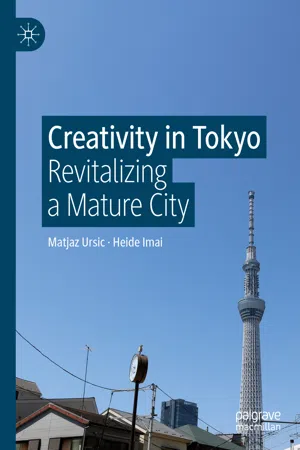
This book focuses on overlooked contextual factors that constitute the urban creative climate or innovative urban milieu in contemporary cities. Filled with reflections based on interviews with a diverse range of creative actors in various local neighborhoods in Tokyo, it offers a rare glimpse into the complex set of elements that provide long-term, physical, and sociocultural support to urban creativity. Ursic and Imai highlight the interplay between physical and soft (social) factors in the process of place-making and explore how a city's creativity is influenced by financial support and accessible infrastructure, as well as the sets of informal networks, services, and tacit, locally embedded knowledge that provide the basic layers of stimuli needed for creativity to fully develop. The authors show how the future development of creativity and the overall development of a city depend not only on the (top-down) planning strategies of formal authorities, but also on the appropriate (bottom-up) inclusion of heterogeneous elements that are provided and embedded within the small, hidden context of city spaces.
Local milieuCreative ecosystemSocial and urban creativityCreative capacityMicro/ macroTop-down and bottom-up
End Abstract
The eye of the beholder may describe the state of things from a particular position that has a specific cognitive and theoretical origin. Therefore, it is important for us to be aware of the “contextual distance” (Bargh, 1994; Demetriadis, Papadopoulos, & Tsoukalas, 2005; Öztürk & Aamodt, 1998), which refers to the potential differences in the interpretation of the same situation. We have both been researching the subject of urban creativity in Tokyo for years, collaborating with local scholars, but neither of us originates from Tokyo or Japan. Consequently, we might speak from a position that can, from some perspectives, be seen as westernized, privileged, or hegemonic. Nevertheless, while reflecting critically upon our potentially ideologically contaminated viewpoints, we argue that our research, analysis, and subsequent argumentation are based on empirical work and data collected in the field, following specific methodological and conceptual standards. Furthermore, in interpreting the collected data, we consider a variety of social, cultural, and historical factors to heighten our sensitivity and awareness of our particular position. We therefore attempt to present multiple perspectives that shift or decentralize the customary views on urban creativity in Tokyo. While our gaijin (stranger, outsider) status in Japan might blur our perspective, it also arguably offers us an unconventional, front-seat position, enabling us to identify and evaluate contradictory information, break the ordinary paradigms, and provide different views on the subject.
The Spatiality of Creativity
In contemporary societies, urban policies are often imagined as a consequence of precise, formalized, and institutionalized systems of space management. Despite this ideal, typical, outsider view of urban planning, the actual implementation of urban policies reflects broader, more complex processes, which—besides managing physical space—include other soft, or social and cultural, factors that are inevitably present in space. This is particularly important for preserving or developing adequate foundations for urban creativity to flourish. For creativity, spatiality matters a great deal because creative people cannot be expected to flourish in a non-stimulating environment. It is a sensitive partnership, as only the right mix of ingredients ensures a creative process can occur. Many authors have referred to a dynamic, interactive exchange of influences between creatives and their close environment (see, e.g., Amabile, 1983; Ericsson, 1996; Gardner, 1988; Mayer, 1999; Mumford, 1995; Simonton, 2000). This interactional perspective on creativity places great emphasis on the soft (i.e., situational, contextual, and cultural) characteristics of environments and excludes mechanistic views that offer simplistic solutions deprived of “cognitive, emotional, personal, and social abilities and knowledge” (Frensch & Funke, 1995, p. 18). The important role of soft factors becomes more noticeable when urban management attempts to ensure adequate economic and physical incentives (e.g., financing and infrastructure) to develop creative services and industries, but fails to preserve or foster a satisfactory social climate in terms of working and living conditions that stimulate and encourage diverse creative actors to prosper in the long term.
Tokyo is not an exception in this case. As the focal point of the Japanese economy and a global city (Sassen, 2001; S. J. Scott, 2000; Simmie, 2001), Tokyo represents a major local and international hub where small, local economic actors congregate alongside large corporations and their main research and development operations. All kinds of local, national, and global actors that contribute to the economic growth of Tokyo converge on its attractive locations (Zheng, 2001), such as Shinagawa ward (Fig. 1.1). Diverse economic actors are strongly attracted to a city that sits at the peak of a national urban hierarchy, where the proximity to new information, people, and investments enables them to further develop their ideas and plans.
Fig. 1.1
Shinagawa ward in Tokyo, one of the attractive locations for capital investment in the creative economy
With the rising importance of innovation and creative economies globally, and even more in the highly competitive East Asian cities (Kim, 2017; Park, Hill, & Saito, 2012), Tokyo is increasingly striving to improve its general social, economic, and spatial advantages to create an environment that would primarily support “creative industries” (Department for Digital, Culture, Media and Sport, 2001; Florida 2002, 2005; Gielen, 2013; Rausch & Negrey, 2006). This process has involved different urban policy actions, which have had mixed results (see, e.g., Cool Japan Movement Promotion Council, 2014; Ministry of Economy, Trade and Industry [METI], 2012a, 2012b; Tokyo Metropolitan Government [TMG], 2013, 2014, 2015).
The limited success of urban policies in the development of creative economies can be ascribed to political, social, cultural, economic, and demographic factors, among others. This book pays special attention to social and local (community) aspects, which represent the core soft, socioenvironmental factors that constitute Tokyo’s creativity. We believe that these factors, despite numerous past attempts for their partial inclusion, still represent a blind spot in current urban regeneration policies and are insufficiently integrated into urban planning practices. We will analyze these factors from the perspectives of two types of actors.
First, we will analyze soft, socioenvironmental factors from the view of small, local (place-embedded) creative actors. We will also examine even more microsituational contexts, where creativity is found in social networks and local community practices, which might not seem to directly affect creative economies. Microcosmoses of local community practices are too often excluded from the analysis of creativity, even though they provide the organically grown social base from which creative economies drain the necessary “human capital.” An analysis of bottom-up (i.e., local community) creative brain drain is inseparable from a top-down analysis of small creativeactors already engaged in specific creative occupations. This perspective focuses on the creativity found in local communities, which do not fall within the standard definition of the creative class. The case studies in this book are presented as urban terrains. Ethnographic fieldwork methods, including participant observation, semi-structured interviews, and storytelling, are used to provide diverse insights into the complex interaction between creatives and their urban environments (Fischer, 2013). We interviewed different creatives, members of subcultural groups, and social entrepreneurs, using a snowball principle. We started by approaching the participant with specific questions to develop a narrative, followed by an urban walk in their specific urban environment to confirm our first assumptions. The results reflect the diversity and close interplay between everyday and creative practices, as the creative actors perform and fulfill multiple roles simultaneously and in the same spatial setting.
Second, we will examine soft, socioenvironmental factors by focusing on small creativeactors employed in creative small and medium-sized enterprises (SMEs). We aim to identify the creative environmental characteristics that are highly regarded by these actors, which could contribute to the future development of creativity in Tokyo. The book focuses on “creative occupations” in terms of “what cultural workers do rather than what they make” (Markusen, Wassall, DeNatale, & Cohen, 2008, p. 25). While relying...
Table of contents
Cover
Front Matter
1. Introduction
2. Tokyo as a Matured City: Torn Between Global Change and Local Lives
3. Conceptualizing Urban Creativity: Searching for Traces of Tokyo’s Urban Development
4. Going Small Matters: The Role of Small Creative Actors in Tokyo’s Creative Ecosystem
5. Going Local 1: Creative Actors, Spatial Resources, and Social Networks
6. Going Local 2: Subcultural Capital and Social Creativity
7. Going Local 3: The Influence of Cultural Capital on the Creative Capacity of Place
8. Going Local 4: The Significance of Local Soft Environmental Factors for Tokyo’s Creative Capacity
9. Concluding Remarks
Back Matter
Trusted by 375,005 students
Access to over 1.5 million titles for a fair monthly price.
Study more efficiently using our study tools.
Frequently asked questions
Yes, you can cancel anytime from the Subscription tab in your account settings on the Perlego website. Your subscription will stay active until the end of your current billing period. Learn how to cancel your subscription
No, books cannot be downloaded as external files, such as PDFs, for use outside of Perlego. However, you can download books within the Perlego app for offline reading on mobile or tablet. Learn how to download books offline
We are an online textbook subscription service, where you can get access to an entire online library for less than the price of a single book per month. With over 1.5 million books across 990+ topics, we’ve got you covered! Learn about our mission
Look out for the read-aloud symbol on your next book to see if you can listen to it. The read-aloud tool reads text aloud for you, highlighting the text as it is being read. You can pause it, speed it up and slow it down. Learn more about Read Aloud
Yes! You can use the Perlego app on both iOS and Android devices to read anytime, anywhere — even offline. Perfect for commutes or when you’re on the go. Please note we cannot support devices running on iOS 13 and Android 7 or earlier. Learn more about using the app
Yes, you can access Creativity in Tokyo by Matjaz Ursic,Heide Imai in PDF and/or ePUB format, as well as other popular books in Ciencias sociales & Geografía. We have over 1.5 million books available in our catalogue for you to explore.