This book focuses on the transmission of ethnic identity across three generations of Italian-Australians, specifically Italian-Australians of Calabrian descent in the Adelaide region of Australia. Simone Marino analyzes ethnographic data collected over a three-year period to consider individual, familial and community cultural practices, as well as societal influences on ethnic identity transmission, in order to present generational differences in the understandings of Italian-Australian identity. Among other factors, the role of community events, community networks, and cultural practices associated with being Italian-Australian are examined. The transmission of ethnic identity is analysed through the lens of sociological theories, including Sayad's concept of double absence and Bourdieu's ideas of habitus and cultural capital, and is considered at the macro, meso, and micro spheres of social life. Ultimately, Marino's study reveals clear generational differences amongst Italian-Australians: the first generation, those who arrived from Italy, manifest a condition of feeling absent, the second generation present a condition of 'in-between-ness', between the world of their immigrant parents and that of Australians, and the third generation experience a sense of ethnic revival.
eBook - ePub
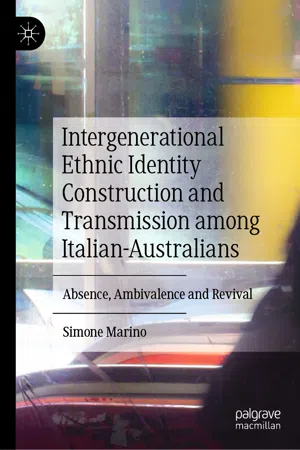
Intergenerational Ethnic Identity Construction and Transmission among Italian-Australians
Absence, Ambivalence and Revival
- English
- ePUB (mobile friendly)
- Available on iOS & Android
eBook - ePub
Intergenerational Ethnic Identity Construction and Transmission among Italian-Australians
Absence, Ambivalence and Revival
About this book
Information
© The Author(s) 2020
S. MarinoIntergenerational Ethnic Identity Construction and Transmission among Italian-Australianshttps://doi.org/10.1007/978-3-030-48145-2_11. Introduction
Simone Marino1
(1)
University of South Australia, Magill, SA, Australia
1.1 Introducing and Situating the Study
The study reported in this book addresses ethnic identity and transmission across members of families originating from Calabria, southern Italy, and living in Adelaide, South Australia. It does so in relation to both the participants’ narratives across three generations, and their cultural practices observed ethnographically. It addresses unanswered questions on the intergenerational dynamics of ethnic identity relations among three generations, and of how they perform their ethnic identities through everyday practices. Firstly, I situate the study in relation to the socio-historical context, the geographical situatedness, the migration of Calabrians and their settlement in South Australia, in particular in Adelaide. Secondly, I present a rationale for and significance of the present study and its attempt to fill the methodological and theoretical gap of previous literature. This includes a discussion related to my own situatedness as a researcher, and the motivation that brought me to investigate the sense of attachment to a Calabrian identity claimed and enacted by individuals who were born in Australia. Lastly, the chapter concludes with a synopsis of all of the chapters in the book.
1.1.1 Italians in Australia
Until the 1920s, Italian migration to Australia had remained infrequent. Of the 14 million Italians who left their mother country between the last quarter of the nineteenth century and World War I, only one-tenth of one per cent found their way to Australia (Cresciani 1986). However, as this trickle of immigrants became a steady flow between the two world wars, Italians could be found working on the cane fields of North Queensland, mining in Kalgoorlie, farming in New South Wales and Victoria and fishing in Fremantle and Port Pirie. As more wives and children joined the men, a number of communities arose, each developing its own distinctive cultural life. The appearance, in the period from about 1930 to 1950, of the Italian festa was symbolic of the emerging confidence that Italians displayed in their own identity and the need to create a cultural space in the mostly hostile Australian environment. Such celebrations, usually in honour of the home-town patron saint, were re-enacted in the form of street festivals in north Queensland and Gippsland, for example, and as fishing festivals in Fremantle and Port Pirie (Pascoe 1992).
From the very beginning, the Anglo-Australian dominant group revealed an ambivalent reaction towards the Italian immigrant group. On the one hand, there persisted among the aristocracy and middle classes of British background a favourable disposition towards Italy as a place of ancient ruins, museums and refinement, a place of pilgrimage (Pascoe 1987). On the other hand, the influx of mostly illiterate Italian workers and peasants did much to undermine such romantic notions. In reality, Italian workers were mostly resented by their Anglo-Australian counterparts, who viewed them as competitors in times of high unemployment and economic depression. Moreover, these early Italian settlers were generally isolated and singled out not only on the basis of their inability to speak English but also, true to the prevailing racist attitudes of the dominant majority, on the basis of their ‘olive’ complexion. As Bosworth (1988) has pointed out, many Anglo-Australians were unsure whether Italians counted as ‘white’, particularly if they came from southern Italy or Sicily. This point contributed to the development of a white fantasy supremacy which placed the Italian group at the bottom of the immigration chart (Hage 2012). On the other hand, such negative out-group categorisation probably served as a further stimulus to the development of an Italian-Australian community identity.
The relative achievement of Italian groups in becoming rapidly established in their numerous activities was also a contributing factor to Anglo-Australian resentment. At the time, such achievement was attributed to their acceptance of exploitative work practices (indentured labour, non-unionism) to which other Australian workers would not submit. As Alcorso (1992) has noted, the parsimony of the Italian family earned it the reputation of being able to ‘live off the smell of an oily rag’. In reality, such success as they reached was hard-fought and derived both from the aspirations and economic vulnerability of the migrants and the high levels of cooperation which existed both between groups of paesani and within the family unit (Zontini 2004; Alcorso 1992).
In many ways the experiences of these early immigrants became emblematic of the struggle to succeed in a new land and set the scene for the second wave of Italians who arrived on Australian shores in the 1950s and 1960s. Like the earlier generation, the majority of post-Second World War migrants also originated from rural areas and small Italian towns. However, as Castles et al. (1992) have noted, they were drawn to the capital cities and industrial centres by the promise of employment in Australia’s expanding manufacturing sector and building construction industry. A significant number of these immigrants had to come to terms with the dislocation of rebuilding their lives in a society which was in the midst of industrial modernisation and which also presented them with the challenge of adapting to new cultural values and institutions.
The Italian-born population reached its peak of nearly 290,000 persons in 1977 when it constituted 2.3% of the total Australian population (Price 1979). However, it has been estimated that the actual number of Italian migrants who settled in Australia in this period approached 365,000 persons, of whom some 90,000 (nearly a quarter) left to return to Italy (Thompson 1980). By the mid-1970s, more Italian-born persons were leaving Australia than entering, largely as a result of the improving economic fortunes of Italy and the desire of some to retire to the ‘old country’ (Hugo 1991). At the 1991 census there were approximately 254,000 Italian-born individuals living in Australia, still representing 1.77% of the Australian population. In addition to this first generation of Italians, the census identified more than 300,000 people who had been born in Australia with at least one Italian-born parent; of these, more than 190,000 or 63.11% had both parents born in Italy. Together, the first and second generations of Italian-Australians accounted for 563,000 people or 3.67% of the total population of Australia at the time. Such records reveal the numerical strength of the Italian community.
However, the distribution of Italian-born individuals—following peaks of immigration in the 1970s, 1990s and more recently in 2006 and 2016—varies across different Australian states and territories. The 1991 census represents the geographical situatedness of Italian migration to Australia, which continues today. According to the census of that time, more than 40% of people born in Italy were living in Victoria, followed in descending order by New South Wales (27.7%), South Australia (77.4%), Western Australia (l0.5%), Queensland (6.9%), the Australian Capital Territory (7.1%), Tasmania (0.5%) and the Northern Territory (0.3%). Of the state capitals in the 1990s, Melbourne had the largest Italian-born population, with 37.2% of the Australian population of people born in Italy. Sydney with 56,828 was the next highest, representing 22.47% of the Italian-born in Australia, followed by Adelaide with 10.6%. In relation to South Australia specifically, the two local government areas with the highest proportion of Italian-born persons were Payneham (72.2%) and Campbelltown (11.8%), both areas in Adelaide.
According to the latest census in 2016, Italian migrants still constitute the largest group of overseas-born migrants after immigrants from the United Kingdom, New Zealand and China. The 2016 census recorded 185,402 Italian-born people in Australia, a fall of 6.9% from the figures of the 2006 census. The 2016 distribution by state and territory showed Victoria still had the largest number, with 76,909 Italian-born, followed by New South Wales (51,626), South Australia (20,708) and Western Australia (19,477).
1.1.2 Italian Migration to South Australia
Italian migration to South Australia was a relatively modern phenomenon of the twentieth century, with the overwhelming majority of settlers arriving after 1945 (see Castles et al. 1992). In a study of Italian migration to and settlement in Western Australia, Gentilli (1982) identified four phases, and these can equally apply to South Australia.
The ‘individualists’ phase of migration covers the earliest period up to the turn of the twentieth century. It was characterised by the arrival of adventurers, Catholic missionaries, sailors and fishermen, and others who jumped ship. During this period in South Australia, ...
Table of contents
- Cover
- Front Matter
- 1. Introduction
- 2. Previous Literature About Italian Immigrant Groups and Ethnic Identity
- 3. Theoretical Reference Points
- 4. Methodology
- 5. Participants’ Perceptions of Their Ethnicity Across the Three Generations
- 6. The Calabrian Community and Its Cultural Practices
- 7. Networks and Comparatico Across the Three Generations
- 8. Cultural Practices and Memories of the Calabrian Grandparents
- 9. Findings and Discussion
- 10. Conclusion and Further Reflections
- Correction to: Intergenerational Ethnic Identity Construction and Transmission among Italian-Australians
- Back Matter
Trusted by 375,005 students
Access to over 1.5 million titles for a fair monthly price.
Study more efficiently using our study tools.
Frequently asked questions
Yes, you can cancel anytime from the Subscription tab in your account settings on the Perlego website. Your subscription will stay active until the end of your current billing period. Learn how to cancel your subscription
No, books cannot be downloaded as external files, such as PDFs, for use outside of Perlego. However, you can download books within the Perlego app for offline reading on mobile or tablet. Learn how to download books offline
Perlego offers two plans: Essential and Complete
- Essential is ideal for learners and professionals who enjoy exploring a wide range of subjects. Access the Essential Library with 800,000+ trusted titles and best-sellers across business, personal growth, and the humanities. Includes unlimited reading time and Standard Read Aloud voice.
- Complete: Perfect for advanced learners and researchers needing full, unrestricted access. Unlock 1.5M+ books across hundreds of subjects, including academic and specialized titles. The Complete Plan also includes advanced features like Premium Read Aloud and Research Assistant.
We are an online textbook subscription service, where you can get access to an entire online library for less than the price of a single book per month. With over 1.5 million books across 990+ topics, we’ve got you covered! Learn about our mission
Look out for the read-aloud symbol on your next book to see if you can listen to it. The read-aloud tool reads text aloud for you, highlighting the text as it is being read. You can pause it, speed it up and slow it down. Learn more about Read Aloud
Yes! You can use the Perlego app on both iOS and Android devices to read anytime, anywhere — even offline. Perfect for commutes or when you’re on the go.
Please note we cannot support devices running on iOS 13 and Android 7 or earlier. Learn more about using the app
Please note we cannot support devices running on iOS 13 and Android 7 or earlier. Learn more about using the app
Yes, you can access Intergenerational Ethnic Identity Construction and Transmission among Italian-Australians by Simone Marino in PDF and/or ePUB format, as well as other popular books in Social Sciences & Criminology. We have over 1.5 million books available in our catalogue for you to explore.