eBook - ePub
Post-Truth, Post-Press, Post-Europe
Euroscepticism and the Crisis of Political Communication
- English
- ePUB (mobile friendly)
- Available on iOS & Android
eBook - ePub
Post-Truth, Post-Press, Post-Europe
Euroscepticism and the Crisis of Political Communication
About this book
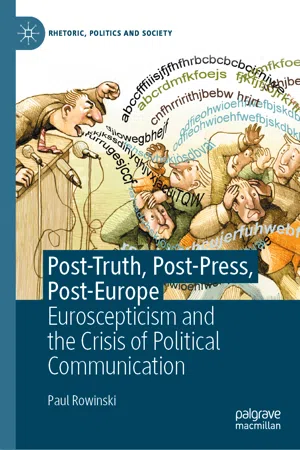
This book explores whether a beleaguered press in recent years has been developing an emotive, Eurosceptic post-truth rhetoric of its own – competing for attention with populist politicians. These politicians now by-pass the media, talking directly to their publics in blogs, on Twitter and Facebook. In the post-truth age, objective facts are less influential in shaping opinion than appeals to emotion. Audiences congregate around views they share and want to believe. The author presents a critical discourse analysis of the language used by populist politicians online, on Facebook, and subsequently quoted in the press, which highlights how the political rhetoric of Italian and British politicians is often at its most inflammatory around the issue of immigration. The same goes for the press. The Italian case study focuses on media coverage of the 2014 and 2019 European elections and 2018 general election. The British case study examines press reporting of the 2016 UK referendum on EU membership, the 2017 general election, and the September 2019 parliamentary debate immediately following the UK Supreme Court ruling that proroguing of Parliament was illegal. From the picture that emerges, the author argues that journalists need to change how they report, to challenge the post-truthers, holding them to account and pressing them on the facts while also harnessing the emotions of disaffected publics.
Information
© The Author(s) 2021
P. RowinskiPost-Truth, Post-Press, Post-EuropeRhetoric, Politics and Societyhttps://doi.org/10.1007/978-3-030-55571-9_11. Introduction
Keywords
Social mediaEmotive Post-Truth Eurosceptic rhetoricPopulist politiciansDemocracyPopulist politicians can today circumvent the need for the press, by conveying their messages on social media. It can be a place where they can communicate an emotive Post-Truth Eurosceptic rhetoric. This book investigates if a beleaguered press in two European countries is growing similarly shrill over the same issues—in a bid to hold the readership.
Our times reflect a real coarseness in public discourse as the disillusioned and disaffected respond to and feed the bating by some politicians. It has never been more important, as journalists, to hold politicians’ feet to the fire, speak truth to power and make sure an enraged and emotional public is not duped or misled. And yet this book explores if journalists have instead fallen prey to the same manipulation by the political class.
The mainstream media is fighting for attention on a series of fronts. The likes of Matteo Salvini, the former extreme right Italian interior minister, can appeal to the emotions of his audience directly with ‘personal’ video messages on Facebook—that are then lifted directly by news websites including the offerings of the mainstream media. To what end? Sometimes journalists are just giving his Post-Truth a whole new audience. But just maybe could such mainstream media posting allow Salvini to be hoisted by his own petard? It depends.
Similarly the British audience may want to hear from the prime minister in a speech, regarding the Brexit crisis enveloping Boris Johnson’s government and the country, more often than not, before reading the perhaps more measured, balanced story in a serious newspaper online. Everybody is posting it. In the battle for clickbait, if one newspaper does not post it, another will. That could mean more clicks and views of the subsequent story. Catch 22.
It is suggested, the public may often opt to first hear emotive and sometimes vitriolic and even racist rhetoric, with a video link posited immediately above the story—before they actually read the analysis below. If they like what they hear from Johnson or Salvini, for instance, it will be that narrative, that context, prefacing all with emotion, rather than what Aristotle called logic (what today would be described as facts), colouring their reading of what follows. What this book goes on to do is to analyse the discourse of newspapers online, establishing if they are feeding the Post-Truth Eurosceptic rhetoric, not just by giving the likes of Johnson and Salvini a platform, but by feeding it with their own Post-Truth discourse. In so doing, the press, it could be argued, is self-harming.
What could be assumed at this point is that those giving Salvini or Johnson a platform, are those supporting their views: the Breitbarts and Fox News media organisations of this world. But it may also be more moderate, mainstream media organisations, like the Daily Telegraph or Corriere della Sera. Those giving these leaders a platform are also at least of the centre-right, so yes, this could be the Daily Telegraph or Corriere della Sera. What should also be investigated is if those opposed to the emotional jostling of Johnson and Salvini are responding in a similar emotive vein to them with their counter-arguments.
The media can accentuate the problem when we frame and amplify the story in a way predisposed to Johnson or Salvini. Instead it is argued that even those media organisations sympathetic to them, should challenge these politicians with a little thing journalists often convey: substantiated, corroborated facts. These facts may fly in the face of the emotive, persuasive rhetoric based on an appeal to the people. That holding to account is crucial. It is that holding to account that is under threat, it is argued.
Johnson claimed at the height of the parliamentary crisis in the UK, that the opposition was scuppering his chance of using a no deal over Brexit, to force the EU to come to a settlement. The EU made clear there were NO negotiations ongoing at that stage—despite Johnson’s government creating the impression that they were knee-deep in serious discussions. The impression Johnson and his government left with the public on this issue is what lingered and it went largely unchallenged by a lot of the mainstream media. The media instead should have pinned him and his government to the wall. Maybe this too is a by-product of our age: suspending at times our willingness to dig out the story. Maybe, in the rush to compete for readers online, journalists drift into the emotional rather than digging and corroborating the story. The lack of EU negotiations could and should have been a big story. Are we allowing Post-Truth to go unchallenged?
At the time of writing, Salvini’s rhetoric has backfired and his bid to become prime minister and force an election failed. Salvini succeeded in creating the opposite, uniting his enemies, who had previously refused to form a government together. The Five Star Movement deserted Salvini’s League Party and instead reformed the government with the Democratic Party. Something similar happened in Britain. The Labour Party, the Scottish National Party, the Liberal Democrats and the Greens, found themselves cooperating more than they would have liked, in what turned out to be the stop Boris and Brexit show. They failed.
Johnson’s provocative rhetoric, some have argued, could be part of his undoing, with many openly calling him a liar. Salvini has suffered a similar critique. Yet the former is firmly ensconced as prime minister—and the latter has been temporarily reduced to the sidelines, but like Marie Le Pen in France, Salvini is far from done. The rhetoric of Salvini and Johnson, two far-right populist politicians seeking to rule through divisions (although bifurcation means they claim to be uniting their nations), will be the focus of analysis—and indeed the media packaging of their utterances—and indeed when the media itself is guilty of the same.
Post-Truth denotes circumstances in which objective facts are less influential in shaping public opinion than appeals to emotion and personal belief (Oxford English Dictionary 2016). Further investigation is prefaced by closer scrutiny of the history of rhetoric (Aristotle 2012; Wiesner et al. 2017; Toye 2013; Leith 2012) before exploring the Post-Truth language and discourse of a previous recent populist leader in Europe, drawing parallels and discerning differences—pre-dating the obsession with Trump, yet still possibly informing his rise.
What is developing is not just a retreat to nationhood (as Britain has proposed with Brexit) but what is now being dubbed a retreat to English nationalism—and actually a Post-Truth threat to democracy in both the UK and Italy.
At the time of writing, the Coronavirus crisis has enveloped the world. The EU has complained that member states have not sought to cooperate. The British government, despite initial denials, decided not to work with the EU-wide scheme to respond to the crisis, including the distribution of crucial ventilators. Conversely, it has been argued the EU has failed member states. Giuseppe Conte, the Italian Prime Minister wanted the debt incurred by the pandemic pooled and argued the political crisis was so deep the existen...
Table of contents
- Cover
- Front Matter
- 1. Introduction
- 2. A Voyage Through Emotive Rhetoric—And the Challenge to Truth
- 3. Methodology
- 4. Italy First
- 5. Italy First: A Journey into Emotive Rhetoric
- 6. Britain First
- 7. Britain First: A Journey into Emotive Rhetoric
- 8. Conclusions
- Back Matter
Trusted by 375,005 students
Access to over 1.5 million titles for a fair monthly price.
Study more efficiently using our study tools.
Frequently asked questions
Yes, you can cancel anytime from the Subscription tab in your account settings on the Perlego website. Your subscription will stay active until the end of your current billing period. Learn how to cancel your subscription
No, books cannot be downloaded as external files, such as PDFs, for use outside of Perlego. However, you can download books within the Perlego app for offline reading on mobile or tablet. Learn how to download books offline
Perlego offers two plans: Essential and Complete
- Essential is ideal for learners and professionals who enjoy exploring a wide range of subjects. Access the Essential Library with 800,000+ trusted titles and best-sellers across business, personal growth, and the humanities. Includes unlimited reading time and Standard Read Aloud voice.
- Complete: Perfect for advanced learners and researchers needing full, unrestricted access. Unlock 1.5M+ books across hundreds of subjects, including academic and specialized titles. The Complete Plan also includes advanced features like Premium Read Aloud and Research Assistant.
We are an online textbook subscription service, where you can get access to an entire online library for less than the price of a single book per month. With over 1.5 million books across 990+ topics, we’ve got you covered! Learn about our mission
Look out for the read-aloud symbol on your next book to see if you can listen to it. The read-aloud tool reads text aloud for you, highlighting the text as it is being read. You can pause it, speed it up and slow it down. Learn more about Read Aloud
Yes! You can use the Perlego app on both iOS and Android devices to read anytime, anywhere — even offline. Perfect for commutes or when you’re on the go.
Please note we cannot support devices running on iOS 13 and Android 7 or earlier. Learn more about using the app
Please note we cannot support devices running on iOS 13 and Android 7 or earlier. Learn more about using the app
Yes, you can access Post-Truth, Post-Press, Post-Europe by Paul Rowinski in PDF and/or ePUB format, as well as other popular books in Politics & International Relations & Journalism. We have over 1.5 million books available in our catalogue for you to explore.