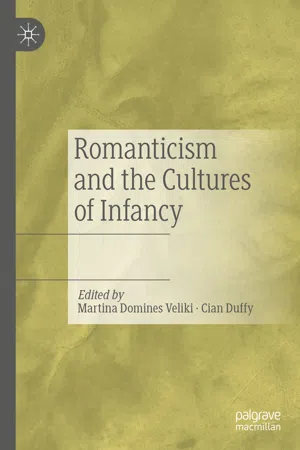
This collection of essays explores the remarkable range and cultural significance of the engagement with 'infancy' during the Romantic period. Taking its point of departure in the commonplace claim that the Romantics invented childhood, the book traces that engagement across national boundaries, in the visual arts, in works of educational theory and natural philosophy, and in both fiction and non-fiction written for children. Essays authored by scholars from a range of national and disciplinary backgrounds reveal how Romantic-period representations of and for children constitute sites of complex discursive interaction, where ostensibly unrelated areas of enquiry are brought together through common tropes and topoi associated with infancy. Broadly new-historicist in approach, but drawing also on influential theoretical descriptions of genre, discipline, mediation, cultural exchange, and comparative methodologies, the collection also seeks to rethink the idea of a clear-cut dichotomy between Enlightenment and Romantic conceptions of infancy.
eBook - ePub
Romanticism and the Cultures of Infancy
- English
- ePUB (mobile friendly)
- Available on iOS & Android
eBook - ePub
Romanticism and the Cultures of Infancy
About this book
Information
© The Author(s) 2020
M. Domines Veliki, C. Duffy (eds.)Romanticism and the Cultures of Infancy https://doi.org/10.1007/978-3-030-50429-8_11. Introduction: The Romantic Cultures of Infancy
Martina Domines Veliki1 and Cian Duffy2
(1)
English Studies, Zagreb University, Zagreb, Croatia
(2)
English Studies, Lund University, Lund, Sweden
In his essay of December 1784, Beantwortung der frage: Was ist Aufklärung? [Answering the question: What is Enlightenment?], the German philosopher Immanuel Kant (1724–1804) defines Enlightenment as ‘der Ausgang des Menschen aus seiner selbst verschuldeten Unmündigkeit’, ‘the emergence of man from his self-imposed nonage’.1 Eighteen years later, in March 1802, the English Romantic poet William Wordsworth (1770–1850) wrote in his poem ‘My heart leaps up’ that ‘the child is father of the man’, one of the most-often quoted lines of English Romantic verse.2 In the two decades between these statements, the concept of ‘infancy’ became across Europe a central topos in a range of different areas of enquiry, genres of cultural productivity, and national contexts. ‘Childhood’, as Andrew O’Malley puts it in the introduction to his Literary Cultures and Eighteenth Century Childhoods, became ubiquitous, ‘both in terms of the print materials marketed to people at this stage of life and in terms of the discourses in which it becomes an important consideration and significant trope’.3 It is with the manifestation of these various ‘cultures of infancy’ in the late eighteenth century and Romantic period that the essays in our volume are concerned.
Before going any further, a note on terminology may prove useful. OED gives the earliest occurrences of the noun infant and the abstract noun infancy in the fifteenth and sixteenth centuries respectively, in theological and pedagogical contexts. For most of the period covered by our volume, the term infant, in the context of human biology, was generally taken to cover the first seven years of life and was often, in that sense, broadly synonymous with child.4 However, it was also during the period covered by this volume that it became increasingly common to use the term infancy in non-biological contexts, for instance, to refer to the infancy of civil society or to the infancy of a particular area of knowledge. Indeed, this diversification in the semantic and epistemological range of the term is one of the key phenomena which we study here. For these reasons, in our editorial commentary, we use infancy to refer to the concept or topos in general and childhood to refer specifically to young humans. This said, there will inevitably be some necessary variance in this policy because of differing usage in the primary and secondary sources which we consider. Where such variance is substantive, we will flag it up.
As a contribution to an already-thriving scholarly field, the essays in this volume shed additional light on the remarkable breadth and cultural significance of the engagement with ‘infancy’ during the Romantic period, tracing it across national boundaries, in the visual arts, in works of educational theory and natural philosophy, and in both fiction and non-fiction written for children. Taken as a whole, our essays also find in the engagement with infancy during the Romantic period certain key features of what we might now call, following Michel Foucault, the Romantic episteme, that is to say, the manner in which knowledge was produced and structured at the time.5 We hope to show here how Romantic-period engagements with infancy, and Romantic-period representations of and for children, constitute sites of complex discursive interaction, where ostensibly unrelated areas of enquiry are brought together through common tropes and topoi.6 Such representations often illustrate, in other words, not only the pre- or proto-disciplinary nature of the Romantic episteme, where the boundaries between what we would now consider different kinds and areas of knowledge are fluid, but also the relative absence of any rigid boundary between literary and non-literary engagements with infancy. If it has often, rightly, been argued that the ‘modern’ child was born in the late eighteenth-century—most recently, for example, by Andrew O’Malley in Literary Cultures and Eighteenth Century Childhoods—then we suggest, here, that in the cultural investment in infancy during the Romantic period is also visible the emergence of a nineteenth-century, disciplinary, and ‘two cultures’ episteme out of earlier forms of thought.7
It has become somewhat routine, now, for both cultural historians of childhood and for scholars of the Romantic period to claim that the Romantics invented childhood. In her recent introduction to The Child in British Literature, for example, Adrienne Gavin suggests that:
Gavin’s emphasis on ‘poetry’, here, and the particular model of the relationship between childhood experience and adult identity which she presents as ‘Romantic’, are instructive. Both point to an equally widespread corollary to the claim that the Romantics invented childhood: the idea that Wordsworth’s ‘Ode. Intimations of Immortality from Recollections of Early Childhood’ (1807) constitutes the definitive, ‘Romantic’ configuration of childhood. Hence Gavin herself cites Wordsworth’s ‘Ode’ as ‘one of the period’s most influential poems about childhood’, whilst Roderick McGillis’s chapter in the same volume goes even further, describing Wordsworth’s ‘Ode’ as ‘arguably the most influential statement concerning the child that has appeared since the beginning of the nineteenth century’ before reminding us how ‘much of the poem focuses on what has become cliché: childhood purity, innocence, wisdom, joy, and freedom’.9 Hence, if Wordsworth does not loom especially large in our essays, it is not so much from any sense of a need to correct such accounts of his influence but rather out of a conviction that the cultural place and legacy of works like ‘Ode’ and ‘My heart leaps up’ has been, now, very well documented. Essays in our volume by Cian Duffy and Martina Domines Veliki, and by Rolf Lessenich, do, however, consider aspects of the work of some Romantic-period writers who wrote back against the paradigm of infancy developed in Wordsworth’s poetry, often on grounds of its perceived lack of realism.For the first time in a sustained way Romantic poetry constructed childhood as a desirable state, distinct from adulthood, for which adults longed: a lost, idealized, clear-visioned, divinely pure, intuitive, in-tune-with-nature, imaginative stage of life, of whose spirits adult felt the loss and sought to capture in literature.8
Whilst it is generally accepted by scholars that the Romantics invented childhood, however, the causes and consequences of that ‘invention’ remain the subject of debate. ‘How and why childhood and the figure of the child became so important to such a wide range of writers’, as Ann Wierda Rowland puts it in Romanticism and Childhood, ‘has long been one of the central questions of literary historical studies’.10 In her seminal account of ‘the fixation on childhood’ by Romantic writers, Judith Plotz traces the claim that the Romantics invented childhood back to the late nineteenth century, by which time, Plotz says, the notion of ‘childhood as a domain for exploration [and of] Wordsworth and his contemporaries as its explorers had become commonplace’.11 In its broadest sense, the claim reflects the idea that attitudes to childhood prevalent in the West today—the sense of ‘childhood as a distinct, individual element of human life’; a developmental understanding of the relationship between child and adult; and an extensive, sentimental investment in the abstrac...
Table of contents
- Cover
- Front Matter
- 1. Introduction: The Romantic Cultures of Infancy
- 2. ‘A detached peninsula’: Infancy in the Work of Thomas De Quincey
- 3. William Blake’s Infant Joy
- 4. The Infant, the Mother, and the Breast in the Paintings of Marguerite Gérard
- 5. Mother at the Source: Romanticism and Infant Education
- 6. Coleridge, the Ridiculous Child, and the Limits of Romanticism
- 7. Educational Experiments: Childhood Sympathy, Regulation, and Object-Relations in Maria Edgeworth’s Writings About Education
- 8. ‘Advice […] by one as insignificant as a MOUSE’: Human and Non-human Infancy in Eighteenth-Century Moral Animal Tales
- 9. William Godwin, Romantic-Era Historiography and the Political Cultures of Infancy
- 10. Experimenting with Children: Infants in the Scientific Imagination
- 11. ‘A wretch so sad, so lorn’: The Feral Child and the Romantic Culture of Infancy
- Back Matter
Trusted by 375,005 students
Access to over 1.5 million titles for a fair monthly price.
Study more efficiently using our study tools.
Frequently asked questions
Yes, you can cancel anytime from the Subscription tab in your account settings on the Perlego website. Your subscription will stay active until the end of your current billing period. Learn how to cancel your subscription
No, books cannot be downloaded as external files, such as PDFs, for use outside of Perlego. However, you can download books within the Perlego app for offline reading on mobile or tablet. Learn how to download books offline
Perlego offers two plans: Essential and Complete
- Essential is ideal for learners and professionals who enjoy exploring a wide range of subjects. Access the Essential Library with 800,000+ trusted titles and best-sellers across business, personal growth, and the humanities. Includes unlimited reading time and Standard Read Aloud voice.
- Complete: Perfect for advanced learners and researchers needing full, unrestricted access. Unlock 1.5M+ books across hundreds of subjects, including academic and specialized titles. The Complete Plan also includes advanced features like Premium Read Aloud and Research Assistant.
We are an online textbook subscription service, where you can get access to an entire online library for less than the price of a single book per month. With over 1.5 million books across 990+ topics, we’ve got you covered! Learn about our mission
Look out for the read-aloud symbol on your next book to see if you can listen to it. The read-aloud tool reads text aloud for you, highlighting the text as it is being read. You can pause it, speed it up and slow it down. Learn more about Read Aloud
Yes! You can use the Perlego app on both iOS and Android devices to read anytime, anywhere — even offline. Perfect for commutes or when you’re on the go.
Please note we cannot support devices running on iOS 13 and Android 7 or earlier. Learn more about using the app
Please note we cannot support devices running on iOS 13 and Android 7 or earlier. Learn more about using the app
Yes, you can access Romanticism and the Cultures of Infancy by Martina Domines Veliki, Cian Duffy, Martina Domines Veliki,Cian Duffy in PDF and/or ePUB format, as well as other popular books in Literature & European Literary Criticism. We have over 1.5 million books available in our catalogue for you to explore.