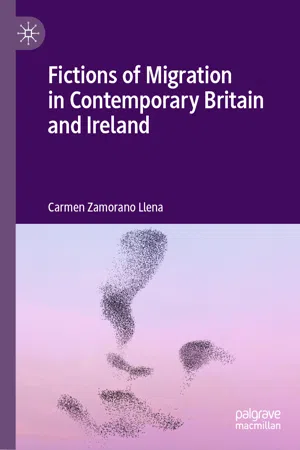
This book examines how the transcultural and transnational migration of people, texts, and ideas has transformed the paradigm of national literature, with Britain and Ireland as case studies. The study questions definitions of migration and migrant literature that focus solely on the work of authors with migrant backgrounds, and suggests that migration is not extraneous but intrinsic to contemporary understandings of national literature in a global context. The fictional work of authors such as Caryl Phillips, Colum McCann, Abdulrazak Gurnah, Rose Tremain, Elif Shafak, and Evelyn Conlon is analysed from a variety of perspectives, including transculturality, cosmopolitanism, and Afropolitanism, so as to emphasise how their work fosters an understanding of national literature, as well as of individual and collective identities, based on transborder interconnectivity.
- English
- ePUB (mobile friendly)
- Available on iOS & Android
eBook - ePub
Fictions of Migration in Contemporary Britain and Ireland
About this book
Information
© The Author(s) 2020
C. Zamorano LlenaFictions of Migration in Contemporary Britain and Irelandhttps://doi.org/10.1007/978-3-030-41053-7_11. Introduction: Migration, Mobility and the Redefinition of National Literatures in a Global Context
Carmen Zamorano Llena1
(1)
Dalarna University, Falun, Sweden
Keywords
British fictionIrish fictionMigrationGlobalisationCosmopolitanismA Sense of Order Amidst the Turbulence of Migration
The contemporary context, in which the present literary study of Irish and British prose fiction is situated, is first and foremost defined as the age of globalisation with migration often regarded as one of its most salient features, which, in the words of sociologist Nikos Papastergiadis (2000), “in its endless motion, surrounds and pervades almost all aspects of contemporary society” (1). Scholars in globalisation studies coincide in regarding the increased volume and pace of the flow of people as one of the most dramatic changes that society has experienced in the last three decades (Appadurai 1996; Bauman 1998), as the number of migrants has reached peaks never experienced before in history. The most recent estimate concerning global figures is that in 2019 there were 272 million international migrants in the world, and that, if gathered within a single nation-state, the number of the migrants worldwide would make for the fifth most populous nation in the world (UN Department of Economic and Social Affairs 2019; International Organization for Migration 2018). As globalisation analysts contend, the phenomenon of migration is not new, but what makes it different from previous migratory movements is “the scale and complexity of movement [whose] consequences have exceeded earlier predictions” (Papastergiadis 2000, 2).
In its simplest form, migration is defined as the “movement of people and their temporary or permanent geographical relocation” (Held et al. 1999, 283). This simplified definition of the term allows for a broad understanding of migratory movements, extending from the earliest displacement of hunters and gatherers from Africa to Eurasia, to the waves of migrant labour determined by colonialist and imperial enterprises between the sixteenth and nineteenth centuries; equally, it involves mass labour migration from south to north and east to west based on the pull exerted by the processes of industrialisation and accompanying urbanisation of societies in the late nineteenth and twentieth centuries. The general thread that often unites this diversity of protagonists and migratory movements is the human need to change geographical locations in search of an improvement in economic, political and human conditions of living. However, one of the key distinguishing features between past migrations and current forms of global migration is what Papastergiadis (2000) has termed “the turbulence of migration” in the contemporary context.
The turbulence of migration, Papastergiadis’s concept inspired by James Rosenau’s work in international relationships, echoes the different levels of transnational interconnection, but it also refers to the breakdown of easily identifiable patterns in human migration. This disruption has been fostered by the present globalising process, in which the revolution in technology, transport and communication systems has facilitated, not only the development of new economic hubs in the world away from the traditional centres in the West and the northern hemisphere, but also drastic changes in the nature of migration patterns and the migratory experience. Contemporary migration is characterised by its multidirectional, reversible and often unpredictable patterns. In earlier periods, however, migration patterns were easily traceable in linear terms and migration was often perceived as irreversible, as suggested by the Irish tradition of the so-called American Wake, a farewell party to the Irish emigrant, whose likelihood of return was often considered so unlikely that, as Patrick Fitzgerald and Brian Lambkin (2008) observe, “the departure was treated as if it were an actual death” (17). The idea of a return to one’s country of birth often impregnated the migrant mind, reflected, for example, in the experience of late nineteenth-century Irish migrants to North America. Amongst disadvantaged migrants, the return journey was often perceived as an unrealisable dream and fed their nostalgia for their land of origins, exemplified in many of the Irish immigrant ballads, such as “Hills of Donegal,” as well as in numerous letters sent back home. As A. B. McMillan wrote in April 1894 from Pittsburgh to her sister Eliza in Newtownards, Co. Down, she lamented her decision to leave for the United States: “times is very dull in this Country, I sometimes think that if I had the money I would go Back Home again” (qtd. in Fitzgerald and Lambkin 2008, 193). Those with better financial resources could more easily realise their dream, which was also aided by the fact that the transition from sail to steam in the nineteenth century involved safer and much more inexpensive travelling. According to David Fitzpatrick (2010), between 1871 and 1921, as a consequence of these technological developments, the migrants’ travel back to Ireland became commonplace, and by the 1890s, “the ‘Returned Yank’ as well as the Irish-born tourist had become a familiar figure in rural Ireland” (634).
As in earlier migration processes, social and economic differences are still part and parcel of the experience of contemporary international migrants, and technological development is also crucial in determining changes in migration patterns. The compression of travel time and the reduction in the actual cost of travel have enabled an increase in the volume and frequency of migratory movements, as well as the possibility for a number of migrants to maintain frequent transnational contact, not only with their families and close community in their country of origin, but also with friends and family that may also be based, temporarily or permanently, in other parts of the world. Similarly, the remote interaction across space enabled by videoconferencing systems as well as by instant messaging, both written and voiced, has also changed the nature of the links maintained between migrants and their communities “back home” and across the globe. Although these systems do not replace face-to-face communication, they partly compensate for its absence, particularly for those international migrants whose economic situation does not allow them to enjoy the benefits of low-cost travel. As a number of recent studies on the relationship between migration and electronic communication observe (Alonso and Oiarzabal 2010; Madianou and Miller 2012), mediated communication has become a crucial component in the making and maintenance of transnational social relationships and “contribute[s] to the creation of social structure” (Fortunati et al. 2012, xx). It can further be argued that traditional understandings of social structures have been revolutionised by contemporary migration, and this, together with the new webs of transnational socio-economic, political and environmental interdependence, has dramatically transformed the nature of societies.
These momentous, rapid transformations have revolutionised traditional Weltanschauungen and can be perceived as turbulences that challenge the traditional view of societies as homogenous, fixed and rooted to a specific geographical space while sharing certain common values and traditions. Papastergiadis’s “turbulence” is partly meant to echo the fears felt by many in relation to the transformation of seemingly perennial social patterns due to increasingly unpredictable migratory patterns. These concerns are evident in the abundance of literature that emerged, particularly in the 1990s, analysing the threats of globalisation to the nation-state, or in the current upsurge of extreme right-wing parties in many European countries which have at the core of their programme what they often term, in a rather euphemistic manner, a concern with immigration and integration politics. As Anthony J. Marsella and Erin Ring (2003) observe, “the fear of the new immigrants may be related to the widespread fear of uncertainty in our world. […] Our world seems to be unraveling and things seem out of control and, under these circumstances, all changes are suspect” (8). However, as Lord Alfred Tennyson (2003) already concluded in his implicit reflections on the consequences of the industrial revolution in his 1835 poem “Locksley Hall,” change is inevitable and often preferable to stasis. Our psychosocial survival amidst such turbulence depends on the ability to understand that, behind the apparent chaos of the world spinning, to borrow from Tennyson’s poem, there lay possibilities which can be grasped through the study and identification of the new emergent social structures. As specialists in various disciplines identified as early as the mid-1990s, there is a need to move away from the paradigm of the national, which has dominated various academic disciplines since the late nineteenth century. Global, transnational mobility of people, goods and information have changed perceptions of time and space, their interrelationship and their interdependent role in the formation of collective and individual identities and sense of belonging.
Migration and Changes to Constructs of National Identity
In the study of migration, for over a century the national paradigm was conducive to a reductive view of the experience of migration in relation to the nation-state. As Christiane Harzig and Dirk Hoerder (2009) contend, “in the century and a half of national perspectives in historiography from the 1830s to the 1960s, emigration as departure from the nation was little studied and immigration received attention in terms of ‘assimilation’ to the institutions and culture of the receiving society” (1). The perception of “the natural condition of man [as] sedentary” and of the “movement away from the natal place [as] a deviant activity associated with disorganization and a threat to the established harmony of Gemeinschaft relationships” meant that the perception of migration as inextricable to any understanding of history did not occur until the 1990s (Jackson 1969, 3, qtd. in Fitzgerald and Lambkin 2008, 5). It was then that the narrative of the nation in what Benedict Anderson seminally defined as “imagined communities” started to be crucially transformed by migration.
According to Anderson (1991), in the nation-building project, the novel in particular plays a crucial role in the process of “imagining” a collective narrative of belonging. Consequently, an analysis of the manner in which migration has transformed and become part of a redefined understanding of “imagined communities” should necessarily include an examination of how fictional works since the 1990s have articulated and, thereby, contributed to this transformation of the nation, as well as offering an insight into the complexities of articulating these new collective and individual identities in a transnational context. This, in turn, implies a necessary transformation of the study of literature and, particularly, of national literatures.
Significantly, some of the most prominent figures voicing the need to re-examine the nature of national literatures and of literary studies as a discipline originated in the field of comparative literature. As Haun Saussy (2006) notes in her commissioned ten-year report on the state of comparative literature for the American Comparative Literature Association, the discipline itself finds its origins in the era of nationalisms. One of its founding texts, Madame de Staël’s De l’Allemagne (1810), was written to explain to a French readership what made “verbal art” the representation of a distinctive ...
Table of contents
- Cover
- Front Matter
- 1. Introduction: Migration, Mobility and the Redefinition of National Literatures in a Global Context
- 2. A Cosmopolitan Revision of the Postcolonial “Home” in Caryl Phillips’s A Distant Shore and Foreigners
- 3. From Exilic to Mobile Identities: Colum McCann’s Let the Great World Spin and the Cosmopolitanisation of Irish Reality
- 4. “Memories of Lost Things”: Narratives of Afropolitan Identity in Abdulrazak Gurnah’s By the Sea and Gravel Heart
- 5. Against the Fear of Complexity: Ethical and Aesthetic Engagement with De-racialising the Muslim Migrant in Elif Shafak’s Honour
- 6. Solidarity Through the Bare Life of Migrants and “noeuds de mémoire” in Rose Tremain’s The Colour and The Gustav Sonata
- 7. “A Map of Bird Migration”: Redefinitions of National Identity Through Transnational Mobility and Multidirectional Memory in Evelyn Conlon’s Not the Same Sky
- 8. Concluding Remarks: Timespace and Affective Networks in Contemporary Fictions of Migration
- Back Matter
Trusted by 375,005 students
Access to over 1.5 million titles for a fair monthly price.
Study more efficiently using our study tools.
Frequently asked questions
Yes, you can cancel anytime from the Subscription tab in your account settings on the Perlego website. Your subscription will stay active until the end of your current billing period. Learn how to cancel your subscription
No, books cannot be downloaded as external files, such as PDFs, for use outside of Perlego. However, you can download books within the Perlego app for offline reading on mobile or tablet. Learn how to download books offline
Perlego offers two plans: Essential and Complete
- Essential is ideal for learners and professionals who enjoy exploring a wide range of subjects. Access the Essential Library with 800,000+ trusted titles and best-sellers across business, personal growth, and the humanities. Includes unlimited reading time and Standard Read Aloud voice.
- Complete: Perfect for advanced learners and researchers needing full, unrestricted access. Unlock 1.5M+ books across hundreds of subjects, including academic and specialized titles. The Complete Plan also includes advanced features like Premium Read Aloud and Research Assistant.
We are an online textbook subscription service, where you can get access to an entire online library for less than the price of a single book per month. With over 1.5 million books across 990+ topics, we’ve got you covered! Learn about our mission
Look out for the read-aloud symbol on your next book to see if you can listen to it. The read-aloud tool reads text aloud for you, highlighting the text as it is being read. You can pause it, speed it up and slow it down. Learn more about Read Aloud
Yes! You can use the Perlego app on both iOS and Android devices to read anytime, anywhere — even offline. Perfect for commutes or when you’re on the go.
Please note we cannot support devices running on iOS 13 and Android 7 or earlier. Learn more about using the app
Please note we cannot support devices running on iOS 13 and Android 7 or earlier. Learn more about using the app
Yes, you can access Fictions of Migration in Contemporary Britain and Ireland by Carmen Zamorano Llena in PDF and/or ePUB format, as well as other popular books in Literature & European Literary Criticism. We have over 1.5 million books available in our catalogue for you to explore.