eBook - ePub
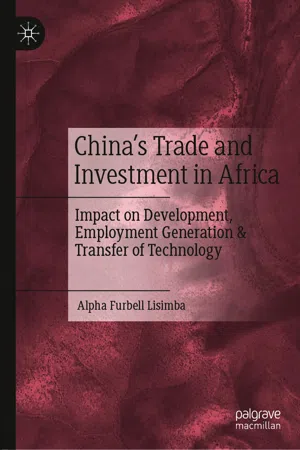
China’s Trade and Investment in Africa
Impact on Development, Employment Generation & Transfer of Technology
- English
- ePUB (mobile friendly)
- Available on iOS & Android
eBook - ePub
China’s Trade and Investment in Africa
Impact on Development, Employment Generation & Transfer of Technology
About this book
The core argument of this book is that China poses both challenges and creates opportunities for Africa, and that the transformative potentials of China-Africa engagements can be compared to Africa's experiences with European colonialism. However, it would be patently misleading to claim any equivalence between African experiences of European colonialism with Africa's engagements with China. Although, China does not replicate the exact colonial model, its actions have all elements of dependent relations, thus underpinning neo-colonialism with Chinese characteristics. Analysing China's growing economic relations with Africa, this book posits that, Africa's underdevelopment situation with China does not indicate a significant point of departure from the colonial model of development because China's actions in Africa, although not exactly colonial, have all possibilities of Neocolonialist model with Chinese characteristics. As such the author argues that China's increasing trade, FDI inflow and influence on the economic growth and development in Africa will result in a long-term negative impact in development outcomes and capacity building, governance practice, democratic transition and human rights for future self-reliance and sustainable development.
Information
Part IConceptualising China-Africa Relations
© The Author(s), under exclusive license to Springer Nature Singapore Pte Ltd. 2020
A. F. LisimbaChina’s Trade and Investment in Africahttps://doi.org/10.1007/978-981-15-9573-8_11. China–Africa Relations: Historical Perspective
Alpha Furbell Lisimba1
(1)
Melbourne, VIC, Australia
Keywords
EconomyGrowthChinaAfricaPeripheryCoreEnergyInvestmentGlobalIntroduction
One of the major noticeable changes that have taken place in the twenty-first-century international order is the ongoing economic shift. The contemporary shift in the economic power from North to East, with the emergence of new economic powers such as China, South Korea, Russia and India is noteworthy. In order to keep the path of their economic growth rate, these emerging economies were searching for sources to avail raw materials and avenues for market expansion and new investments. Africa with its vast reserves of natural resources and sizeable market size, soon figured as the most desirable prize for the emerging economies (Alden and Large 2018). China’s spectacular economic growth and the enhancement of its strategic power is followed quite keenly around the globe, triggering anxiety as well as admiration in different parts of the world. The developing world has been quite appreciative of China’s rise in the global order and these countries look forward to closer cooperation with China to reinvent their own development model (Brautigam 2009; Moyo 2009; Broadman 2008). Africa for example, sees China as a powerful global actor that can aid development in the continent, given its own history of socio-economic development. Most of the African continent has been on the margins of the mainstream global economic development for a long time and China’s rise and its increasing interest in the African economy is viewed with a great degree of anticipation in the continent (Taylor 2009; Kagame 2009; Alden 2008). China has been building up considerable economic and political influence with countries in Africa in recent years (Alden 2007; Carmody 2011; Brautingam 2011; Taylor 2006; Naidu and Ampiah 2008). The China–Africa relationship has captured global attention due to its rapid rate of growth, geopolitical implications of the strengthening relationship and its long-term effects on growth and development in the African continent has become a subject of debate among scholars who are concerned with the rise of China and its developmental implications for the world and Africa in particular. The emerging economic and political integration of China and Africa has been studied by a number of leading IR and IPE scholars; they have examined China’s rise and its relationship with other developing countries (Alden 2007; Carmody 2011; Brautingam 2011; Taylor 2006). China–Africa relations have been analysed from different perspectives (Mlambo 2019; Lubieniecka 2014) as this emerging alliance of China and Africa has serious implications for geopolitics, geo-economics and geostrategic objectives, not only for China and Africa but also for the larger international community. A greater alignment of China–Africa objectives has generated a high degree of interest among different global powers as this relationship incorporates a crucial dimension of the global political economy (see for example Draper and Le Pere 2007; Carmody and Owusu 2007; French 2007). Draper and Le Pere have noted that there is a risk of China–Africa economic relations being caught in the ‘colonial trap’, a pattern of trade where Africa was mainly the supplier of resources, minerals and a market for the traditional trading partners and China exporting manufactured goods and advanced technologies to Africa. While China’s increasing trade and investment in Africa is a good opportunity for Africa to review its development strategies with this new partner, the key challenge for the African states is to manage and shape their interaction with China in a way which guarantees that it will benefit their own economies and not lead to building personal wealth at the expense of wider population—this is perhaps the most challenging task to test the maturity of the African leaders and their determination and political will to tackle the problems of poverty and other social challenges which the continent encounters today.
China’s deepening economic engagement with Africa is one of the most significant developments in international relations and specifically in international political economy (IPE) in the post-Cold War era (Raine 2009). This debate is articulated within the context of South–South trade activities as opposed to the traditional South–North relations which has been consistently criticised by unfair trade advocates of hindering Africa’s development potential (Hirsch 2018). The criticism of North–South interaction is based on the ground that trade activities between the two benefits the Global North more at the expense of the Global South (‘Naidu and Ampiah 2008’ Shelton and Garth Le Pere 2007). China’s engagement in Africa has attracted significant attention from major global powers and it has also generated policy and scholarly debates on the nature, scope and implications of this relationship (Naidu and Ampiah 2008; Naidu et al. 2009; Alden 2007; Taylor 2006). It can be argued that China’s interest in Africa is not altogether new, however, in the current geopolitical climate, China’s reinvigorated economic, political, military and cultural links with Africa has created ripples in the established global order (Tan-Mullins et al. 2010; Friedman 2009). China’s ever-increasing involvement in Africa can be seen in the growing volume of China’s investment in the resources-rich countries (RRDCs) and non-resources-rich (NRRDCs) countries in Africa. China has employed its economic power and political influence to build closer diplomatic and economic links with the African countries. Gradually with additional trade and investment in Africa, China has emerged as the most important trading partner in the region.
China’s emergence as a key economic powerhouse in Africa has become the subject of intense global scrutiny, not only because of how China does business and consolidates its economic position in Africa, but also because of the impact of these relations on economic development outcomes and capacity building in Africa (Alden 2007; Taylor 2006; Naidu and Ampiah 2008). China is viewed as an enigma: on the one hand China symbolises a challenge to Africa’s long-term and sustainable development (Taylor 2009; Tull 2006), while on the other, China presents tempting and tantalising opportunities for economic growth and development of the continent (Moyo 2009; Shinn and Eisenman 2012; Alves and Power 2012). Although economic development models of Europe and the United States, which are based on the ‘Washington Consensus’ (WC), continue to dominate several parts of Africa; China’s development model known as Beijing Consensus (BC) has quickly become prominent and welcomed by all African states as an alternative to the former. The reason is that the BC is anchored on economic and political assistance to Africa in comparison to the WC that focused on institutional reforms especially in Africa as requisite for development assistance to Africa (Lopes 2012). The WC is a set of policies underpinning the World Bank’s operations, derived from neoliberal economic thought that placed the freedom of the market above all else, condemning state intervention and arguing that strengthening the market in the form of free trade and democratic stability would empower those in developing countries to achieve rapid economic success and democratic transformation (Lopes 2012). However, Washington-based international financial institutions namely IMF and the World bank responsible for imposing the (WC) Consensus policies in Africa ignored the specific circumstances of each country, adopting a one-size-fits-all policy which failed to spur growth in the continent. Following criticism of the World Bank’s track record during the 1980s and the 1990s in Africa, debate within Washington-based institutions led to a re-evaluation of the role of the state in Africa and support for domestic institutions necessary for successfully implementing capitalist donor projects (United Nations Economic Commission for Africa, UNECA 2019). The post-Washington Consensus era experienced new policies with arguments within these liberal institutions for more transparency in functioning and the strengthening of these institutions in developing countries, due to their failure to achieve designed goals in Africa, including the financial system, the civil service, government and local legal systems (Lopes 2012; Bretton Woods Project 2019). As Africa started to feel China’s growing economic influence, it gradually started to fully accept the Chinese model of economic development, the ‘Beijing Consensus’ (BC) as an alternative to the Washington Consensus (WC). Similar to WC, the rival Beijing Consensus (BC) is a term used to refer to the set of economic development or reform policies introduced after the death of Chairman Mao Zedong (Bennhold 2011). It is purely an economic model which is presented as an important challenge to the Washington Consensus (WC). In contrast to the WC, the BC, as an economic development model encourages the heavy involvement of the state in economic activities and country’s development process (Bennhold 2011). Moreover, the BC is seen by most African governments as most suitable because it provides loans and grants with more flexible conditionality in comparison to that of the ‘Washington Consensus’ (Mensah 2010; Baah and Jauch 2009; Thompson 2005). Most importantly the BC unlike WC which asks states to implement multiple donor projects only focusses on projects that benefit donor projects.
On the other spectrum, the debate about development in Africa is regularly framed with reference to the historical baggage of colonialism. One of the key arguments that explains most of the contemporary challenges that beset Africa, underlines the legacy of extractive colonial policies which had pushed Africa’s economy to an inferior position vis-à-vis the European colonial states. Postcolonial Africa has experienced high incidences of ‘Civil Wars’ and ‘Political Instability’, not triggered entirely by ethnic divisions of colonial policies but also due to the lack of effective tools and resources for economic development and poverty alleviation due to the failure of the continent’s postcolonial leadership. Further to this, a number of these political upheavals and civil unrests emerge from the lack of successful tools and resources for inclusive economic development. This situation has further worsened by the lack of robust institutional and infrastructural capacities in Africa; certainly, a number of these structural insufficiencies are inherited from colonial rule (Sachs et al. 2004). Majority of African states since their liberation had access to some kind of foreign aid and assistance, mostly from the United States and one-time European colonial powers (Di Muzio 2016). These economic assistance packages but did not...
Table of contents
- Cover
- Front Matter
- Part I. Conceptualising China-Africa Relations
- Part II. The Impact of China’s Trade and Investment on Employment Generation, the Transfer of Technology, Debt Trap and the Emergence of New Form of Dependency
- Back Matter
Trusted by 375,005 students
Access to over 1.5 million titles for a fair monthly price.
Study more efficiently using our study tools.
Frequently asked questions
Yes, you can cancel anytime from the Subscription tab in your account settings on the Perlego website. Your subscription will stay active until the end of your current billing period. Learn how to cancel your subscription
No, books cannot be downloaded as external files, such as PDFs, for use outside of Perlego. However, you can download books within the Perlego app for offline reading on mobile or tablet. Learn how to download books offline
We are an online textbook subscription service, where you can get access to an entire online library for less than the price of a single book per month. With over 1.5 million books across 990+ topics, we’ve got you covered! Learn about our mission
Look out for the read-aloud symbol on your next book to see if you can listen to it. The read-aloud tool reads text aloud for you, highlighting the text as it is being read. You can pause it, speed it up and slow it down. Learn more about Read Aloud
Yes! You can use the Perlego app on both iOS and Android devices to read anytime, anywhere — even offline. Perfect for commutes or when you’re on the go.
Please note we cannot support devices running on iOS 13 and Android 7 or earlier. Learn more about using the app
Please note we cannot support devices running on iOS 13 and Android 7 or earlier. Learn more about using the app
Yes, you can access China’s Trade and Investment in Africa by Alpha Furbell Lisimba in PDF and/or ePUB format, as well as other popular books in Economics & International Business. We have over 1.5 million books available in our catalogue for you to explore.