This collection turns a spotlight on gender innovation in the social sciences. Eighteen short and accessibly written case studies show how feminist and gender perspectives bring new concepts, theories and policy solutions. Scholars across five disciplines– economics, history, philosophy, political science and sociology – demonstrate how paying attention to gender can sharpen the focus of the social sciences, improve the public policy they inform, and change the way we measure things. Gender innovation provokes rethinking at both the core and the margins of established disciplines, sometimes developing alternative fields of research that chart new territory. These case studies celebrate the contribution of feminist and gender scholars and span topics ranging from budgeting, electoral systems and security studies to the ethics of care, emotional labor and climate change.
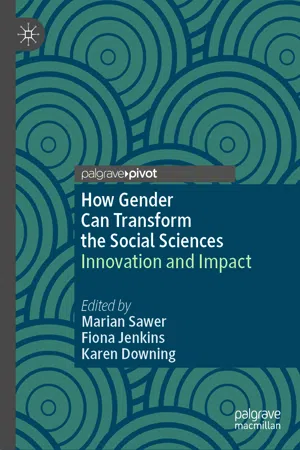
eBook - ePub
How Gender Can Transform the Social Sciences
Innovation and Impact
- English
- ePUB (mobile friendly)
- Available on iOS & Android
eBook - ePub
How Gender Can Transform the Social Sciences
Innovation and Impact
About this book
Information
Part IIntroduction
© The Author(s) 2020
M. Sawer et al. (eds.)How Gender Can Transform the Social Scienceshttps://doi.org/10.1007/978-3-030-43236-2_11. Introduction: The Gender Lens and Innovation in the Social Sciences
Fiona Jenkins1 , Marian Sawer1 and Karen Downing1
(1)
The Australian National University, Canberra, ACT, Australia
Abstract
This collection turns a spotlight on the transformations wrought by gender innovation in the social sciences. Eighteen short and accessibly written case studies show how feminist and gender perspectives bring new concepts, theories and policy solutions. Scholars in five disciplines—economics, history, philosophy, political science and sociology—demonstrate how paying attention to gender can sharpen the focus of the social sciences, improve the public policy they inform and change the way we look at things. Gender innovation provokes rethinking at both the core and the margins of established disciplines, sometimes developing new fields of research that chart new territory. These case studies celebrate the contribution of feminist and gender scholars and the impact of their work within and beyond the social sciences.
Keywords
Social sciencesGender lensPublic policyCase studiesInterdisciplinarityHow is our understanding of social, economic and political questions transformed when we apply a gender lens? In this book we turn a spotlight not so much on the flaws of gender-blind social science as on the positive contribution being made by gender innovation. By offering a series of case studies that exemplify major new insights, we show how new approaches to old questions arise from paying attention to gendered differences in experience, opportunity and outlook; or how entirely new questions and areas of study can arise from critically examining the presuppositions of the social sciences.
The case studies presented here all reveal how the application of a gender lens has sharpened the focus of the social sciences, offering gains in understanding and new approaches to problems. They reveal, for instance, the ways in which gender research can improve our response to climate change or disaster management, and enable recognition of the importance of care-giving to the economy. A gender lens also changes our approach to calculating GDP, measuring poverty, evaluating electoral systems or telling the stories of our nation-states.
This gender innovation has had more impact in some areas of social science than others. Each of the case studies begins with the gaps in knowledge that existed in a particular subject area before gender perspectives provided new insights. They are loosely grouped into the disciplines of philosophy, political science, history, economics and sociology, to provide the context for a wider discussion of how, in each of these fields, questions of gender arise in distinctive ways. We also highlight the wide variation in the impact of gender innovation on mainstream areas of these disciplines. Our project grew from an interest in assessing and interpreting the evident differences between disciplinary fields in the extent to which feminist and gender perspectives have transformed their thinking. Our research suggests that there are strong correlations between the extent of women’s progress and the relative degree of transformation of these disciplines. Disciplines that perform poorly at achieving gender parity—for instance, economics, philosophy and political science—also miss out on the valuable insights of gender innovation.
In this introduction we begin by acknowledging some of the existing work on the practice of feminist research across the social sciences, before introducing our case studies and what they tell us about gender innovation in different disciplines.
Feminist Research Practice
There are a number of excellent surveys of feminist research practice that show how social science can be improved by taking gender into account. These include the classic Feminist Methods in Social Research published by Shulamit Reinharz (1992) and the more recent Handbook of Feminist Research edited by Sharlene Nagy Hesse-Biber (2012). Both drew attention to the wide varieties of method being used by feminist researchers across the social sciences, arguing this diversity was a strength not a weakness. While feminist researchers have tended to favour qualitative and mixed-methods approaches rather than purely quantitative ones, they have drawn on the full range of methods found in the social sciences with the possible exception of rational choice. Rational choice theory provides a framework for modelling social and economic behaviour, for example, through the mathematical framework provided by game theory, and has spread beyond economics into political science and elsewhere. It presents difficulties for feminist researchers in being based on methodological individualism (the assumption of the autonomous rationally choosing individual) rather than looking at the broader social structuring of choice by factors including gender and race relations.
Despite the variety of method, a common feature of feminist research practice is the ‘feminist research ethic’—emphasising the need for reflexivity about power relations and the values the researcher brings to their research (Ackerly and True 2019 [2010]). In the past, explicit acknowledgement of values sometimes led to judgements that feminist research lacked legitimacy, that it was not ‘objective’. In response, feminist researchers identified the unacknowledged values often causing distortions in social science research. Reflexivity may entail disclosure of embodiment and standpoint, including lived experience of discrimination and marginalisation but also of relatively advantaged locations; such disclosure adds to rather than detracting from the value of research by acknowledging the situation in which it is conducted. Feminist research, moreover, avows its ethical and political commitments in undertaking enquiry that will increase understanding of the nature and source of gender inequalities in order to change them. This normative component and emphasis on reflexivity are unifying characteristics of feminist research, which otherwise now varies widely in its methods and approach.
One change that has taken place in feminist research practice over time has been an increased focus on ‘intersectionality’. This meant expanding the analytic construct of gender to encompass the intersection of gender with identities and oppressions relating to race, class, sexuality, disability, ethnicity or other attributes. The concept of intersectionality was introduced by Kimberlé Crenshaw to bring into focus the distinctive experience of African American women and the intersecting identities and privileges that complicate gendered power relations (Crenshaw 1989). The concept was quickly taken up by gender experts, both scholars and practitioners, who began to refer to gender equality policies as ‘gender+’ policies, to emphasise that other axes of inequality always intersect with gender.
Queer theory emerged in the 1990s, challenging in various ways assumptions about the ‘normal’ alignment of gender, sex and sexuality as well as binary thinking about natural sex difference. Key theorists such as Judith Butler argued that the social regulation of gender through ‘heteronormative’ practices fails to take account of the possibilities for organising gender experience and relations differently (Butler 2006 [1990]). Queer theory has stressed not just the social construction but also the materiality of gender as embodied and ‘performative’, and therefore has criticised the familiar assumption that gender is socially constructed whereas ‘sex’ is simply a given bodily identity (male or female). Sex, on this influential account, is not simply a biological fact, but becomes embodied in ways that are highly variable (see discussions by Roberts and Jolly in this volume).
Another change arising from shifting the focus towards a broader and more complex understanding of gender and power has been the increased attention paid to the construction of masculinities, the nature of ‘hegemonic masculinity’ and its variation over time and place. Here insights about heteronormative and patriarchal social orders are brought together with insights about the way power reproduces itself. Like other feminist research, this has been closely tied to policy applications such as violence prevention and the role of men and boys in achieving gender equality (Connell 1995; Breines et al. 2000).
Queer theory, attention to masculinities and gender+ have all advanced the understanding of gender and its relationship with power. A dominant but still too often unacknowledged focus on some men’s experience and life worlds continues to shape both the social sciences and public policy. Gender innovation takes place not just by exposing this bias but by offering fresh and productive perspectives and new analytic tools.
The Gender Innovation Case Studies
Our case studies of gender innovation come from the five disciplines, that are the subject of the recent Gendered Excellence in the Social Sciences project—namely philosophy, political science, economics, history and sociology. The GESS project has been researching the relationship between the status of women in these social science disciplines and the integration of gender innovation and feminist research. It has employed a complex framework, comparing the recognition of women and of feminist scholarship across the five disciplines and four countries—Australia, Canada, the United Kingdom and the United States. The project has amassed a wide range of data, including academic workforce statistics, recognition indices and bibliometrics.1 Its publications (including special journal issues and books) have included comparative work on the differences between disciplines in mainstreaming gendered knowledge, viewed against the differences in women’s presence and leadership across disciplines and across countries.
One aim of the project has been to identify the kind of gender innovation taking place in the social sciences and the extent of its impact on how disciplinary knowledge is produced. An international conference hosted by the GESS project in 2016 identified significant innovations and the extent of their integration into disciplinary mainstreams. It found, for example, that in the disciplines of economics and political science, the public policy impact of feminist scholarship tended to be greater than impact within the discipline itself. The case studies presented in this book have their origins in the gender innovation strand of the GESS project and illustrate how gendered approaches have resulted in new knowledge, both theoretical and applied. Despite the very different disciplinary contexts, there are common themes, such as the need to expand existing concepts so that they more satisfactorily explain complex problems.
Philosophy
Philosophy has been and remains one of the most male dominated of the academic disciplines (Hutchison and Jenkins 2013). Despite the fact that feminist philosophy has been a highly productive and influential sub-field, its impact to date has been felt beyond rather than within the discipline. The contribution of feminist researchers highlighted by our two case studies in philosophy address ethics and epistemology, and both have wide implications for social science research, social policy and social relations but have enjoyed only limited uptake within the central academic journals of the discipline (Pearse et al. 2018).
The approach described as an ‘ethics of care’ was first developed in the 1980s as part of a wave of feminist revaluations of moral philosophy. By demonstrating how the history of philosophical thinking on ethics systematically downgraded virtues associated with women, feminist approaches both invited a reappraisal of the foundations of the discipline and offered new recognition of essential dimensions of human life. Gaining a better understanding of the value of care work is a major theme in other case studies in this volume, proving to be a missing piece in many accounts of the economy. Recognising how unpaid care and paid work interact also leads to better historical understanding of women’s roles and identities. This case study discusses the impact of the ethics of care on a wide range of areas including security studies and environmentalism.
Likewise, the concept of ‘epistemic injustice’ offers a rich and influential account of how knowledge is beholden to social relations. Philosophers have traditionally thought of knowledge in highly individualised and abstract terms. This feminist approach shows how knowing relies upon relations of testimony and trust which are downplayed in conventional accounts of knowledge. As such, it can be chronically distorted by gender, race and class relations. All of these lead to unreasonably high credibility attaching to some speakers and low credibility to others. It is a form of injustice that has had significant effects on policy, on science and on medicine, as the case study shows. Epistemic injustices, we would argue, have detrimentally shaped all the university disciplines and further afield, our social, legal and political institutions.
Political Science and International Relations
The political science and international relations (IR) case studies of gender innovation throw new light on the operation of political institutions and political recruitment. Conceptual tools that take gender into account have been refined from existing approaches in the discipline, including discourse analysis, with its emphasis on the politics of framing, and new institutionalism with its emphasis on informal rules, as well as more quantitative approaches (Sawer 2020; Sawer and Baker 2019). New knowledge concerning electoral systems, candidate quotas, parliamentary practices and gendered electoral violence has been generated—often with immediate policy impact. While political science once assumed that politics was a male domain, it now helps promote gender equality and gender+ equality projects. Our case studies illustrate the different ways in which a gender lens has contributed to the disc...
Table of contents
- Cover
- Front Matter
- Part I. Introduction
- Part II. Philosophy
- Part III. Political Science
- Part IV. History
- Part V. Economics
- Part VI. Sociology
- Part VII. Transdisciplinary Innovation
Trusted by 375,005 students
Access to over 1.5 million titles for a fair monthly price.
Study more efficiently using our study tools.
Frequently asked questions
Yes, you can cancel anytime from the Subscription tab in your account settings on the Perlego website. Your subscription will stay active until the end of your current billing period. Learn how to cancel your subscription
No, books cannot be downloaded as external files, such as PDFs, for use outside of Perlego. However, you can download books within the Perlego app for offline reading on mobile or tablet. Learn how to download books offline
Perlego offers two plans: Essential and Complete
- Essential is ideal for learners and professionals who enjoy exploring a wide range of subjects. Access the Essential Library with 800,000+ trusted titles and best-sellers across business, personal growth, and the humanities. Includes unlimited reading time and Standard Read Aloud voice.
- Complete: Perfect for advanced learners and researchers needing full, unrestricted access. Unlock 1.5M+ books across hundreds of subjects, including academic and specialized titles. The Complete Plan also includes advanced features like Premium Read Aloud and Research Assistant.
We are an online textbook subscription service, where you can get access to an entire online library for less than the price of a single book per month. With over 1.5 million books across 990+ topics, we’ve got you covered! Learn about our mission
Look out for the read-aloud symbol on your next book to see if you can listen to it. The read-aloud tool reads text aloud for you, highlighting the text as it is being read. You can pause it, speed it up and slow it down. Learn more about Read Aloud
Yes! You can use the Perlego app on both iOS and Android devices to read anytime, anywhere — even offline. Perfect for commutes or when you’re on the go.
Please note we cannot support devices running on iOS 13 and Android 7 or earlier. Learn more about using the app
Please note we cannot support devices running on iOS 13 and Android 7 or earlier. Learn more about using the app
Yes, you can access How Gender Can Transform the Social Sciences by Marian Sawer, Fiona Jenkins, Karen Downing, Marian Sawer,Fiona Jenkins,Karen Downing in PDF and/or ePUB format, as well as other popular books in Social Sciences & Economic Theory. We have over 1.5 million books available in our catalogue for you to explore.