European colonization played a major role in the acquisition, formation, and destruction of different ways of knowing. Recently, many scholars and activists have come to ask: Are there ways in which knowledge might be decolonized? Epistemic Decolonization examines a variety of such projects from a critical and philosophical perspective. The book introduces the unfamiliar reader to the wide variety of approaches to the topic at hand, providing concrete examples along the way. It argues that the predominant contemporary approach to epistemic decolonization leads one into various intractable theoretical and practical problems. The book then closely investigates the political and scientific work of Frantz Fanon and Amílcar Cabral, demonstrating how their philosophical commitments can help lead one out of the practical and theoretical issues faced by the current, predominant orientation, and concludes by forging links between their work and that of some contemporary feministepistemologists.
eBook - ePub
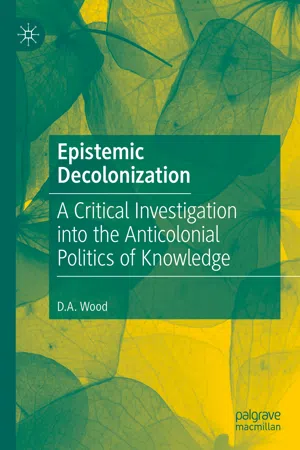
Epistemic Decolonization
A Critical Investigation into the Anticolonial Politics of Knowledge
- English
- ePUB (mobile friendly)
- Available on iOS & Android
eBook - ePub
Epistemic Decolonization
A Critical Investigation into the Anticolonial Politics of Knowledge
About this book
Information
Topic
PhilosophySubtopic
World History© The Author(s) 2020
D. WoodEpistemic Decolonizationhttps://doi.org/10.1007/978-3-030-49962-4_11. Introduction
D. A. Wood1
(1)
Dillard University, New Orleans, LA, USA
D. A. Wood
Keywords
Critical theoryEpistemic decolonizationIdeologyTaken as a whole, European colonization has transformed the political, legal, social, gendered, economic, environmental, and cultural dimensions of the world more than any other set of historical processes in the past half-millennium. “Whereas in 1800 Europe and its colonies covered around 55 per cent of the globe, in 1878 they covered 67 per cent and in 1914 84 per cent.”1 Laws, customs, racial geographies, ecologies, desires, and political borders around the world harbor their own colonial histories. In some cases, these realities serve as signs of successful resistance to past forms of conquest and domination. At other times, they endure as scars—reminders of wounds that have never fully healed and which remain tender, or, even worse, which threaten to reopen. Due to modern colonialism’s vastness and deep entrenchment in so many different spheres, it is hard to imagine anyone currently living whose existence has not been affected or shaped by it in one way or another. Well-aware of this state of affairs, many theorists and activists have striven to better comprehend those colonial realities that have shaped and continue to structure our world—however hidden and ugly they might be. This book critically examines and evaluates a variety of different approaches to one such reality among others, namely, the relation between modern colonialism and knowledge.
To demonstrate the types of problems with which this book concerns itself, I begin with three short stories that have different characters and settings, yet which share some common themes. Despite the centuries that separate them, the examples below highlight episodes in which colonialism and colonialist ideology, on the one hand, and the pursuit and production of knowledge, on the other, bear upon one another. The first story concerns Francis Bacon’s New Atlantis, the second recounts moments from the history of the Manhattan Project, and the third pertains to contemporary biocolonialism. After recounting each story, I will note some of their shared patterns to introduce this book’s overarching themes.
1.1 Three Stories
During the lifetime of the philosopher Francis Bacon (1561–1626), mercantile capital had begun to generate substantial competition between rival European powers. Along with the Dutch and the French, England in the sixteenth and seventeenth centuries set out to curb Spanish colonialism through state-sanctioned privateering, smuggling, and raiding in the Americas. To these forms of extraction were added the conquest and establishment of overseas settler colonies and plantation systems in the early seventeenth century. The ensuing regular encounters between British forces and Indigenous groups resulted in the marginalization and decimation of the latter, most notably in the burgeoning Atlantic slave trade, the first voyage of which set sail from England the year after Bacon’s birth. Already by the middle of the seventeenth century, over one million slaves had been imported into Anglo-America.2
Bacon served as Lord Chancellor under James I and was an active member of the Commons during the initial emergence of the British Empire. He referred to colonies as ‘heroical works’ and appropriated the Emperor Charles V’s expansionist motto plus ultra (further yet) for his natural-philosophical schemes. Nonetheless, Bacon remained unsatisfied with some of James I’s policies, and toward the end of his life he began to write a utopian novella entitled New Atlantis in which he implicitly criticized the king’s underestimation of the importance of using empirical research for England’s increased international-political empowerment. New Atlantis depicts a ship of Spanish sailors who come across an island called ‘Bensalem’ west of Peru in 1612. The crew learn from Bensalem’s governor that one night in the distant past, the canonical and non-canonical works of the Bible (even those which had not yet been written) came to the island amidst a bright pillar of light. On this island, there exists the ideal institution of scientific learning, Salomon’s House, whose research is in part supported by camouflaged ships of men who set sail to obtain new knowledge every dozen years. And, the House’s overt, central purpose of investigating the “Causes, and secret motions of things” operates in conjunction with the “enlarging of the bounds of Human Empire, to the effecting of all things possible.” Well on its way to such an ideal, Salomon’s House excels in the acquisition and production of unrivaled forms of knowledge, medicine, and futuristic technology. Bacon’s vision of this ideal natural-philosophical institution, which would later be taken as a model by “mid-century republicans and the monarchist founders of the Royal Society,” united the ends of science with those of empire in such a way that both could mutually reinforce each other.3
The elements of patriarchy and racism both inside and outside of Salomon’s House suggest that the expansion of the bounds of ‘Human Empire,’ to Bacon’s mind, would not do away with the hierarchical subordination of some types of human being to others. Bensalem in general and Salomon’s House in particular are both governed exclusively by men, and different rituals serve to entrench this utopia’s androcracy. The author depicts the greatest achievement attainable by a woman as being the bearer of a long lineage of men, for which she can be seated in a lofted chair during the celebration of the family, but where she must nevertheless remain concealed, able to see through a window but not be seen. Such social and political views infuse Bacon’s natural philosophy as well, and he often describes the investigation of nature in gendered and sexualized terms or through analogies involving heterosexual marriage. Similarly, negative racial prejudices continue to circulate freely within the novella’s imaginary. For example, mention is made of “a little foul ugly Æthiop,” and terms of disparagement are marshalled to distinguish some of Bensalem’s policies from those of the Orient: “It is true, the like law against the admission of strangers without licence is an ancient law in the kingdom of China, and yet continued in use. But there it is a poor thing; and hath made them a curious, ignorant, fearful, foolish nation.”4
A little over three centuries later, in October 1941, US President Franklin D. Roosevelt was informed about the potential for constructing a nuclear weapon. The US had entered an arms race with the Germans to develop a super bomb, and its ensuing Manhattan Project culled together some of the most powerful minds in science. Italian émigré Enrico Fermi undertook the task of creating a chain reaction by fission at the University of Chicago. “He built a small reactor, called an atomic pile, under the stands at the west of Stagg Field in a space that had previously been squash quarts. It was constructed of blocks of graphite (a kind of carbon that absorbed neutrons, uranium, and uranium oxide.” The success of his experiments marked the beginning of the “atomic age.”5
Arthur Compton was another member involved in the possibility of creating a nuclear bomb. Present at Fermi’s successful test, he called James Conant at Harvard University to secretly relay the results,Following this famous exchange, those of the Manhattan Project set their sights on producing an uncontrolled chain reaction. An unprecedented amount of uranium would be required for such a large project, and because “the best known sources in Europe and the Belgian Congo were under the control of Germany, new mines were needed.”6 Such resources were uncovered in northern Canada, where aboriginal laborers were used to mine and haul radioactive materials to supply the Manhattan Project, which led to a variety of chronic illnesses and cancers among these workers. Abandoned uranium mines in Colorado and nuclear tests conducted in New Mexico and Nevada have also led to serious, lasting health problems for many different Native American groups.7 After the first nuclear test which created an “implosion with conventional explosives that compressed the fissionable material and set off the uncontrolled chain reaction,” the Scientific Director chosen by Brigadier-General Leslie Groves, Robert Oppenheimer, quoted the Bhagavad-Gita, saying, “…now I am become Death, the destroyer of worlds…”8
“The Italian navigator has landed in the New World,” said Compton.
“How were the natives?” asked Conant.
“Very friendly.”
The lands of Native American peoples in North America were not the only colonized spaces in the twentieth century where Western powers unleashed toxic chemicals. Contemporary transnational corporations have used various forms of scientific knowledge to foist chemically-based industrial agriculture onto former colonies. After the two World Wars, factories which possessed the capacity to fixate nitrogen to build explosives were transformed into plants for the production of synthetic fertilizers. Throughout much of the Global South, US-led corporations then played and continue to play the leading role of economic missionaries for these fertilizers, as well as for genetically modified seeds and herbicides (some of which have been named ‘Pentagon,’ ‘Prowl,’ ‘Assert,’ and ‘Avenge’). In addition to the immensely destructive effects of nitrate-based fertilizers on the atmosphere, their very production has come to devastate former colonies. “In 1984, the worst industrial disaster killed 3000 when a gas from a pesticide plant of Union Carbide leaked in Bhopal. 30,000 have died since then, hundreds of thousands have been crippled for life, and the Bhopal victims are still fighting for justice.”9
In order to increase profit margins, contemporary transnational corporations appropriate forms of knowledge from previously colonized spaces in order to patent (and so to ensure the exclusive rights to) such knowledge. This phenomenon has been referred to as ‘bioprospecting,’ ‘biopiracy,’ and ‘biocolonialism.’ To give but one example: Neem is a type of evergreen tree native to India. The US Department of Agriculture and the transnational corporation W.R. Grace took out a patent “for a method of controlling fungi on plants by the aid of an extract of seeds from the Neem tree.” However, Dr. Vandana Shiva, the European Parliament’s Green Party, and the International Federation of Organic Agriculture challenged the novelty of such a patent since the fungicidal qualities “of the Neem and its use has been known in India for over 2000 years and used to make insect repellents, soaps, cosmetics, and contraceptives.” While this patent was eventually revoked by the European Patent Office, many others still receive recognition as constituting genuine innovations. Such patents not only legalize theft and the ownership of types of living beings, but also encourage artificially inflating the prices of GMO varieties and their affiliated pesticides, thereby forging exploitative relations of economic dependency and criminalizing sustainable farming practices (such as saving seeds). Where such economic exploitation has become deeply ensconced, as i...
Table of contents
- Cover
- Front Matter
- 1. Introduction
- 2. An Epistemography of the Anticolonial Politics of Knowledge
- 3. Anti-Janus: Or, Impasses of the Differential Approach
- 4. The Fanonian Alternative
- 5. Becoming-Grounded: The Cabralian Option
- 6. Forging Alliances: Fanon, Cabral, and Contemporary Feminist Epistemology
- Back Matter
Trusted by 375,005 students
Access to over 1.5 million titles for a fair monthly price.
Study more efficiently using our study tools.
Frequently asked questions
Yes, you can cancel anytime from the Subscription tab in your account settings on the Perlego website. Your subscription will stay active until the end of your current billing period. Learn how to cancel your subscription
No, books cannot be downloaded as external files, such as PDFs, for use outside of Perlego. However, you can download books within the Perlego app for offline reading on mobile or tablet. Learn how to download books offline
Perlego offers two plans: Essential and Complete
- Essential is ideal for learners and professionals who enjoy exploring a wide range of subjects. Access the Essential Library with 800,000+ trusted titles and best-sellers across business, personal growth, and the humanities. Includes unlimited reading time and Standard Read Aloud voice.
- Complete: Perfect for advanced learners and researchers needing full, unrestricted access. Unlock 1.5M+ books across hundreds of subjects, including academic and specialized titles. The Complete Plan also includes advanced features like Premium Read Aloud and Research Assistant.
We are an online textbook subscription service, where you can get access to an entire online library for less than the price of a single book per month. With over 1.5 million books across 990+ topics, we’ve got you covered! Learn about our mission
Look out for the read-aloud symbol on your next book to see if you can listen to it. The read-aloud tool reads text aloud for you, highlighting the text as it is being read. You can pause it, speed it up and slow it down. Learn more about Read Aloud
Yes! You can use the Perlego app on both iOS and Android devices to read anytime, anywhere — even offline. Perfect for commutes or when you’re on the go.
Please note we cannot support devices running on iOS 13 and Android 7 or earlier. Learn more about using the app
Please note we cannot support devices running on iOS 13 and Android 7 or earlier. Learn more about using the app
Yes, you can access Epistemic Decolonization by D.A. Wood,D. A. Wood in PDF and/or ePUB format, as well as other popular books in Philosophy & World History. We have over 1.5 million books available in our catalogue for you to explore.