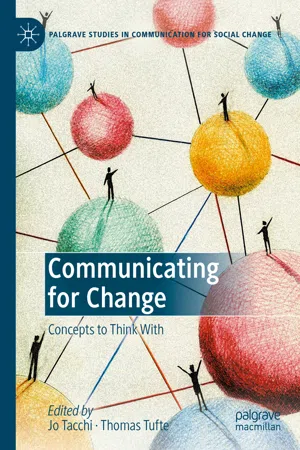
This book offers a fresh set of innovative and creative contributions related to the role of communication in processes of change. Given the current fast pace of social-economic, political and technological change across the globe, and the central role of communication in this, there is a growing need to reconceptualize how we approach communication and change that provides entry points to help us expand and enrich our scholarly and practical work. This collection presents 14 concepts from a multi-disciplinary collection of internationally leading and emerging scholars, from 13 countries on 5 continents. They come together around three meta-topics: citizenship and justice, critiques of development, and renewing thought (from and for the margins). The short chapter format ensures that authors get straight to the nub of their ideas, providing readers — students, scholars and practitioners alike — with accessible, engaging and innovative ways to think critically about communication and social change, in new ways.
eBook - ePub
Communicating for Change
Concepts to Think With
- English
- ePUB (mobile friendly)
- Available on iOS & Android
eBook - ePub
About this book
Information
© The Author(s) 2020
J. Tacchi, T. Tufte (eds.)Communicating for ChangePalgrave Studies in Communication for Social Changehttps://doi.org/10.1007/978-3-030-42513-5_15Disappearance
Florencia Enghel1
(1)
Jönköping University, Jönköping, Sweden
What Is the Problem?
That strategic communicative interventions in the functioning of human affairs can and must play a role in tackling social problems is a central tenet of communication for development /social change.1 Starting from that principle, the expression communication for development /social change refers here to a three-dimensional object that encompasses: (1) an academic field of study, (2) a more or less professional practice and (3) an institutional project. By “more or less professional practice”, I mean the practical work carried out on the ground or in intermediary organizations (typically non-governmental or other non-profit organizations) by workers who tend to freelance rather than be employed regularly and whose training and education vary. By “institutional project”, I mean the governance structures—national, bilateral, regional and multilateral—that set the wider agendas and establish the rules of the game that frame the practice of communication for development /social change. Each of these three dimensions has specific characteristics and a distinct scope. But they also interact with each other in ways that are enabled and constrained by their differential power, and their goals may coincide or compete (Enghel 2015).
Over the years, the academic field of study has been marked by a strong concern with identifying the achievement of tangible results on the ground and generally devoted to demonstrating usefulness and building normative models, paying scant attention to the contextual conditions in which the practice has taken place (Waisbord 2008; Chakravartty 2009; Thomas and van de Fliert 2014; Enghel 2015; Ferron and Guevara 2017). Calls to attend to the institutional arrangements made in Western countries and multilateral fora that enable and constrain the conditions of possibility of the practice have been issued, but not heeded (Ngomba 2013; Enghel 2015). Instead, repeated and never settled discussions about what communication for development/social change is or should be, and one-off studies of discrete initiatives, have prevailed over efforts to research the standing over time of communication for development/social change as a practice and an institutional project (Wilkins 2009; Enghel 2014; Ferron and Guevara 2017). More specifically, the fact that communication for development/social change once existed as a clear-cut institutional approach within specific types of organizations, and no longer does, remains unattended. As I will argue and illustrate throughout this chapter, the notion of disappearance is useful to address this blind spot.2
How Does Communication for Development/Social Change Disappear?
I started thinking about this notion years ago, out of a concern with the material dismantling of organizational spaces that were once dedicated to communication for development/social change and ceased to exist in ways that seemed rather sudden. Within the academic field of study, those disappearances tended to be taken for granted or explained away rather than questioned as potential indicators of shifts in the practice and institutional project (Enghel 2013, 2015). As a corrective to this shortcoming, in this chapter I put forward, unpack and illustrate a definition of disappearance in three senses: as observable fact, as conceptual lens and as path dependence.
Disappearance as Observable Fact
The first meaning refers to observable facts that speak of the instability, rather than the sustainability, of the practice and the project of communication for development/social change. In this sense, disappearance refers to the process by which the operations of an organization (or organizational unit) specifically devoted to communication for development/social change are discontinued, with potential repercussions across dimensions. Relatedly, disappearance refers more widely to the process by which communication for development/social change ceases to be implemented regularly in the absence of supportive infrastructures. While the first type of process alludes to single events that appear to take place rather rapidly,3 the second one hints at a more structural shift, which may or may not be incremental but in any case merits longitudinal analysis.
One empirical example of the first type is the dismantling of the World Bank’s (WB) Development Communication Division (DevComm) sometime towards the end of 2010. Created in 1998, DevComm was “devoted specifically to mainstreaming communication in Bank operations and upstreaming it in the development agenda” (World Bank 2007, p. xxv; Mefalopulos 2008). Its stated task was to support “the Bank’s mission of reducing poverty by providing clients with strategic communication advice and tools they need to develop and implement successful projects and pro-poor reform efforts”.4 The Division understood communication instrumentally, favoured a behavioural approach to the production of social change that turned a blind eye to politics, and may have served to distract from contradictions between the WB’s pro-participation discourses and its manipulative practices (Rush 2009; Enghel 2013). But, despite these arguably problematic qualities, while it lasted it also called increasing attention to communication as a valuable component of international development intervention within and beyond the WB.5 By 2003, the Division had 17 professional staff members working across four expertise areas.6 Between 2004 and 2006, in the process of organizing the First World Congress on Communication for Development (WCCD), to which I return later in this chapter, it contributed to spotlighting communication as a significant issue in the WB’s agenda. In 2007, it commissioned a study aimed at demonstrating the presumed positive impact of communication on development activities, that explicitly sought to influence research approaches within the field and succeeded by gaining traction among academics despite its methodological deficiencies (Inagaki 2007; see Enghel 2014 for a discussion of uncritical adoption). In 2008, the Division was said to be “consolidating and strengthening its core of activities” (Mefalopulos 2008, p. xix). However, in 2009 its activities started to wane.7 By 2012, when I could no longer locate the Division’s subpage in the WB’s website, I emailed a prominent WB DevComm member to ask what was going on. Surprisingly, s/he replied that s/he had no clue and asked me to contact a WB officer so they could look into it (personal communication).
In turn, the WB officer to which I was redirected gave me a polite but cryptic answer, which referred to the subpage only without clarifying the fate of the Division: s/he informed me that, unfortunately, the DevComm page was no longer available (personal communication). This told me that the WB had decided to shut down its DevComm Division without announcing the decision. In line with that institutional silence, the closure was not publicly discussed by scholars in the field of communication for development/social change despite the fact that a significant number of them had collaborated with the Division as expert consultants over the years, and neither its causes nor its consequences were researched.
A different empirical example of the first type of disappearance as observable fact is the closure of Panos London in 2013. Established in 1987, and registered as a charity in the UK, this organization operated during 26 years with the goal of fostering sustainable and equitable development through voice, dialogue, media and ICTs.8 Unlike ...
Table of contents
- Cover
- Front Matter
- Communicating for Change
- Outrage(ous) Citizenship
- Institutional Listening: An Essential Principle for Democracy in Digital Times
- Communicative Development
- Advocating with Accountability for Social Justice
- Intangible Outcomes (of Communication for Social Change)
- The Power of Weak Communication
- Context-Responsiveness
- Meaningful Mobilities
- Dramaturgy of Social Change
- Communicating Cosmopolitanism, Conviviality and Creolisation
- Artistic Conviviality
- Dissonance
- Pain in Communication for Social Change
- Disappearance
- Back Matter
Trusted by 375,005 students
Access to over 1.5 million titles for a fair monthly price.
Study more efficiently using our study tools.
Frequently asked questions
Yes, you can cancel anytime from the Subscription tab in your account settings on the Perlego website. Your subscription will stay active until the end of your current billing period. Learn how to cancel your subscription
No, books cannot be downloaded as external files, such as PDFs, for use outside of Perlego. However, you can download books within the Perlego app for offline reading on mobile or tablet. Learn how to download books offline
Perlego offers two plans: Essential and Complete
- Essential is ideal for learners and professionals who enjoy exploring a wide range of subjects. Access the Essential Library with 800,000+ trusted titles and best-sellers across business, personal growth, and the humanities. Includes unlimited reading time and Standard Read Aloud voice.
- Complete: Perfect for advanced learners and researchers needing full, unrestricted access. Unlock 1.5M+ books across hundreds of subjects, including academic and specialized titles. The Complete Plan also includes advanced features like Premium Read Aloud and Research Assistant.
We are an online textbook subscription service, where you can get access to an entire online library for less than the price of a single book per month. With over 1.5 million books across 990+ topics, we’ve got you covered! Learn about our mission
Look out for the read-aloud symbol on your next book to see if you can listen to it. The read-aloud tool reads text aloud for you, highlighting the text as it is being read. You can pause it, speed it up and slow it down. Learn more about Read Aloud
Yes! You can use the Perlego app on both iOS and Android devices to read anytime, anywhere — even offline. Perfect for commutes or when you’re on the go.
Please note we cannot support devices running on iOS 13 and Android 7 or earlier. Learn more about using the app
Please note we cannot support devices running on iOS 13 and Android 7 or earlier. Learn more about using the app
Yes, you can access Communicating for Change by Jo Tacchi, Thomas Tufte, Jo Tacchi,Thomas Tufte in PDF and/or ePUB format, as well as other popular books in Social Sciences & Media Studies. We have over 1.5 million books available in our catalogue for you to explore.