eBook - ePub
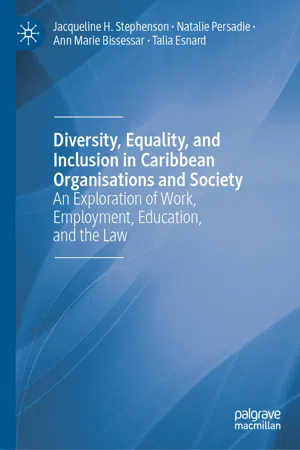
Diversity, Equality, and Inclusion in Caribbean Organisations and Society
An Exploration of Work, Employment, Education, and the Law
- English
- ePUB (mobile friendly)
- Available on iOS & Android
eBook - ePub
Diversity, Equality, and Inclusion in Caribbean Organisations and Society
An Exploration of Work, Employment, Education, and the Law
About this book
This book focuses on equality, inclusion, and discrimination within the English-speaking Caribbean region, specifically as it relates to employment, education, society, and the law. Though anti-discrimination laws have recently been enacted in the Caribbean, this, in and of itself, neither translates to societal changes nor changes within the organisational context. The authors examine racial diversity in public sector organisations in Trinidad and Tobago and Guyana, gender diversity in organisations across the Caribbean region, sexual orientation and its impact on employment, disability and access within organisations, and equality and inclusion within Caribbean institutions of higher education. Further, the book explores the region's equality laws and compares them with legislation from selected developed countries. This interdisciplinary text provides researchers in HRM, organisational behavior, sociology, and public policy with an overview of the types of discrimination prevalent within the Caribbean as well as the varied institutional frameworks in place that encourage equality.
Information
© The Author(s) 2020
J. H. Stephenson et al.Diversity, Equality, and Inclusion in Caribbean Organisations and Societyhttps://doi.org/10.1007/978-3-030-47614-4_11. Introduction
Jacqueline H. Stephenson1 , Natalie Persadie2, Ann Marie Bissessar1 and Talia Esnard1
(1)
University of the West Indies, St. Augustine, Trinidad and Tobago
(2)
The University of Trinidad and Tobago, Point Lisas, Trinidad and Tobago
The Anglophone Caribbean is an archipelago of former colonies of the United Kingdom (UK), which gained independence during the 1960s and 1970s. These islands include Antigua and Barbuda, the Bahamas, Barbados, Belize, Dominica, Grenada, Jamaica, St. Kitts and Nevis, St. Lucia, St. Vincent and the Grenadines, and Trinidad and Tobago. These populations vary in size from 52,441 (St. Kitts and Nevis) to 2,890,299 (Jamaica), according to the most recent census data (i.e. 2000–2001). The economies in the Caribbean region rely largely on tourism, oil and gas, manufacturing, agriculture, financial services and, in the main, are stable. These island states are considered variously as the third world or developing countries but are generally economies managed by qualified individuals with stable political governance and limited political unrest.
Despite being a collection of individual islands, governed by separate independent governments, the Caribbean region is often regarded as homogeneous, however, although the English-speaking islands are collectively referred to as the Commonwealth Caribbean, there is a widespread diversity across the island chain. Diversity may be broadly categorised as either surface- or deep-level diversity. Surface-level diversity refers to observable personal attributes such as sex, age, race inter alia, while deep-level diversity refers to less observable characteristics including one’s beliefs, values, attitudes and culture inter alia (Barak 2016; Phillips and Loyd 2006; Roberson 2019). Within these groups there are several points of departure particularly with respect to differences in age, sex, race, culture, socialisation and education, which are evident globally and by extension in the Caribbean region. Currently, there is a paucity of literature in relation to equality, diversity and inclusion with a focus on the English-speaking Caribbean (see Stephenson and Persadie 2019), hence the objective of this book is to critically assess whether, and the extent to which, these issues are practically and theoretically relevant, in respect of work, education, employment and society. To wit, this text examines diversity, discrimination, inclusion and exclusion, on the basis of sex, race, sexual orientation and disability, in relation to employment, education, politics and applicable legal and societal systems, in the Caribbean.
The debate concerning equal opportunities and non-discrimination is said to have evolved over time, from simply considering equality from a radical or liberal perspective (Jewson and Mason 1986), to enveloping new concepts, namely managing diversity accepting differences and inclusion (Kirton and Greene 2006). The three primary categories of equality are: equality of results, treatment/opportunity and consistency (Jewson and Mason 1986). It has been suggested that pursuing equality, with a view of treating everyone the same could be an “oversimplification of the problem”. This is because treating everyone the same could result in disadvantage, where for example within the organisational context, all employees are given access to the same printed employee manual. Although this may appear, prima facie, as an attempt to treat everyone the same, employees who are visually impaired would be unable to access the information in the manual, unless it is converted into braille or they are permitted to use specially designed software in order to access it. Such occurrences are observed in the workplace daily and this contributes to the failure of some equal opportunity initiatives (Liff and Wajcman 1996). Moreover, there is an absence of irrefutable evidence to support any assertion that equal treatment approaches have resulted only in benefits in relation to equality; in part, this is because acceptance of stereotypes appear to create some difficulty for organisational managers to conceptualise job requirements in neutral terms (Collinson et al. 1990; Curran 1988). An alternative approach to equality of treatment is to find a way to value and utilise employee differences. This is the managing diversity approach where organisations are encouraged to strengthen their workforce and competitive advantage by employing different people from those already in the workforce. This approach challenges the equal treatment model suggesting that people do not necessarily wish to be treated the same in every aspect of their working life but, by offering different working arrangements or benefits, employers facilitating the diversity approach may realise greater benefits within their workplaces, relative to those pursuing equality (Liff and Wajcman 1996). Managing diversity encourages a focus on inclusivity and embracing the skills and talents of different types of employees (Thomas 1990), which may involve changing workplace policies and practices such that there are no exclusions (intentional or unintentional) based on an employee’s immutable characteristics (i.e. age, sex, race, etc.). It has been argued that even though the language being used in relation to equality is continuously being updated, the changes are variations in emphasis, rather than paradigm shifts (Oswick et al. 2010). Otherwise stated, the underlying premise remains unchanged, i.e. the achievement of equity and fairness (Liff 1999).
One of the prevailing objectives in this ongoing discourse is the reduction and/or elimination of discrimination. Discrimination is said to occur when one person is treated less favorably than another, typically on the basis of immutable characteristics (Dipboye and Colella 2013). Discrimination in the Caribbean is prevalent primarily on the grounds of race, sexual orientation, sex and disability. As it relates to race, given the history of enslavement and indentured servitude within the region, there remains some latent hostilities among racial groups which comprise the populace (Bissessar 2002; Chadee 2003), which in turn gives rise on occasion, to discrimination on the basis of race, particularly between racial groups (primarily persons of African and Indian descent). Moreover, with buggery laws still in place in many Caribbean islands, a remnant of colonial rule, discrimination is rife against persons with an other than heterosexual orientation, i.e. members of the Lesbian, Gay, Bisexual, Transgender and Queer (LGBTQ) community. This is further reinforced by the extent to which deterrent punitive measures are embedded in relevant legislation, prevailing cultural norms, and religious beliefs, which dictate expected and accepted sexual behavior, such that any deviation is opposed and rejected without due consideration (CADRES 2013a, b, c). Further, discrimination on the grounds of sex is manifested within society with men and women expected to perform certain roles in the home, workplace and society more broadly. For women, disparate treatment can have an adverse effect on their ability to obtain and retain desirable full employment, their remuneration, development and career progression (Bissessar 2014; Esnard et al. 2015; Mahabir and Ramrattan 2015). Within the Caribbean region, for persons of working age, having a disability may prove challenging when trying to secure employment; this is in part due to the acceptance of stereotypes by employers as it relates to persons with disabilities (PWD) and their capabilities. Such disparate treatment is also evident within wider society as persons with disabilities experience less inclusion, and social satisfaction as a result of their treatment and perception by the populace, as a homogeneous group with significant limitations which prohibit their inv...
Table of contents
- Cover
- Front Matter
- 1. Introduction
- 2. Race Relations in the Caribbean: The Myth of Representative Bureaucracy
- 3. Equality and Discrimination on the Basis of Sex
- 4. Sexual Orientation and Inclusivity in the Caribbean Region
- 5. Disability: Disparate Treatment or Inclusion in Caribbean Organisations
- 6. Politics and Inclusivity in the Caribbean
- 7. Equality and the Law: A Caribbean Perspective
- 8. Equality Laws Compared: The Caribbean, the UK and the USA
- 9. Liberalisation of Higher Education in the Caribbean: Situating Matters of Access, Diversity and Equity
- 10. The Challenge of Equity, Diversity and Inclusion Within Educational Reform: The Case of Trinidad and Tobago
- 11. Conclusion
- Back Matter
Trusted by 375,005 students
Access to over 1.5 million titles for a fair monthly price.
Study more efficiently using our study tools.
Frequently asked questions
Yes, you can cancel anytime from the Subscription tab in your account settings on the Perlego website. Your subscription will stay active until the end of your current billing period. Learn how to cancel your subscription
No, books cannot be downloaded as external files, such as PDFs, for use outside of Perlego. However, you can download books within the Perlego app for offline reading on mobile or tablet. Learn how to download books offline
Perlego offers two plans: Essential and Complete
- Essential is ideal for learners and professionals who enjoy exploring a wide range of subjects. Access the Essential Library with 800,000+ trusted titles and best-sellers across business, personal growth, and the humanities. Includes unlimited reading time and Standard Read Aloud voice.
- Complete: Perfect for advanced learners and researchers needing full, unrestricted access. Unlock 1.5M+ books across hundreds of subjects, including academic and specialized titles. The Complete Plan also includes advanced features like Premium Read Aloud and Research Assistant.
We are an online textbook subscription service, where you can get access to an entire online library for less than the price of a single book per month. With over 1.5 million books across 990+ topics, we’ve got you covered! Learn about our mission
Look out for the read-aloud symbol on your next book to see if you can listen to it. The read-aloud tool reads text aloud for you, highlighting the text as it is being read. You can pause it, speed it up and slow it down. Learn more about Read Aloud
Yes! You can use the Perlego app on both iOS and Android devices to read anytime, anywhere — even offline. Perfect for commutes or when you’re on the go.
Please note we cannot support devices running on iOS 13 and Android 7 or earlier. Learn more about using the app
Please note we cannot support devices running on iOS 13 and Android 7 or earlier. Learn more about using the app
Yes, you can access Diversity, Equality, and Inclusion in Caribbean Organisations and Society by Jacqueline H. Stephenson,Natalie Persadie,Ann Marie Bissessar,Talia Esnard in PDF and/or ePUB format, as well as other popular books in Business & Human Resource Management. We have over 1.5 million books available in our catalogue for you to explore.