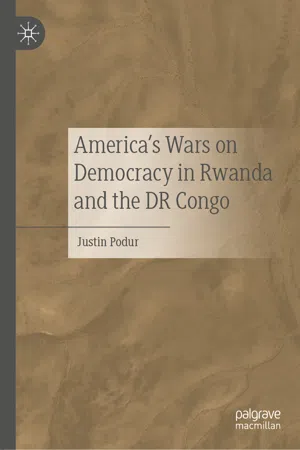
This book examines US interventions in the Democratic Republic of the Congo and Rwanda -- two countries whose post-independence histories are inseparable. It analyzes the US campaigns to prevent Patrice Lumumba from turning the DR Congo into a sovereign, democratic, prosperous republic on a continent where America's ally apartheid South Africa was hegemonic; America's installation of and support for Mobutu to keep the region under neo-colonial control; and America's pre-emption of the Africa-wide movement for multiparty democracy in Rwanda and Zaire in the 1990s by supporting Paul Kagame's Rwandan Patriotic Front (RPF). In addition, the book discusses the concepts of African development, democracy, genocide, foreign policy, and international politics.
- English
- ePUB (mobile friendly)
- Available on iOS & Android
eBook - ePub
America's Wars on Democracy in Rwanda and the DR Congo
About this book
Information
© The Author(s) 2020
J. PodurAmerica's Wars on Democracy in Rwanda and the DR Congohttps://doi.org/10.1007/978-3-030-44699-4_11. Introduction: I Am Not an Africanist
Independence Day, 2020. Picture the scene. It’s June 30, 2020, sixty years since the Democratic Republic of the Congo became independent of Belgium. At a stadium in Kinshasa, the country’s stunning capital and the seat of the United Nations, the 95-year-old Lumumba, three-time prime minister, one-time president, later secretary-general of the United Nations, and now a retired senator, is asked to give what all Congolese suspect will be his last words in public, as he is frail and rarely leaves his house these days. Accompanied by his grandchildren, Lumumba shuffles up to the microphone to address the gathered thousands of people on the Independence Day celebration.
Men and women of the Congo, Victorious Independence Fighters, I salute you in my own name only today, for I am no longer a representative of the Congolese government.
“Sixty years ago, on this day, June 30, as promised, Belgium passed the reins of government over to Congo’s elected parliament seamlessly, creating a giant Black Republic in the middle of Africa.” Tears welled up in the crowd, who remembered how the elected president, Kasavubu, was quickly overshadowed by the talented, energetic prime minister, Lumumba, who quickly emerged from the mentorship of Kwame Nkrumah to become the leader of a pan-African movement.
Over the next six decades, our Congo paved the way for democratic, parliamentary politics in Africa, while also using our immense mineral wealth, building on the undamaged infrastructure inherited from the era of Belgian colonialism to build a high-tech manufacturing base and become the engine of economic growth in Africa. The South African Apartheid regime was unable to hold on for very long after our country’s two decade long rise. With our country’s economy powering the growth of the rest of the continent, even as our democratic system inspired other African countries, the apartheid regime was not able to face down the extraordinary opposition of the South African people. The Soweto Uprising in 1976 was enough to finish that old racist project off.
Older people in the audience remember some of the frightening moments of those years, like the attempted coup by one of Lumumba’s military officers, Joseph-Desire Mobutu, who was sacked, court-martialed, and briefly imprisoned in the late 1960s.
Those decades were not without challenges, for us and our neighbours. With our size and might, we had the obligation to intervene to put a stop to ethnic violence in Burundi and Rwanda and help negotiate peaceful, multiethnic parliamentary governments in these neighbouring countries. Let us honour the representatives of those governments, who are here today and who are celebrating their own independence in these days!
The elected presidents of Burundi and Rwanda stand to the applause of the crowd.
I am very old now, and leave the future to the young generation. But many years ago I made a speech here in this city, and I would like to reflect on what we have achieved. We have achieved peace, prosperity, and greatness. We have established social justice. We have showed the world what the black man, and the black woman, can do when working in liberty, and we have made the Congo the pride of Africa. We have instituted in the country a peace resting not on guns and bayonets but on concord and good will.
Lumumba coughs, takes a sip of water, and finished his speech: “Eternal glory to the fighters for national liberation! Long live independence and African unity! Long live the independent and sovereign Congo!”
Sadly, this is not what happened.
Instead of living to age 95 to give a speech on Independence Day to a prosperous and powerful nation, Lumumba was murdered at age 35, his country in ruins. Instead of intervening to stop the conflicts in the Congo’s neighbors, those neighboring countries’ conflicts spilled over into the political and military vacuum created by the Congo’s collapse. Instead of Lumumba’s dream coming to fruition, it was drowned in blood.
Instead of being quickly stopped by its powerful neighbor, the genocide in Rwanda has become the evergreen example of inhumanity, used in everything from anti-bullying books1 to the example of evil, alongside the Nazis and the Taliban, in business books.2
In the presentation of Rwanda to Western audiences, the Rwandan Hutu population has a special role to play, the entire population demonized as guilty of genocide against the Tutsis, the massacres suffered by the Hutu community excused in advance in terms of revenge or reprisal. Through decades of dedicated effort by Rwanda’s post-1994 rulers and their Western friends, Rwandan Hutus have been rendered what Italian scholar Giorgio Agamben calls Homo Sacer.3 Writing in the late 1990s, after the genocide, Agamben found the Rwandan refugees (obviously Hutus based on the timing and the description) to be the quintessential example of Homo Sacer: “It takes only a glance at the recent publicity campaigns to gather funds for refugees from Rwanda to realize that here human life is exclusively considered (and there are certainly good reasons for this) as sacred life – which is to say, as life that can be killed but not sacrificed – and that only as such is it made into the object of aid and protection. The ‘imploring eyes’ of the Rwandan child… may well be the most telling contemporary cipher of bare life that humanitarian organizations, in perfect symmetry with state power, need.”4
The special demonization in Western writing of the entire Hutu population of Rwanda has had a devastating impact on the whole region of Central Africa since the genocide and will be given commensurate attention in this book. Writing about the Nazi death camps, Agamben suggests that “The correct question to pose concerning the horrors committed in the camps is, therefore, not the hypocritical one of how crimes of such atrocity could be committed against human beings. It would be more honest and, above all, more useful to investigate carefully the juridical procedures and deployments of power by which human beings could be so completely deprived of their rights and prerogatives that no act committed against them could appear any longer as a crime.”5 This latter question is what I pose in this book, and I argue that the way in which Rwandans and Congolese in the path of Western-supported dictatorships and war machines are written about in the West is a part of “the deployment of power by which they are deprived of their rights,” such that “no act committed against them could appear any longer as a crime.”
What about the rest of Lumumba’s fictional speech? The difference between Lumumba’s vision and today’s Congolese reality is not coincidence, bad luck, nor the failings of Congolese, but Western policy. The Belgians never intended for the Congo to become a sovereign, independent, parliamentary republic. The US never intended to let the Congolese run their own country. The South African apartheid regime was never going to tolerate an enormous African-ruled power on the continent. All set quickly to work after Independence to undermine those possibilities.
Aime Cesaire described the contours of neocolonial Africa in 1966: “look at it, our Africa! Brought down, tied up, trampled, fixed as a target! But you’ll say to me, she hopes! She suffers, but she hopes! It’s true! For from the bottom of the abyss, she sees the surface blaze and blush, and it grows, it grows, the stain of light!”6
American interventions to overthrow and kill Lumumba, to install Mobutu, to support the warlords Kagame and Museveni in Uganda, Rwanda, and beyond, are all extremely well documented, as I will show.
But when these American actions are invoked as the causes of the current broken state of the Congo and its neighbors’ polities and economies, a break occurs for many Westerners. A search for alternative explanations begins. Sure, the empire may have played a destructive role, but what about local corruption? What about the Russians and the Chinese in the Cold War? What about ancient ethnic hatreds, as between the Hutu and the Tutsi, the Hema and the Lendu, the Luba and the Lunda? What about the historical scars caused by Leopold and colonialism?
There are so many distinct tropes, images, arguments, and stories that are used to sow confusion about the relationship between Western interventions and their effects that half of this study is devoted to propaganda about the Congo and Rwanda. This propaganda pops up throughout scholarly and popular literature, as well as media portrayals—any sources Western audiences might try to find to begin to understand what is happening in Central Africa. In his 2001 book On the Postcolony, Cameroonian philosopher Achille Mbembe describes this confusion in terms of an anxiety in Western literature: “Africa as an idea, a concept, has historically served, and continues to serve, as a polemical argument for the West’s desperate des...
Table of contents
- Cover
- Front Matter
- 1. Introduction: I Am Not an Africanist
- 2. The Politician’s Words Against the Empire’s Weapons
- 3. Sow Doubt, Aestheticize, Essentialize: How to Write About African Leaders
- 4. Killing Hope in the Congo
- 5. The Agency’s Kingmaker
- 6. The Revolutionary and the White Supremacist
- 7. The Tyrant Subcontractors: America’s Chosen African Dictators, 1965–1990
- 8. Economic Poison: Western Economic Medicine Before the Rwanda Genocide and Congo Wars of the 1990s
- 9. The Peacekeeper and the Warlord
- 10. Good and Evil: How Africanists Present Hutus as Deserving of Death
- 11. The Infrastructure of Judgment and Denial
- 12. The State Kagame Built
- 13. Stories From the African Mind
- 14. The Front Men and the Refugees: The Congo War 1996–1997
- 15. The Nuance to Protect an Empire
- 16. The Warlord’s Aide and the Broken Alliance: The 1998–2003 Congo War
- 17. Conclusion: The Empire’s System for Central Africa
- Back Matter
Trusted by 375,005 students
Access to over 1.5 million titles for a fair monthly price.
Study more efficiently using our study tools.
Frequently asked questions
Yes, you can cancel anytime from the Subscription tab in your account settings on the Perlego website. Your subscription will stay active until the end of your current billing period. Learn how to cancel your subscription
No, books cannot be downloaded as external files, such as PDFs, for use outside of Perlego. However, you can download books within the Perlego app for offline reading on mobile or tablet. Learn how to download books offline
Perlego offers two plans: Essential and Complete
- Essential is ideal for learners and professionals who enjoy exploring a wide range of subjects. Access the Essential Library with 800,000+ trusted titles and best-sellers across business, personal growth, and the humanities. Includes unlimited reading time and Standard Read Aloud voice.
- Complete: Perfect for advanced learners and researchers needing full, unrestricted access. Unlock 1.5M+ books across hundreds of subjects, including academic and specialized titles. The Complete Plan also includes advanced features like Premium Read Aloud and Research Assistant.
We are an online textbook subscription service, where you can get access to an entire online library for less than the price of a single book per month. With over 1.5 million books across 990+ topics, we’ve got you covered! Learn about our mission
Look out for the read-aloud symbol on your next book to see if you can listen to it. The read-aloud tool reads text aloud for you, highlighting the text as it is being read. You can pause it, speed it up and slow it down. Learn more about Read Aloud
Yes! You can use the Perlego app on both iOS and Android devices to read anytime, anywhere — even offline. Perfect for commutes or when you’re on the go.
Please note we cannot support devices running on iOS 13 and Android 7 or earlier. Learn more about using the app
Please note we cannot support devices running on iOS 13 and Android 7 or earlier. Learn more about using the app
Yes, you can access America's Wars on Democracy in Rwanda and the DR Congo by Justin Podur in PDF and/or ePUB format, as well as other popular books in Politique et relations internationales & Politique africaine. We have over 1.5 million books available in our catalogue for you to explore.