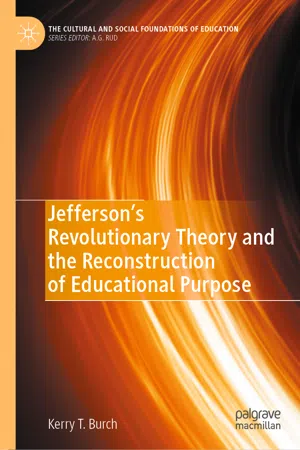
This book newly interprets the educational implications of Thomas Jefferson's revolutionary thought. In an age where American democracy is imperilled and the civic purposes of schooling eviscerated, Burch turns to Jefferson to help bring to life the values and principles that must be recovered in order for Americans to transcend the narrow purposes of education prescribed by today's neoliberal paradigm. The author argues that critical engagement with the most radical dimensions of Jefferson's educational philosophy can establish a rational basis upon which to re-establish the civic purposes of public education. Bracketing the defining features of Jefferson's theory throughout each of the chapters, the author illuminates the deficiencies of the dominant educational paradigm, and charts a new path forward for its progressive renewal.
eBook - ePub
Jefferson’s Revolutionary Theory and the Reconstruction of Educational Purpose
- English
- ePUB (mobile friendly)
- Available on iOS & Android
eBook - ePub
Jefferson’s Revolutionary Theory and the Reconstruction of Educational Purpose
About this book
Information
Topic
EducationSubtopic
Education Theory & Practice© The Author(s) 2020
K. T. BurchJefferson’s Revolutionary Theory and the Reconstruction of Educational PurposeThe Cultural and Social Foundations of Educationhttps://doi.org/10.1007/978-3-030-45763-1_11. Introduction
Kerry T. Burch1
(1)
College of Education, Northern Illinois University, DeKalb, IL, USA
The generation which commences a revolution can rarely complete it.—Thomas Jefferson, 1823
Today we routinely hear Americans declare that the republic is in a state of existential crisis. In news media, commentators opine that even the most finely wrought descriptive words cannot begin to capture the enormity of the crisis. The emergence of the COVID-19 pandemic, moreover, has greatly magnified these related crises. For purposes of clarification, then, it may be useful to frame the problems of the moment as paradigmatic in nature, as a system-wide crisis consisting of a set of concomitant, interconnected crises. Crises over the status of truth in public discourse; crises over corporate corruption in a post-Citizens United world; crises over the country’s unconstitutional forever wars; crises over a seemingly irreversible planetary ecocide led by the United States; crises over a neoliberal educational regime whose defining feature appears to be the civic and democratic demoralization of America’s public schools; and finally, crises over a combined sense of hopelessness and what might be called outrage fatigue. A rapid intensification of these political and cultural contradictions seems to be the hallmark of our era.1
On the educational front, teacher strikes in Arizona, West Virginia, Kentucky, Oklahoma, Colorado, North Carolina, and in the city of Chicago, among other locales, speak at once to the shameful conditions that teachers face and to the hope that their underlying causes may soon be addressed. From a paradigmatic standpoint, it seems as if the very purposes of education that neoliberalism has imposed upon the nation’s schools in the last few decades itself constitutes one of our deepest systemic problems and challenges. Since the public schools have always been in the business of modeling some form of identity or another, as they necessarily must, the question arises: As possible models of human identity toward which the schools might aspire to educate the young, should they continue along the path charted by neoliberalism and concern themselves primarily with reproducing versions of Homo Economicus? Or, should the schools recover their civic purposes and concern themselves primarily with reproducing versions of Homo Civicus?2
This book is an invitation to think through these questions and problems from a Jeffersonian perspective. It makes the case that a critical engagement with the most radical dimensions of Jefferson’s educational philosophy—what I am calling his revolutionary theory—can establish a rational basis upon which to reestablish both the civic purposes of public education and the quality of our democracy. I believe that the educational challenges posed by the predicaments outlined above can be most intelligently met—and remedied—when interpreted in relation to the democratic-revolutionary tradition launched by the American Revolution. I further contend that if teachers in particular were to develop a keener appreciation for what is most “revolutionary” about the American Revolution, it would not only illuminate many contemporary predicaments, but its remembrance could serve as a resource for envisioning and working toward a more just and democratic America. In this regard, I am increasingly convinced that however well-intentioned our efforts on behalf of educational reform, they are bound to fail to the degree they are symbolically and normatively untethered from the nation’s democratic-revolutionary tradition. We turn to Jefferson today to re-tether ourselves to this forgotten tradition.3
Perhaps the most cogent expression of the radical democratic tradition of the American Revolution is Thomas Jefferson’s revolutionary theory.4 In the following chapters, the goal is to articulate how a better grasp of Jefferson’s revolutionary vision can serve as a kind of moral and pedagogical compass for both restoring and redirecting the democratic civic purposes of public education.
In broad conceptual strokes, the idea of permanent revolution signifies a positive cultural orientation to conflict and to political renewal.5 Whatever terminology we use, whether “revolutionary theory” or theory of “permanent revolution,” the theory’s defining quality for Jefferson was both processual and moral (moral because it contained a democratic telos, or end-in-view). The theory can be posited interchangeably as a revisionary state of being, a conceptual framework, a discourse, and importantly, as a form of democratic rhetoric. This rhetorical dimension is crucial to bear in mind, for Jefferson deployed the theory rhetorically to serve as a conduit for channeling the mythopoetic Spirit of 76.6 The function of the theory as a form of rhetoric was not to describe the static and finished dimensions of reality (to the extent any exist), but rather to theorize historical reality in all of its kaleidoscopic permutations.
Because of the democratic and inter-generational teleological foundation of Jefferson’s revolutionary theory, it aptly symbolizes that which is most revolutionary about the American Revolution.7 The “most revolutionary” quality of the nation’s founding event did not rest, for example, on the fact that the American patriots successfully seized state power from the British. The most revolutionary dimension of the American Revolution was the idea that its success would depend on its moral values being enacted and reenacted, generation after generation.8 Jefferson repeatedly observed that the ultimate success, or vindication, of the American Revolution would hinge on whether subsequent generations of Americans would have the capacity and willingness to re-imbue the meaning of the Spirit of 76 into novel historical circumstances, unforeseeable circumstances that would require politically and culturally inventive efforts to refresh the meaning of its core values.9
The ultimate status of the American Revolution, then, would depend on the ability of the American people to learn the art of revising the meaning of that Spirit as new conditions and new needs developed over successive generations. According to this historiographic perspective, it was not the formal structures of US government (e.g., checks and balances, election cycles) that was most significant about the American Revolution, as important as they were. As suggested, what was most revolutionary was the historical emergence of a Spirit & Idea, a secularized religious project that gave birth to the nation’s democratic-revolutionary tradition. This mythical terrain, as a meaning narrative, represented a sharp discontinuity from ancient regimes and their monarchies, standing armies and entrenched aristocratic elites. Yet, we could also trace the discursive lineage of this spirit to ancient democratic Athens, to the classical republican tradition, and to the radical democratic strand of the Enlightenment tradition.10 For Jefferson, this new animating spirit seemed to contain a “mythopoetic” quality, a moral geography, if you will, capable of summoning up within individual’s emotional intensities and devotions to a set of democratic moral ideals. In the chapters ahead, I make the case that Jefferson’s discourse of permanent revolution can be interpreted as a hermeneutic through which the symbolic field of meanings sequestered within the Spirit of 76 can be channeled and empirically realized.11
Unfortunately, however, the popular image of the American Revolution that most of us pick up along the way is rooted in an assumption that the revolution was, above all, a finite event synonymous with, and reducible to, the military phase of the conflict (1775–1782). Jefferson’s revolutionary theory explicitly rejects this mechanical conception of the founding. His theory assumes instead that our revolution should not, ultimately, be imagined as something finished or complete, but should rather be imagined as a perpetually unfinished historical project. In other words, the popular image of the American Revolution taught in the schools tends to conflate and confuse a finite war with a set of inter-generationally embodied moral purposes. One of the essential features of Jefferson’s revolutionary thought is that it highlights the significance of this conceptual distinction.
Turning to the curricular implications of Jefferson’s revolutionary theory, I argue that its defining elements point directly to the importance of developing in students’ their capacities to revise, to improvise, to experiment, to rebel, to remember, and to become mindful of political ambition and greed in all its guises. A Jeffersonian-inspired redirect of curricular purpose today, would certainly mean, among other things, a restoration of the centrality of both civic education and the humanities into the K-12 curriculum. Jefferson valued these traditions because he understood that the foundational pillars of a republican civic identity—freedom, truth, reason, civic engagement, to name a few—were moral capacities whose development depended in no small measure on the tradition of the humanities. Although Jefferson was not the only founder to link the survival of the republic to the project of educating the intelligence and virtue of the American people, he was perhaps the most eloquent in establishing the crucial linkages between education and the ongoing nature of the revolution. It is on these moral and curricular grounds, that I recruit Jefferson today as an iconic, if controversial resource for providing insight into the ongoing task of educating virtuous democratic citizens and societies.
In writing the book, I am mindful that, for some readers, Jefferson’s racist pronouncements and practices may well nullify any prospect that his theories could have contemporary relevance. It is not my intention in this book to condemn or to praise Jefferson so much as it is to grasp what he was trying to “get at” in formulating his revolutionary thought. Rather than ignoring the growing number of critical perspectives on the slave-holding enlightener from Monticello, I frame Jefferson as a synecdoche of the nation, as a figure who continues to stand for and symbolize the ideals, contradictions, hopes, and tragedies gyrating at the nucleus of American political culture.12 As many authors before me have observed, to inquire into Jefferson, is also to inquire into the often baffling, contradictory, ambiguous, and tragic qualities of the American experience itself. An examination of these problematic facets of Jefferson’s life reveals some stark reminders. First, we must recognize the danger of uncritically appropriating the thought of any eighteenth-century figure for purposes of interpreting twenty-first century conditions. Perhaps more importantly, we should never overlook Jefferson’s most egregious shortcoming: His failure, despite his democratic sympathies, to promote a multi-racial image of national identity for America’s future.13
The Style and Structure of the Book
The book has been influenced by the style of writing adopted by two giants in my disciplinary field: John Dewey and George Counts. As chief architects of the twin disciplines of philosophy of education and the social foundations of education, Dewey and Counts frequently deployed a genre of writing that combined a critical analysis of American power relations with a ...
Table of contents
- Cover
- Front Matter
- 1. Introduction
- Part I. Promise: Revolutionary Rhetoric for a Democratic America
- Part II. Declension: Betrayal of Founding Principles
- Part III. Renewal: Reconstructing Educational Purpose
- Back Matter
Trusted by 375,005 students
Access to over 1.5 million titles for a fair monthly price.
Study more efficiently using our study tools.
Frequently asked questions
Yes, you can cancel anytime from the Subscription tab in your account settings on the Perlego website. Your subscription will stay active until the end of your current billing period. Learn how to cancel your subscription
No, books cannot be downloaded as external files, such as PDFs, for use outside of Perlego. However, you can download books within the Perlego app for offline reading on mobile or tablet. Learn how to download books offline
Perlego offers two plans: Essential and Complete
- Essential is ideal for learners and professionals who enjoy exploring a wide range of subjects. Access the Essential Library with 800,000+ trusted titles and best-sellers across business, personal growth, and the humanities. Includes unlimited reading time and Standard Read Aloud voice.
- Complete: Perfect for advanced learners and researchers needing full, unrestricted access. Unlock 1.5M+ books across hundreds of subjects, including academic and specialized titles. The Complete Plan also includes advanced features like Premium Read Aloud and Research Assistant.
We are an online textbook subscription service, where you can get access to an entire online library for less than the price of a single book per month. With over 1.5 million books across 990+ topics, we’ve got you covered! Learn about our mission
Look out for the read-aloud symbol on your next book to see if you can listen to it. The read-aloud tool reads text aloud for you, highlighting the text as it is being read. You can pause it, speed it up and slow it down. Learn more about Read Aloud
Yes! You can use the Perlego app on both iOS and Android devices to read anytime, anywhere — even offline. Perfect for commutes or when you’re on the go.
Please note we cannot support devices running on iOS 13 and Android 7 or earlier. Learn more about using the app
Please note we cannot support devices running on iOS 13 and Android 7 or earlier. Learn more about using the app
Yes, you can access Jefferson’s Revolutionary Theory and the Reconstruction of Educational Purpose by Kerry T. Burch in PDF and/or ePUB format, as well as other popular books in Education & Education Theory & Practice. We have over 1.5 million books available in our catalogue for you to explore.