This book presents a series of urban investigations undertaken in the metropolis of Melbourne. It is based on the idea that 'enchantment' as an affective state is important to ethical and political engagement. Alexander and Gleeson argue that a sense of enchantment can give people the impulse to care and engage in an increasingly troubled world, whereas disenchantment can lead to resignation. Applying and extending this theory to the urban landscape, the authors walk their home city with eyes open to the possibility of seeing and experiencing the industrial city in different ways. This unique methodology, described as 'urban tramping', positions the authors as freethinking freewalkers of the city, encumbered only with the duty to look through the delusions of industrial capitalism towards its troubled, contradictory soul. These urban investigations were disrupted midway by COVID-19, a plague that ended up confirming the book's central thesis of a fractured modernity vulnerable to various internal contradictions.
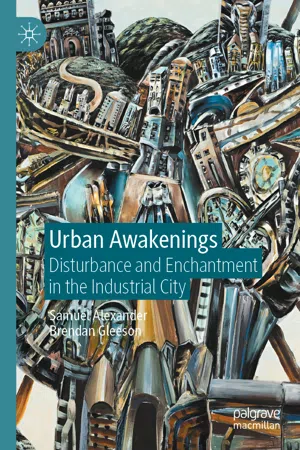
eBook - ePub
Urban Awakenings
Disturbance and Enchantment in the Industrial City
- English
- ePUB (mobile friendly)
- Available on iOS & Android
eBook - ePub
About this book
Information
Topic
Ciencias socialesSubtopic
Ciencia medioambiental© The Author(s) 2020
S. Alexander, B. GleesonUrban Awakeningshttps://doi.org/10.1007/978-981-15-7861-8_11. A Disturbed Book: Bubbles Under the Throne
Samuel Alexander1 and Brendan Gleeson1
(1)
Melbourne Sustainable Society Institute, University of Melbourne, Melbourne, VIC, Australia
Dear reader, this is not the book we planned for you. Along the way of its writing, it was blown up—into two parts—by an unforeseen and dramatic turn in the recent course of human history. You may already know what we are talking about. Yes, the global COVID-19 pandemic that surfaced first in the Chinese city of Wuhan and subsequently spread outwards with dizzying swiftness in the early months of 2020. Countless human projects and indeed human lives were suddenly extinguished by the pandemic. Much suffering and loss ensued, both in terms of lives lost and diminished by the horrid touch of the virus, as well as the epic dislocations and depredations that it imposed on social and economic life across the globe. Let us explain what this dramatic turn of events meant for the book we’d thought to present to you.

Courtesy of Pawel Kuczynski © (http://pawelkuczynski.com/).
Urban Awakenings was the name we gave to the project reported in this book, which took form on Wurundjeri land. It was a project conceived in early 2019 as a series of urban investigations by the authors which set out to find novel ways of looking at the contemporary industrial city, in this case the metropolis of Melbourne where we live, capital of the State of Victoria, Australia. We were inspired and guided by the thesis set out in Jane Bennett’s 2001 book, The Enchantment of Modern Life,1 which urges a new and critical way of seeing contemporary modernity as a fractured, contradictory, unreasonable, and ultimately mortal dispensation. Far from accepting modernity’s dominant narrative of disenchantment, however, Bennett seeks to tell an alter-tale, one that recognises that the world still has the capacity to enchant in ways that she maintains has ethical (and, we will argue, political) significance. We wanted to apply and extend her analysis to the urban landscape, by walking the city with eyes open to the possibility of enchantment—a methodology we describe as ‘urban tramping’.2
Since its emergence, capitalist modernity has always attempted a ruse on humanity, because it suppresses through its arrogations of ‘pure reason’ the key restraining Enlightenment value of doubt. Like thinkers such as Hannah Arendt and Ulrich Beck, Jane Bennett urges us to see through the hubris of modernism and assert a radical doubt about its claims to hyperrational order, linear progress, and the ethical detachment of market rule. Her novel approach, unpacked further in forthcoming chapters, is to seek out ‘enchantments’ in a social dispensation that deceptively imagines itself free of this ancient value. Doing so, we argue, can unsettle the assumption that the global economic order we know today is somehow the natural modern expression of the Enlightenment. By carefully examining and experiencing the diversity of cultural forms, sites, and histories, the countless chinks that exist in capitalism’s armour of self-rationalisation can be exposed.
Thus Bennett rather cheekily invites enchantment, normally an anti-modern notion, back onto the agenda, not seeking to reinstate fairies, magic, or superstition, but to give licence to doubt about the claims of capitalism to be the rational, and thus, natural expression of modernity. Might there not be other ways to theorise and experience modernity? According to Bennett, to experience the world as merely the mechanical workings of lifeless matter, commodified and traded in a marketplace, is to see the world as disenchanted, and her (and our) concern is that the tendency of modernity to disenchant our lives has destructive social and ethical consequences. It can tempt us ‘moderns’ to quietly live a life of resignation, apathy, individualism, acquisitiveness, and myopia, leaving people without the necessary ‘affective propulsions’3 required to create purpose in their lives and struggle for a more humane world. A disenchanted culture is one suffering the strange ache of malaise, the cause of which is difficult to identify, like a knot of anxiety that cannot be easily untied.
To actively seek out and appreciate moments of urban enchantment, on the other hand, has ethical potential. It can give people the energy—the impulse—to care and engage, in a world that is desperately in need of ethical and political revaluation and provocation. What Bennett highlights is how the feelings one has participate in and shape the thoughts one has, and vice versa. And what people feel and think obviously affects how they act, both personally and politically. She wagers that ‘to some small but irreducible extent, one must be enamoured with existence and occasionally even enchanted in the face of it in order to be capable of donating some of one’s scarce mortal resources to the service of others’.4 In this way, the interconnections between affect, thought, ethics, and politics become apparent, even if those interconnections always and everywhere remain mysterious and shifting.
We are pointing here to what might be called the affective or even aesthetic dimension of ethics and politics,5 too often marginalised by the pose of pure reason. One cannot, we argue, even in principle, master all things in life by calculation—either physically or economically—and this critical doubt opens up theoretical space beyond calculation where moments of enchantment might be able to rewire the circuitry of the dominant imaginary and lay the foundations for alternatives to arise. We have found that meditating on and in this territory—this blurry nexus between affect, ethics, and politics—can be enlightening but also discomforting.
Indeed, Bennett begins her treatise by noting that ‘a discomforting affect is often what initiates a story, a claim, a thesis’.6 Or, in the words of political theorist John Holloway: ‘The starting point of theoretical reflection is opposition, negativity, struggle…. an inarticulate mumble of discontent’.7 In our case, a vague sense of urban disenchantment gave birth to an idea for a book, but the process of writing it (as we walked the city) somehow induced a more expansive and visionary mood, a new affective state, on account of what Bennett would call ‘the wonder of minor experiences’,8 of which we will be giving account. We see and feel more in the urban landscape than we once did, and in part this book is about how and perhaps why that happened—the process. We have discovered that enchantments can disturb, and disturbances can enchant, from which we inquire: Might such affective and intellectual provocations have the potential to awaken more people from the dogmatic slumber into which our urban age has fallen? Put otherwise, can a disturbed affect lead to a genuinely progressive and enchanting effect?

Courtesy of Thea T © (https://www.redbubble.com/people/tatefox/portfolio).
Bennett wants us all to look under the shiny bonnet of the neoliberal machine to find the muffled knocks and disturbances that betray its smooth running. This is not to question reason but rather to affirm it by resisting the structural urge of capitalism to always naturalise itself as the only feasible modern social form. Nothing in nature preordains capitalism. We know that the (really) great thinkers of the Enlightenment would support this assertion as a rational truth. They would forgive the use of enchantment to confound the cause of naturalisation.
Before we go further, a word about neoliberalism, the atmospheric political construct that whirls through and around our book. This global political project emerged in the Anglophone West during the 1970s, vowing to restore growth and prosperity to a sclerotic capitalist world economy. Geographer David Harvey explains it correctly, however, as an ideologically masked wealth grab by capitalist elites and their adherents.9 The project has survived all attempts at political censure by weakened and increasingly divided progressive forces. Today, in an urban age, we can speak of neoliberal urbanism as a form of the project that seeks to shackle all city ambitions and interests to the cause of capital expansion and the unequal division of its spoils. With an appeal to problematic definitions of ‘efficiency’, this zeitgeist defers all major planning and distributive decisions to the dubious wisdom of the market.
The ‘industrial city’ that we set out to examine in this book has been redefined by this narrow commitment to growth by any means, at any cost. It is a city overlaid with the disenchantments of widening social division and ecocidal urbanisation, and it is a settlement that remains haunted by its colonial history. Our walking ground Melbourne is an artefact, like the many, of neoliberal urbanism, but for many millennia before us these lands were walked, and are still walked, by Australia’s Indigenous peoples. We acknowledge from the outset that our project takes place on stolen Aboriginal land and that sovereignty has never been ceded. Today, as you will see, this colonial city showcases many of the trappings of the growth machine economy, including freewheeling high-rise development we term ‘vertical sprawl’. This increasingly disenchanted metropolitan ground beckoned our critical attention.
***
So, to our project. As urbanists of liberal definition, we authors set out to apply Bennett’s thesis to the question of the contemporary industrial city. We thought to reframe the project of critique she urges as a set of material—that is, spatially enacted—investigations of our home city Melbourne, in quest for counter-evidence to the claims of contemporary capitalism to be a natural, self-regulating order, freed from the facts of natural ecology and human frailty. We crafted an idea of ourselves as ‘urban tramps’ who might attempt this critical inquiry. The tramps were to be freethinking freewalkers of the city, encumbered only with the duty to look through the mindless objectivity of industrialism towards its troubled, contradictory soul. These irruptions of capitalist reason were to be found in the ranging, mouldering fabrics of the city.
The ‘tramp’ was to be an original critical identity that distinguished us, while at the same time relating us, to the various traditions of urban observation: flâneurs, slum journalists, ethnographers, missioners, psychogeographers, etc.10 The crafting of this identity was partly inspired by Stephen Graham’s 1926 book The Gentle Art of Tramping,11 which laid out a set of desiderata for journeying that refused the dictates and assumptions of the settled life. Graham sought an unsettled life as means for self-realisation, while Bennett wanted to find disruption and contradiction in the everyday fabric of modernity.
We fused the two to create the figure of the ‘urban tramp’ who would seek out the discomforts and disruptions of modern life so often to be found, if one looked carefully, in the otherwise machinic confidence of the contemporary industrial city. In other words, we set out to sojourn through urban landscapes with the same sense of wonder and critical attention that a nature-walker like Henry David Thoreau embodied as he sauntered through Walden Woods. Nature can enchant and disturb, but so can the city. This book project was therefore conceived as a series of tramps around our city which would be essayed and brought together in a general published consideration that we conceived as Urban Awakenings. All this is explained in our early chapters to follow.
What we need to relate now—before you read another word!—is how during the working out of this project the COVID-19 pandemic changed our tramping and our publishing plans. We tell the tale simply and with confidence because the whole disruption, surprisingly (or not!), proved to be a powerful confirmation of our work and the thesis behind it. As it unfolded, the pand...
Table of contents
- Cover
- Front Matter
- 1. A Disturbed Book: Bubbles Under the Throne
- Part I. Sleepers, Wake!
- Part II. BC (Before-COVID)
- Part III. AC (After-COVID)
- Part IV. Coming Through Slaughter
Trusted by 375,005 students
Access to over 1.5 million titles for a fair monthly price.
Study more efficiently using our study tools.
Frequently asked questions
Yes, you can cancel anytime from the Subscription tab in your account settings on the Perlego website. Your subscription will stay active until the end of your current billing period. Learn how to cancel your subscription
No, books cannot be downloaded as external files, such as PDFs, for use outside of Perlego. However, you can download books within the Perlego app for offline reading on mobile or tablet. Learn how to download books offline
Perlego offers two plans: Essential and Complete
- Essential is ideal for learners and professionals who enjoy exploring a wide range of subjects. Access the Essential Library with 800,000+ trusted titles and best-sellers across business, personal growth, and the humanities. Includes unlimited reading time and Standard Read Aloud voice.
- Complete: Perfect for advanced learners and researchers needing full, unrestricted access. Unlock 1.5M+ books across hundreds of subjects, including academic and specialized titles. The Complete Plan also includes advanced features like Premium Read Aloud and Research Assistant.
We are an online textbook subscription service, where you can get access to an entire online library for less than the price of a single book per month. With over 1.5 million books across 990+ topics, we’ve got you covered! Learn about our mission
Look out for the read-aloud symbol on your next book to see if you can listen to it. The read-aloud tool reads text aloud for you, highlighting the text as it is being read. You can pause it, speed it up and slow it down. Learn more about Read Aloud
Yes! You can use the Perlego app on both iOS and Android devices to read anytime, anywhere — even offline. Perfect for commutes or when you’re on the go.
Please note we cannot support devices running on iOS 13 and Android 7 or earlier. Learn more about using the app
Please note we cannot support devices running on iOS 13 and Android 7 or earlier. Learn more about using the app
Yes, you can access Urban Awakenings by Samuel Alexander,Brendan Gleeson in PDF and/or ePUB format, as well as other popular books in Ciencias sociales & Ciencia medioambiental. We have over 1.5 million books available in our catalogue for you to explore.