eBook - ePub
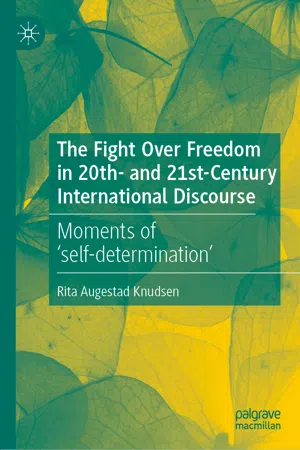
The Fight Over Freedom in 20th- and 21st-Century International Discourse
Moments of ‘self-determination’
- English
- ePUB (mobile friendly)
- Available on iOS & Android
eBook - ePub
The Fight Over Freedom in 20th- and 21st-Century International Discourse
Moments of ‘self-determination’
About this book
This book shows how international discourse citing 'self-determination' over the last hundred years has functioned as a battleground between two ideas of freedom: a 'radical' idea of freedom, and a 'liberal-conservative' idea of freedom. The book examines each of the major moments in which 'self-determination' has been a central part of the language of high-level international politics and law: the early 20th century discourse of V.I. Lenin and U.S. President Woodrow Wilson, the aftermath of the First World War and the formulation of the UN Charter, the 1950-1960s UN debates on 'self-determination', and the 2008-2010 International Court of Justice case on Kosovo's declaration of independence. At each of these moments in history, 'self-determination' was at the top of the international agenda. And at each moment, a fight over the meaning of freedom played out in 'self-determination' discourse. Besides providing insights into the historical times in which self-determination was prominently cited internationally, the book offers a recasting and renewal of international debates on freedom in international discourse.
Information
© The Author(s) 2020
R. Augestad KnudsenThe Fight Over Freedom in 20th- and 21st-Century International Discoursehttps://doi.org/10.1007/978-3-030-46429-5_11. Introduction: ‘Self-Determination’ and Ideas of Freedom
Rita Augestad Knudsen1
(1)
Norwegian Institute of International Affairs, Oslo, Norway
Keywords
FreedomSelf-determinationInternational discourseInternational historyInternational relationsLegitimationIn early 1918, on one of the last days of the coldest January recorded by that point in time, American President Woodrow Wilson took his wife and his closest advisor on a leisurely drive. It was the President’s first day outside the White House after suffering from a bad cold. Seemingly in good spirits after several days in bed, Wilson was happy that he was able to have ‘one or two real talks’ with the two people to whom he was closest. Meanwhile, the First World War was entering into a dramatic phase, with hectic diplomacy and public exchanges on the preferred terms for peace for the belligerent participants. In a provocative statement in late 1917, Vladimir Ilyich Lenin and the Russian Bolsheviks asked the Allies what their commitment to ‘self-determination’ really was. Reading their statement, some of Wilson’s advisors urged him to appropriate this language, while others warned against it. In early January 1918, Wilson delivered his Fourteen Points speech to the U.S. Congress without citing ‘self-determination’. A few days before that cold January afternoon, the German Chancellor, Georg von Hertling, publicly presented his reply to Wilson’s Fourteen Points.
Until Wilson’s motoring excursion, the President was unsure of what his next public move should be. The international situation appeared to be approaching conditions favourable to peace , and a misguided initiative could jeopardise this development. In the car, Wilson told his wife that he wanted to take a stand against the German Chancellor’s preference for the ‘old diplomacy which has brought the world into such difficulties’. Almost two weeks later, on 11 February 1918, Wilson laid out his position in another speech to Congress. He effectively proclaimed that von Hertling was missing the point; fatally, the Chancellor was ignoring the principle of ‘self-determination’. Before Wilson’s speech, ‘self-determination ’ had been associated with Lenin, and it was Lenin who ensured that this term became part of the war’s discursive exchanges. But with Wilson’s February 1918 address, the President both claimed and properly internationalised this language. Wilson’s role in the history of self-determination has often been exaggerated—but he did ensure that the specific phrase ‘self-determination’ reached a worldwide audience.1
This book tells a story of how important statements on ‘self-determination’ in the twentieth and early twenty-first centuries have contained and reflected a battle over the international meaning of freedom. It does so by examining how a struggle between two ideas of freedom has emerged in international discourse about ‘self-determination’ at key historical moments. I call these two ideas a ‘radical’ idea of freedom and a ‘liberal-conservative’ idea of freedom. Although the battle over the international meaning of freedom has also appeared in many other domains and forms of discourse, this book focuses on the ways in which the struggle between these two ideas of freedom has played out through key international discourse of ‘self-determination’ of the last hundred years.
Before outlining the radical and the liberal-conservative ideas of freedom that have been central to international ‘self-determination’ discourse, it is important to sketch the mechanics linking this discourse with the ideas of freedom. Since the early twentieth century, every important international reference to ‘self-determination’ has depended on one of these two ideas of freedom as its standard of legitimation.2 Like any other political or legal actor, the key international agents who have used the language of ‘self-determination’ over the last hundred years—politicians, diplomats, lawyers, judges and international institutions—have sought legitimation for their arguments and ideas in order to convince their immediate audiences and enhance their general moral authority. And each of these agents, as will be shown, has relied on one of two ideas of freedom when doing so.
Given the logic informing the legitimation of discourse, one would not expect these historical agents to have created their own legitimising standards or to have been drawn to unusual or peculiar ones. Only by invoking standards already known and valued in the international forums and formats in which they operated could they have realistically expected to be persuasive.3 The legitimising ideas of freedom that they drew upon in their historical discourse about self-determination may have even been so dominant and taken-for-granted that some presenters likely were unaware of using them.4 The discourse of ‘self-determination’ and the ways in which it has been legitimised at various moments can therefore be analysed as a reflection of the ideas of freedom already present, dominant and appealing in the international arenas in which such discourse appeared.
The focus of this book departs from that of most scholars of ‘self-determination’, many of whom have been preoccupied with defining ‘self-determination’—frequently by trying to establish the boundaries of the ‘self’ to which it might apply. For instance, might this ‘self’ or ‘self-determination unit’ be defined in national, ‘ethnic’ or territorial terms? Might self-determination itself be understood as a ‘right’, a ‘remedy’, a ‘principle’, a ‘process’ or a ‘claim’? Is it a ‘plebiscite principle’,5 a ‘human need or urge’,6 ‘self-government’,7 a ‘doctrine of the legitimacy of political institutions’8 or perhaps a ‘struggle for inclusion ’?9 Can the concept of self-determination be equated with the process of granting independence to former colonies, or does it necessitate other policy solutions? What criteria should apply to implementing self-determination in practice? And where does the conceptual ancestry of this term lie—with the French revolution,10 nineteenth-century philosophy,11 the German Enlightenment,12 ‘early medieval Western Europe’13 or ‘ancient times’?14
Recent interest in ‘self-determination’ has added to this range of questions by addressing its connection to human rights , with disagreement often being focused on the role of self-determination in the history of human rights.15 Concentrating on the process of decolonisation, some scholars have argued that granting self-determination as statehood for former colonies facilitated the international rise of human rights .16 Others have claimed that prioritising self-determination as independence for colonial peoples partly came at the long-term cost of individual human rights.17 Still others have considered self-determination itself as a human right.18 But most contributions have seen self-determination as being synonymous with colonial independence and have also tended to place the concept on the state side of a ‘state rights versus individual rights’ framework .19
Most of these scholarly and discursive questions and points of disagreement about ‘self-determination’ have persisted for decades, effectively overshadowing what has remained constant in the twentieth-century and twenty-first-century international discourse about self-determination : ideas of freedom have consistently been used to legitimise it. Along with the twentieth-century formalisation of ‘self-determination’ in international law , the connection between this term and ideas of freedom is what has enabled it to endure as an authoritative international reference point. Examining the connection between self-determination and freedom in international discourse is not only key to understanding the role of self-determination in contemporary international affairs, but it also enables a better understanding of how, and which, ideas of freedom have appeared in international discourse over the last hundred years.
The Liberal-Conservative Idea
Of the two ideas of freedom drawn upon to legitimise twentieth-century and twenty-first-century international discourse about ‘self-determination’, the ‘liberal-conservative’ idea has dominated.20 In unmistakably liberal terms, discourse built upon this idea presented interference with action as being the greatest threat to freedom. Freedom, in this line of thought, means non-interference : if interference is present, freedom is constrained. To establish freedom means to minimise interference. In the international language on ‘self-determination’, this outlook has most often led to endorsing the principle of non-interference with states—especially regarding their boundaries and their freedom of trade—and sometimes , as an even more conventionally liberal concern, the freedom of individuals from state interference . The liberal-conservative perspective has tended to be relatively inattentive to peoples , groups or other non-state collectives, and it has not weighed as heavily potential ways that freedom can be impaired other than by interference.
Peace and stability further defined the content of the liberal-conservative idea of freedom , as seen through the discourse regarding ‘self-determination’ of the last hundred years. Not unlike the ‘liberal peace thesis’ of international relations theory,21 the liberal-conservative discourse of ‘self-determination’ portrayed order and stability, both within and between states, as being the ultimate insurance against interference with the actions of states and individuals. Hence, it set up a deep and intimate connection between peace and freedom. At one level, such discourse presented peace as an ultimate form of freedom, since peace in itself amounts to a form of absence of interference, such as violence, disruption and instability. Simultaneously, the liberal-conservative idea elevated ‘peace’ and ‘stability’ as more valuable standards than ‘freedom’ referred to on its own. From this point of view, the worth of ‘freedom’, ‘self-determination’ or any other value or standard is bound up with the ability to ensure peace and stable order.
When positing peace in this way (i.e., as the ultimate standard and the aim of all politics), language drawing upon the liberal-conservative idea depicted political legitimacy as being closely linked to authorities’ capacity to preserve the peace. Since the maintenance of peace on this account legitimates power, governmental sovereignty has been considered legitimised if it produced or was likely to produce peaceful outcomes. In international ‘self-determination’ discourse, an a priori assumption of those of the liberal-conservative inclination has been that peace is in the interest of all people, including those who have not articulated such an interest for themselves. Consequently, the expressed preferences of real-life ‘self-determination’ claimants have not been in focus; whatever such claimants might say, peace should be the priority. Following the liberal-conservative view, political authorities would be considered justified in taking any action to protect the peace, even in the absence of bottom-up consultations with the subjects of their rule. Ideas of this kind surfaced in the twentieth-century and twenty-first-century history of international discourse, especially in Woodrow Wilson’s language of ‘self-determination’ from the First World War, as well as during the 1960 United Nations General Assembly debate on decolonisation.
These characteristics also display the conservative propensities of the liberal-conservative idea. With robust appreciation of stability and freedom as non-interference, statements founded upon this outlook have been keen to reject change and to opt instead for solidif...
Table of contents
- Cover
- Front Matter
- 1. Introduction: ‘Self-Determination’ and Ideas of Freedom
- 2. Lenin, ‘Self-Determination’ and the Radical Idea of Freedom
- 3. Woodrow Wilson, ‘Self-Determination’ and the Liberal-Conservative Idea of Freedom
- 4. ‘Self-Determination’ Enters International Law
- 5. Defining ‘Self-Determination’, Disagreeing on Freedom
- 6. In Court: ‘Self-Determination’ and Freedom in the ICJ Case on Kosovo
- 7. Conclusions: The Fight over Freedom at Moments of Self-Determination
- Back Matter
Trusted by 375,005 students
Access to over 1.5 million titles for a fair monthly price.
Study more efficiently using our study tools.
Frequently asked questions
Yes, you can cancel anytime from the Subscription tab in your account settings on the Perlego website. Your subscription will stay active until the end of your current billing period. Learn how to cancel your subscription
No, books cannot be downloaded as external files, such as PDFs, for use outside of Perlego. However, you can download books within the Perlego app for offline reading on mobile or tablet. Learn how to download books offline
Perlego offers two plans: Essential and Complete
- Essential is ideal for learners and professionals who enjoy exploring a wide range of subjects. Access the Essential Library with 800,000+ trusted titles and best-sellers across business, personal growth, and the humanities. Includes unlimited reading time and Standard Read Aloud voice.
- Complete: Perfect for advanced learners and researchers needing full, unrestricted access. Unlock 1.5M+ books across hundreds of subjects, including academic and specialized titles. The Complete Plan also includes advanced features like Premium Read Aloud and Research Assistant.
We are an online textbook subscription service, where you can get access to an entire online library for less than the price of a single book per month. With over 1.5 million books across 990+ topics, we’ve got you covered! Learn about our mission
Look out for the read-aloud symbol on your next book to see if you can listen to it. The read-aloud tool reads text aloud for you, highlighting the text as it is being read. You can pause it, speed it up and slow it down. Learn more about Read Aloud
Yes! You can use the Perlego app on both iOS and Android devices to read anytime, anywhere — even offline. Perfect for commutes or when you’re on the go.
Please note we cannot support devices running on iOS 13 and Android 7 or earlier. Learn more about using the app
Please note we cannot support devices running on iOS 13 and Android 7 or earlier. Learn more about using the app
Yes, you can access The Fight Over Freedom in 20th- and 21st-Century International Discourse by Rita Augestad Knudsen in PDF and/or ePUB format, as well as other popular books in History & World History. We have over 1.5 million books available in our catalogue for you to explore.