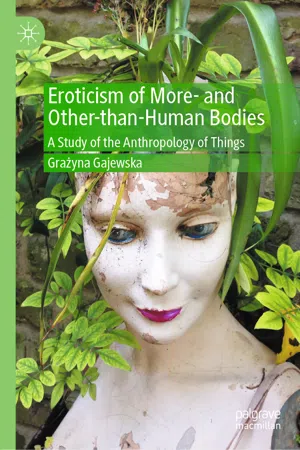
Focusing on non-human actors, Gra?yna Gajewska expands the discussion of eroticism in contemporary culture by bringing in material culture, object studies, and "the anthropology of things." She sets out from the assumption that things (such as, for instance, attire, underwear, shoes, or jewelry) play an important role in arousing erotic imagination—they are genuine participants in the process, not mere signifiers of eroticism. Their use does not denote only undeniable facts of everyday life associated with functionality, the pragmatic or aesthetic aspect, but also contribute to the shaping of human emotions, fantasies and phantasms. In her study, Gajewska brings eroticism in contemporary culture to light through applying gender studies to new contexts—animals, robots, virtual worlds—even as she explores a new methodology, the anthropology of things.
eBook - ePub
Eroticism of More- and Other-than-Human Bodies
A Study of the Anthropology of Things
- English
- ePUB (mobile friendly)
- Available on iOS & Android
eBook - ePub
Eroticism of More- and Other-than-Human Bodies
A Study of the Anthropology of Things
About this book
Information
© The Author(s) 2020
G. GajewskaEroticism of More- and Other-than-Human Bodieshttps://doi.org/10.1007/978-3-030-54042-5_11. Introduction: The Dynamics of Affects and Experiences of the More- and Other-than-Human Bodies
Grażyna Gajewska1
(1)
Adam Mickiewicz University, Poznań, Poland
In his 1993 essay entitled The Double Flame: Love and Eroticism,1 Mexican poet and essayist Octavio Paz deliberates on the intricate and convoluted relationships between sex, eroticism, and love. Although interwoven, they must not be considered one and the same. Paz conveys their simultaneous interconnectedness and difference via the metaphor of fire and flame: nature kindles the fire of sex above which a red flame of eroticism flickers, and still above there quivers a subtle, blue flame of love. Neither the red not the blue flame can exists without the fire, but they are distinct from the blaze over which they hover. Paz underlines that sex is the least human of that triad due to the fact that besides the Homo sapiens it is observed in many other species where it serves reproduction. While sex belongs to the sphere of nature, the flame of eroticism cannot be situated within the latter; culture is its much more likely domain. Although eroticism is not an “unnatural” act it does go beyond it, exploiting the unused resources of sexual energy and desire. Thus, on the one hand, eroticism is closely linked to nature (we would not be erotic beings were we not sexual animals in the first place), while on the other it transfers the surplus energy and the ingenuity it generates into the realm of culture, by separating desire from reproduction.
Following Paz’s line of thought, Zygmunt Bauman observes: “That surplus is a standing invitation to cultural inventiveness. The uses to which that reproductively redundant and wasted excess may be put are a cultural creation”.2 At the same time, the author stresses the inability to “liberate” (cultural) eroticism from (natural) sexuality: “[…] the reproductive function of sex is simultaneously the indispensable condition and a thorn in the flesh of eroticism; there is an unbreakable link, but also a constant tension between the two – that tension being as incurable as the link is unbreakable”.3 Whereas Bauman notes the ambiguity of the sex–eroticism relation and the impossibility of alienating the latter wholly from the sphere of nature, George Bataille draws a clear dividing line between sexuality and eroticism, emphasizing that transition from one to the other essentially reflects the progression from the animal to the human. In The History of Eroticism from 1976, Bataille argues: “Essentially, eroticism is the sexual activity of man, as opposed to that of animals. Not all of human sexuality is erotic, but it is erotic often enough not to be simply animal sexuality”.4 Here, eroticism appears to be a singularly human category, thus being in line with Western culture’s well-established opposition between nature and culture which underscores the exceptional traits of the human that set them apart from the animal world.5 The notions of animal sex and human eroticism are very much congruent with that opposition. It may be noted that in Western culture the expression “animal sex” possesses pejorative overtones and usually describes violent, vulgar, and often obscene human behaviours (which do not befit the human).
In my text, I depart from such clear-cut oppositions which juxtapose the animal against the human, nature against culture, and the normative against the non-normative. This owes to reflection inspired by the ideas of the post-human, new materialism and the concept of post-human sexuality which grew out of that intellectual background. In the perspective I have adopted, the dichotomy of “animal sex” versus “human eroticism” is hardly tenable. One can still track down and deconstruct such notions as well as suggest new ways of conceiving and presenting the complex relationships between the human and the non-human, or else still—to portray the sphere of eroticism within a nexus of manifold, non-binary but yet mutable, networked relations. This is exactly what this book sets out to do.
In their descriptions of the sex–eroticism–love triad, both Paz and Bauman devote most of their attention to the third element and rank it the highest as well. In this work, however, I place emphasis on the second of the above spheres. Erotic attraction is universal and it is observed in all societies, but the concepts of eroticism and its forms are associated with varied social, intellectual, and moral dispositions. I focus chiefly on those which function in the Western culture, since the concepts of love espoused in other cultures may be quite considerably different. The aforesaid author of The Double Flame maintains that the causes of the discrepancies should be sought in the fact that in the East the emotions function within a given religious concept, while in the Western culture—since Greek antiquity until the present day—the philosophy of erotic love remained outside official religion. In Plato, reflections on such states of elation are aligned with the entirety of his philosophy, in which the critique of myths and religious practices plays an important role. Another case in point is “courtly love”, construed as a knowledge of the senses combined with courtly refinement, which found little approval in the eyes of the Catholic Church. “No such thing is to be found in the Oriental tradition”—writes Paz—and cites Ts’ao Hsueh-ch’in’s Dream of the Red Chamber…
[…] a counterpoint between two worlds which, although separate, are in communication with each other: the beyond of Buddhism and Taoism, peopled by monks, ascetics, and divinities, and the passions, encounters, and separations of a polygamous aristocratic family in eighteenth-century China. Religious metaphysics and psychological realism. The same duality governs Lady Murasaki’s novel. None of these works, or other novels, works for the theater, and poems whose theme was love, were accused of heterodoxy.6
Indeed, some were criticized, but the reason for censure was obscenity rather than the ideas they put forward. Meanwhile, Western culture saw a great number of literary works being included in the Index librorum prohibitorum, not only due to the boldness or obscenity of depicted acts but also because they went against the teachings of the Church. It may suffice to mention Justine or the Misfortunes of Virtue (1791) by Donatien-Alphonse-François de Sade, which extolled a life of libertine freedom, above law, religion, and morality, or The Red and the Black (1831) by the freemason Stendhal (Marie-Henri Beyle), whose protagonist is torn between the throes of passion and calculation, which makes him see priesthood as a career rather than calling.7 The differences between Eastern and Western notions of destiny and freedom are also an obstacle to looking for common conceptions of passionate raptures and love. Sharing the belief in metempsychosis, Buddhism, Hinduism, and Taoism perceive outbursts of violent passion, jealousy, and amorous failures to be both a fruit of present actions and individual will, as well as an upshot of one’s life in previous incarnations. In the Western culture—at least in the contemporary times8—an intimate encounter of partners is seen rather as an unconstrained choice made “here and now”, based on individual preference.9 Consequently, unlike in the Eastern cultures, the notion of “karma” does not extend beyond that which has taken place in one’s current life, i.e. to the previous incarnation (as this is absent) but denotes life’s vicissitudes or “fate”. Such an understanding of fate in Western culture is evinced in the story of Tristan and Iseult, in which a magical potion bonds lovers for eternity, but in order for it to be effective mutual affirmation and attraction between the lovers is required.
In spite of the numerous differences between Eastern and Western conceptions of eroticism, one cannot overlook the analogies, reciprocal influences, or fascinations. Even Paz’s approach to Eastern and Western culture in The Double Flame is indicative of that fascination which to some extent idealizes the remote, mentally distinct modes of comprehending love and eroticism. There can be no doubt that over the centuries intercultural contact contributed to borrowings and penetration of concepts, motifs, attitudes to feelings and ways of arousing and showing those. The most eloquent examples here is the Arabic “courtliness” and the variant which, via Muslim Spain, reached the courts of Europe. The idealized “courtly love” can hardly be grasped without taking the Arabic eroticism into consideration. Cultures are not impenetrable fortresses but—trite though it may sound—crossroads, sites of flux whose effect is rarely ever one-sided. This is even more evident today, in the age of globalization and universalization, when the conceptions of eroticism can hardly be discussed without being aware of those fluxes, influences, or contradictions and conflicts which nevertheless arise from interaction. I do not mean the space alone, as time is also vital. Although I focus on the (post)modern period, it is not detached from the past; continuity of tradition and its contestation, disruptions, shifts of emphasis in the norms of conduct, morality, lifestyles, and worldviews engender multiple dependencies between what was and what one observes today. Changes affect concepts of love and eroticism alike, transforming the notions of what is considered erotically attractive, alluring, and arousing desire.
My deliberations concerning (post)modernity or late modernity rely on the diagnoses of the sociologist Anthony Giddens, who finds that the reality disintegrated only to reassemble itself in different configuration within a variety of domains, roles one performs and lifestyles one embraces. Late modern identity is founded on authenticity or, in other words, on being oneself and self-integrity. The period attaches great importance to personal development, determination of individual needs, and attempts to satisfy those needs. As a result, social constraints have to be challenged and personal emotional inhibitions have to be surmounted. The essential points of reference that inform life choices are aligned towards the “self”, to inner-direction that results from reconstructing and constructing one’s autobiography.10 This is a highly affirmative image of identity in the late modern era, but lurking behind the looking glass are uncertainty, trepidation, sense of instability, randomness, and varied disappointments: with people, situations, wasted opportunities, coincidences, or lack of our own capacity and inclination at a given place and time.
In the realm of intimate relationships, this manifests itself on the one hand in even greater efforts to discover new sensations, new experiences, and thrills of excitement, but at the same time the opportunities thus engendered and the quest for new experience are paid for with uncertainty and instability of relationships. Nonetheless, Giddens emphasizes the emancipatory nature of human relationships within the domains of love–eroticism–sex in the postmodern age. He argues that this owes to the spread of the concept of romantic love (through novels and subsequently films), as well as the emergence of effective contraceptives, which made it possible to separate sex from procreation. Consequently, individuals gained considerable freedom in terms of frequency of intercourse and the number of partners (without being encumbered by concerns of potential pregnancy) as well explorations and experiments in intimate relationships, in which pleasure and satisfaction became the chief goal. Bearing that in mind, late modernity or postmodernity may be approached as a period which, yielded novel practices a...
Table of contents
- Cover
- Front Matter
- 1. Introduction: The Dynamics of Affects and Experiences of the More- and Other-than-Human Bodies
- 2. More-than-Human Network of Relationality
- 3. Nature as a Phantasm of Culture
- 4. The Obsession of Artificial Bodies
- 5. The “Beloved” Objects
- 6. Conclusion
- Back Matter
Trusted by 375,005 students
Access to over 1.5 million titles for a fair monthly price.
Study more efficiently using our study tools.
Frequently asked questions
Yes, you can cancel anytime from the Subscription tab in your account settings on the Perlego website. Your subscription will stay active until the end of your current billing period. Learn how to cancel your subscription
No, books cannot be downloaded as external files, such as PDFs, for use outside of Perlego. However, you can download books within the Perlego app for offline reading on mobile or tablet. Learn how to download books offline
Perlego offers two plans: Essential and Complete
- Essential is ideal for learners and professionals who enjoy exploring a wide range of subjects. Access the Essential Library with 800,000+ trusted titles and best-sellers across business, personal growth, and the humanities. Includes unlimited reading time and Standard Read Aloud voice.
- Complete: Perfect for advanced learners and researchers needing full, unrestricted access. Unlock 1.5M+ books across hundreds of subjects, including academic and specialized titles. The Complete Plan also includes advanced features like Premium Read Aloud and Research Assistant.
We are an online textbook subscription service, where you can get access to an entire online library for less than the price of a single book per month. With over 1.5 million books across 990+ topics, we’ve got you covered! Learn about our mission
Look out for the read-aloud symbol on your next book to see if you can listen to it. The read-aloud tool reads text aloud for you, highlighting the text as it is being read. You can pause it, speed it up and slow it down. Learn more about Read Aloud
Yes! You can use the Perlego app on both iOS and Android devices to read anytime, anywhere — even offline. Perfect for commutes or when you’re on the go.
Please note we cannot support devices running on iOS 13 and Android 7 or earlier. Learn more about using the app
Please note we cannot support devices running on iOS 13 and Android 7 or earlier. Learn more about using the app
Yes, you can access Eroticism of More- and Other-than-Human Bodies by Grażyna Gajewska in PDF and/or ePUB format, as well as other popular books in Social Sciences & Philosophy History & Theory. We have over 1.5 million books available in our catalogue for you to explore.