This book seeks to diagnose and analyze the social, economic and technological consequences of the 2008 financial crisis, which brought epochal changes to our lives. First and foremost, a paradigm shift arose in economic theories that fail to predict or explain the crisis. On the governmental side, we have been observing a natural parallel between authoritarianism and the way many democratic countries are being governed. Liberalism seems to have failed. Driven by the anger over the crisis and its heavy burden, a variety of technological innovations were birthed and gained momentum. Bitcoin was a manifesto to the monetary system; sharing economy was a rebellion to the consumerist lifestyle; and subscriptions were a threat to ownership. This books ties each of these events to the 2008 crisis and explains the connection.
eBook - ePub
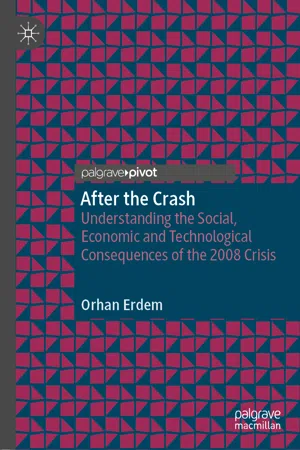
After the Crash
Understanding the Social, Economic and Technological Consequences of the 2008 Crisis
- English
- ePUB (mobile friendly)
- Available on iOS & Android
eBook - ePub
After the Crash
Understanding the Social, Economic and Technological Consequences of the 2008 Crisis
About this book
Information
© The Author(s) 2020
O. ErdemAfter the Crashhttps://doi.org/10.1007/978-3-030-43343-7_11. Introduction
Orhan Erdem1
(1)
PURI School of Business, Rockford University, Rockford, IL, USA
Abstract
This chapter introduces the main idea and presents the flow and the plan of the book.
Keywords
Financial crisesTransformationRecoveryTechnologyFinancial crises do not always result in economic consequences only. Changing political arena, new institutions and social unrest often accompany economic consequences. Analyzing 20 developed countries (Funke et al. 2016), for example, reveal that after a financial crisis, democratic tendencies weaken, political polarization rises, and voting share of the extreme right parties increase by an average of 30 percent. Some of the offsprings of the crises might include new governments with new promises, new laws or new financial, and economic institutions. These offsprings are mostly analyzed alone, excluded one from the others; economists call this ceteris paribus—everything else is kept constant. Political scientists would like to discuss the crises from their perspective, sociologists prefer to analyze the cases from social points of view, and economists study economic consequences. However, a broader discussion without excluding the other disciplines provides us with a better understanding as the world is getting more and more complex. The question I am trying to answer in this book is “What are the social, economic, and technological consequences of the 2008 crisis?”
Eleven years after the 2008 global financial crisis, much has been said and written about its causes and the lessons to be learned.1 However, as Mian and Sufi (2014) say “the recovery from the Great Recession has been terrible.” Thus, the changes that took place afterward deserve to be discussed from a broader perspective.
The 2008 crisis was one of the biggest the world has experienced.2 Millions of people were hurt, economically or psychologically. Many companies went bankrupt or were rescued by the governments, causing billions of dollars of losses to taxpayers. Many economies have gone through recessions, and some have not recovered yet. Even though the U.S. economy has recovered almost fully from the crisis, it is estimated that the crisis cost every American a lifetime present-value income loss of $70,000 (Barnichon et al. 2018). However, its effects were not restricted to financial damages only. It marked the beginning of a new era, which was associated with a new understanding of theoretical and practical economics.
This book looks at the crisis with the perspective that the 2008 crash had epochal changes in our lives. These changes point to an era whose characteristics are fundamentally different from those of pre-2008 years. It has been famously said, “Every cloud has a silver lining,” and this crisis is no exception. What did the crisis change and what are its implications for us?
I begin by explaining that the first thing that was deeply affected by the crisis was the economic theory. The classical economic theory, which was central to the economic policies of several countries, is not well-suited for error-making humans, and it needs to be updated. We were imagined to be creatures with perfect foresight, calculation ability, and consistency; these assumptions provided easy, elegant solutions to problems. However, some of its main assumptions are unrealistic and provide useless results in real life. For example, Gary Becker, who received the Sveriges Riksbank Prize in Economic Sciences in Memory of Alfred Nobel3 in 1992, claimed that people had children because children were durable goods (Becker 1960), no different than a refrigerator, washing machine, or hairdryer. The 1982 Nobel laureate, George Stigler, wrote in 1977 that the tastes of people are similar and do not change over time (Stigler and Becker 1977). This claim means that everybody has the same preferences over choices, like food, cars, and houses. This is done for the sake of easy and simple solutions to economic problems. Once it is assumed that everybody has the same tastes, it will be straightforward to calculate how a nation would behave. However, the prediction will not be accurate.
These were some stunning examples of a broader idea, called rationality, which formed the basis of current economic models . We had to update the economic models to understand the economic decision-making of humans, but we could not. The economists kept using outdated models, which paved the way to a financial crisis. Even though many researchers warned academia about the downsides of these assumptions , they were not heeded. The idea that people and companies act rationally was shaken heavily when market participants did not behave during the crisis as the theory said they should. The results of the incomplete formulations and unrealistic assumptions were devastating. Barry Eichengreen, professor of economics at the University of California at Berkeley, described this situation: “The great credit crisis has cast into doubt much of what we thought we knew about the economics” (The Economist 2009) In other words, the aim to solve the economic problems of humanity was simplified so heavily that it became useless.
In 2017, nine years after the crisis, an economist received a Nobel Prize simply for saying that humans make mistakes, they are not robots. His outstanding works, which were ignored and even ridiculed for decades, are now appreciated at the highest level. The crisis led us to rethink and redesign the economic theory, which will totally change the markets and economic policies in the future. Most of the new research in economics is no longer assuming fully rational agents acting in perfect free markets. New theories and policy assertions now consider humans as error-making and evolving. Thus, this era can be identified with more humane values. The social life, science, even economic policies, will be designed in a way that better suits human needs. This would not have happened if there had been no crisis because economics was previously referred to as one of the most isolated sciences.
The after-the-crisis-changes are barely restricted to economic theory, which I explain next. On the governmental side, we have been observing a natural parallel between authoritarianism and the way many democratic countries are being governed. Liberalism seems to have failed.4 People have been losing their trust in economic regimes. Driven by the anger over the crisis and thanks to technology, people invented new ways of trading, traveling, lodging, and living that once seemed contrary to capitalism. Some of these are practical changes, such as cryptocurrencies, sharing economy, and service subscriptions. Bitcoin was a manifesto to the monetary system; sharing economy was a rebellion to the consumerist lifestyle; and subscriptions were a threat to ownership, the basis of capitalism. Without a crisis, these would never have been created.
We are experiencing a profound transformation driven mainly by the consequences of the crisis, and winding back the clock is not an option. What do they imply and how are they shaping our lives? What do they mean for the future? This book, which derives conclusions from several research, including mine, and political developments, aims to answer these questions. A few pieces which are related to the behavioral finance are paraphrased from my earlier empirical works. I use a narrative way of presentation, and aim to make the book a scholarly one which targets scholars from all disciplines.
The book proceeds as follows: Chapter 2 starts with the precrisis period. It mentions a couple of main breakthrough events in history. Chapter 3 talks about the crisis and how it happened, and...
Table of contents
- Cover
- Front Matter
- 1. Introduction
- 2. Before the Crisis
- 3. The 2008 Crisis
- 4. The Crisis and Aftermath-I: Behavioral Economics
- 5. The Crisis and Aftermath-II: Society and Economics
- 6. Conclusion
- Back Matter
Trusted by 375,005 students
Access to over 1.5 million titles for a fair monthly price.
Study more efficiently using our study tools.
Frequently asked questions
Yes, you can cancel anytime from the Subscription tab in your account settings on the Perlego website. Your subscription will stay active until the end of your current billing period. Learn how to cancel your subscription
No, books cannot be downloaded as external files, such as PDFs, for use outside of Perlego. However, you can download books within the Perlego app for offline reading on mobile or tablet. Learn how to download books offline
Perlego offers two plans: Essential and Complete
- Essential is ideal for learners and professionals who enjoy exploring a wide range of subjects. Access the Essential Library with 800,000+ trusted titles and best-sellers across business, personal growth, and the humanities. Includes unlimited reading time and Standard Read Aloud voice.
- Complete: Perfect for advanced learners and researchers needing full, unrestricted access. Unlock 1.5M+ books across hundreds of subjects, including academic and specialized titles. The Complete Plan also includes advanced features like Premium Read Aloud and Research Assistant.
We are an online textbook subscription service, where you can get access to an entire online library for less than the price of a single book per month. With over 1.5 million books across 990+ topics, we’ve got you covered! Learn about our mission
Look out for the read-aloud symbol on your next book to see if you can listen to it. The read-aloud tool reads text aloud for you, highlighting the text as it is being read. You can pause it, speed it up and slow it down. Learn more about Read Aloud
Yes! You can use the Perlego app on both iOS and Android devices to read anytime, anywhere — even offline. Perfect for commutes or when you’re on the go.
Please note we cannot support devices running on iOS 13 and Android 7 or earlier. Learn more about using the app
Please note we cannot support devices running on iOS 13 and Android 7 or earlier. Learn more about using the app
Yes, you can access After the Crash by Orhan Erdem in PDF and/or ePUB format, as well as other popular books in Economics & Economic History. We have over 1.5 million books available in our catalogue for you to explore.