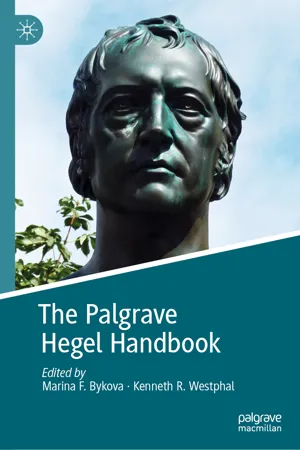
This handbook presents the conceptions and principles central to every aspect of Hegel's systematic philosophy. In twenty-eight thematically linked chapters by leading international experts, The Palgrave Hegel Handbook provides reliable, scholarly overviews of each subject, illuminates the main issues and debates, and details concisely the considered views of each contributor. Recent scholarship challenges traditional, largely anti-Kantian, readings of Hegel, focusing instead on Hegel's appropriation of Kantian epistemology to reconcile idealism with the rejection of foundationalism, coherentism and skepticism. Focused like Kant on showing how fundamental unities underlie the profusion of apparently independent events, Hegel argued that reality is rationally structured, so that its systematic structure is manifest to our properly informed thought. Accordingly, this handbook re-assesses Hegel's philosophical aims, methods and achievements, and re-evaluates many aspects of Hegel's enduring philosophical contributions, ranging from metaphysics, epistemology, and dialectic, to moral and political philosophy and philosophy of history. Each chapter, and The Palgrave Hegel Handbook as a whole, provides an informed, authoritative understanding of each aspect of Hegel's philosophy.
eBook - ePub
The Palgrave Hegel Handbook
- English
- ePUB (mobile friendly)
- Available on iOS & Android
eBook - ePub
The Palgrave Hegel Handbook
About this book
Information
Topic
PhilosophySubtopic
HistoriographyPart IIntellectual Background and Philosophical Project
© The Author(s) 2020
M. F. Bykova, K. R. Westphal (eds.)The Palgrave Hegel HandbookPalgrave Handbooks in German Idealismhttps://doi.org/10.1007/978-3-030-26597-7_11. Hegel: His Life and His Path in Philosophy
Marina F. Bykova1
(1)
North Carolina State University, Raleigh, NC, USA
Keywords
Tübinger StiftHölderlinSchellingNiethammerJena periodBerlin periodFrench RevolutionKantian philosophyBerlin LecturesRightly considered the most systematic of German idealists, Georg Wilhelm Friedrich Hegel (1770–1831) elaborated a comprehensive philosophical system which, he believed, could consistently explain how everything in the world, including our thoughts, is interrelated. It is hard to overestimate his ambition and the complexity of his undertaking, which, together with the highly abstract metaphysical background of his philosophy, has led to a number of misinterpretations and misconceptions about both his philosophical project and its results. Hegel’s writings are difficult to read and comprehend, yet his many valuable insights into numerous topics remain philosophically significant today and secure for him a permanent place in philosophy and its history.
This chapter sketches the thinker’s life and views him in the context of his historical time and intellectual milieu. It does not attempt to discuss all the nuances of Hegel’s intellectual development. There are many outstanding biographies of Hegel published only in recent years (Pinkard 2000; Althaus 2000; Fulda 2003; Vieweg 2019), and it would be hard to surpass either their details or their breadth. My more modest aim is to explore links between Hegel’s life, philosophical ideas, and specific intellectual context that together can provide the context necessary for a thorough understanding of the thinker and his ideas.
This chapter examines the most formative and decisive periods of Hegel’s life, which either significantly impacted his thought or reflected some notable changes in his philosophical views. It begins with a discussion of the early stage of Hegel’s intellectual development, which focuses on his life in Stuttgart (most notably 1777–1788), then turns to Hegel’s time in Tűbingen and his interactions with Hölderlin and Schelling that proved to be instrumental to his philosophical self-awareness (1788–1793). The third section considers the transitional years between his time as a student and the beginning of his academic career, as he first tries his hand at writing philosophical essays (1793–1800), the fourth turns to Hegel’s stay at Jena where he successfully launched his university career (1801–1806), the fifth section draws from Hegel’s years outside the university (1807–1816), the sixth examines a short two-year period at Heidelberg, and the final, seventh, section addresses the Berlin period, perhaps the most productive of Hegel’s philosophical career (1818–1831). I thus aim to consider Hegel in his natural setting, i.e. the historical and intellectual context that shaped him as an individual and influenced the development of his philosophical thought.
1 Early Life and First Encounter with Philosophy
The son of Georg Ludwig Hegel and Maria Magdalena Louisa, Georg Wilhelm Friedrich Hegel was born on 27 August, 1770 in Stuttgart, the capital of the Duchy of Württemberg. The youngest of six children, only he, his sister Christiane Luise, and his brother Georg Ludwig survived into adulthood. Throughout his life Hegel was plagued by health difficulties and, in his early years, suffered through several life-threatening illnesses. Hegel’s father, Georg Hegel, had studied law at Tűbingen University and eventually became a secretary to the revenue office at the court of Wűrttemberg. Equally impressive, Hegel’s mother was unusually educated for a woman of her time.
The Hegel family was moderately well off in comparison to other households, which allowed them to move close to the “non-noble notables” (Ehrbarkeit) “who staffed the Wűrttemberg assembly of estates and who had a near-monopoly on the better, more prestigious positions in Württemberg” (Pinkard 2000, 5). However, Hegel’s family was not part of this establishment and had to rely on education and the opportunities procured through their hard work and talent instead of familial or social connections. As a child, at the age of three, Hegel began attending German School. In addition, his mother taught him Latin at home, and by the time he was placed in Latin School, he already knew basic Latin. No doubt, this emphasis on education and learning would characterize Hegel’s views on the role education (both as schooling and as enculturation [Bildung]) would play in the modern world.
When Hegel was eleven, his mother died from bilious fever (a sort of acute intestinal or malarial fever) that spread through Stuttgart. Hegel himself barely survived and, as a result of the disease, developed a speech impediment characterized by stuttering and periodic gasping, with which he had to cope his entire life. His mother’s death had a lasting, traumatic impact on the young boy, who was now left in the care of his father.
In 1784, Hegel was admitted to the Gymnasium Illustre in Stuttgart. The school, like many others during this period, was unorderly and in a state of partial disarray. Nonetheless, it managed to combine Enlightenment thought with the Protestant humanism of the Renaissance, thus giving Hegel a sense of both tradition and progress in his youth. The decision to send the boy to the Gymnasium was likely a compromise between his father, who wanted to provide Hegel with an Enlightenment education, and his deceased mother’s desire to see her son studying theology at Tűbingen. As some of the seats at Tűbingen were reserved for students who attended the Gymnasium, Hegel could get an Enlightenment education and still be qualified for a theological career (Pinkard 2000, 8).
One of the most significant influences on Hegel’s thought during this period was his friendship with Professor Jacob Friedrich von Abel, a faculty member of the Karlsschule, a unique educational institution founded by Duke Karl Eugen of Württemberg to train officials and high ranking military officers in the new sciences.1 Hegel’s sister wrote that von Abel “fostered” Hegel (or made him his “protégé”), so it should be no surprise that, when Abel voiced his opinion on the debate surrounding Kant’s Critique of Pure Reason and Prolegomena to Any Future Metaphysics through the publication of his 1787 book Versuch über die Natur der speculativen Vernunft zur Prüfung des Kantischen Systems (An Essay on the Nature of Speculative Reason for a Test of the Kantian System), Hegel would take his mentor’s opinion very seriously.
Abel’s book sought to defend the traditional rationalist metaphysical stance against Kant’s claims that positive metaphysical knowledge of the world is impossible, and that all one can know is the negative claim that there are metaphysical things. Moreover, in light of the view that God is a metaphysical being, Kant’s argument held that one cannot know anything of God. It was this line of thought that Professor Abel attacked in his book, which claimed that the world simply must have a creator and that this divine creator establishes the relation of our experience to the world (Pinkard 2000, 13). This book was one of Hegel’s first introductions to Kant’s philosophy, and given the influence that his mentor had on him, it is likely that Hegel would have been inclined to have a highly critical view of Kant’s philosophy. Indeed, his anti-Kantianism seems to be confirmed by his dismissive attitude toward Kantian philosophy over the next several years.
While Hegel might have held less than enthusiastic views about Kant’s philosophical system, he was greatly swayed by Gotthold Ephraim Lessing (1729–1781), whose attitude toward philosophy and education of the general public made a substantial impact on Hegel’s intellectual development. In a letter to Hegel, one of his contemporaries, Karl Joseph Hieronymus Windischmann, observes:
The study of your system of science has convinced me that someday, when the time for understanding has come, this work will be viewed as the elementary text of human emancipation, as the key to the new Gospel announced by Lessing. (Letters 558)
Lessing, a philosopher, writer, publicist, and art critic, was widely regarded as one of the German-speaking world’s most prominent “men of letters.” In particular, Hegel became fascinated with Lessing’s role as an “educator of the people” (Volkserzieher) and envisioned a similar future for himself. His diary was filled with musings on what being an educator of the people entailed, and what exactly he would teach all of them.2
2 Time in Tübingen: Acquaintance with Hölderlin and Schelling, and Lived Experience of the French Revolution
In 1788, Hegel began his studies at the Tübinger Stift, a Protestant theological Seminary, which he entered with the intent of studying theology and eventually becoming a Lutheran pastor.3 Many commentators and biographers of Hegel underscore the idyllic setting of the Stift on the bank of the Neckar River and the glorious traditions of this oldest of theological institutions, whose roots can be traced to the Middle Ages (see Plant 1999). Yet, at the time of Hegel’s arrival, the Stift was in such a state of decline that it was in danger of closing altogether: the lecturing material was antiquated, the professoriate was comprised of amateurs who were only able to teach in virtue of their family relationships or friendship with the Stift administration, and the Seminary’s antiquated mission of providing corrective attitudes towards the students was oppressive. Thus, it should not come as a surprise that Hegel’s initial reaction was one of overwhelming disappointment and discouragement. Nonetheless, two major events that happened during Hegel’s stay in Tübingen altered the course of his life f...
Table of contents
- Cover
- Front Matter
- Part I. Intellectual Background and Philosophical Project
- Part II. Phenomenology of Spirit
- Part III. Science of Logic and the System of Philosophy
- Part IV. Philosophy of Nature
- Part V. Philosophy of Spirit
- Part VI. Practical and Political Philosophy
- Part VII. Philosophy of World History and History of Philosophy
- Part VIII. Hegelianism and Post-Hegelian Thought
- Back Matter
Trusted by 375,005 students
Access to over 1.5 million titles for a fair monthly price.
Study more efficiently using our study tools.
Frequently asked questions
Yes, you can cancel anytime from the Subscription tab in your account settings on the Perlego website. Your subscription will stay active until the end of your current billing period. Learn how to cancel your subscription
No, books cannot be downloaded as external files, such as PDFs, for use outside of Perlego. However, you can download books within the Perlego app for offline reading on mobile or tablet. Learn how to download books offline
Perlego offers two plans: Essential and Complete
- Essential is ideal for learners and professionals who enjoy exploring a wide range of subjects. Access the Essential Library with 800,000+ trusted titles and best-sellers across business, personal growth, and the humanities. Includes unlimited reading time and Standard Read Aloud voice.
- Complete: Perfect for advanced learners and researchers needing full, unrestricted access. Unlock 1.5M+ books across hundreds of subjects, including academic and specialized titles. The Complete Plan also includes advanced features like Premium Read Aloud and Research Assistant.
We are an online textbook subscription service, where you can get access to an entire online library for less than the price of a single book per month. With over 1.5 million books across 990+ topics, we’ve got you covered! Learn about our mission
Look out for the read-aloud symbol on your next book to see if you can listen to it. The read-aloud tool reads text aloud for you, highlighting the text as it is being read. You can pause it, speed it up and slow it down. Learn more about Read Aloud
Yes! You can use the Perlego app on both iOS and Android devices to read anytime, anywhere — even offline. Perfect for commutes or when you’re on the go.
Please note we cannot support devices running on iOS 13 and Android 7 or earlier. Learn more about using the app
Please note we cannot support devices running on iOS 13 and Android 7 or earlier. Learn more about using the app
Yes, you can access The Palgrave Hegel Handbook by Marina F. Bykova, Kenneth R. Westphal, Marina F. Bykova,Kenneth R. Westphal in PDF and/or ePUB format, as well as other popular books in Philosophy & Historiography. We have over 1.5 million books available in our catalogue for you to explore.