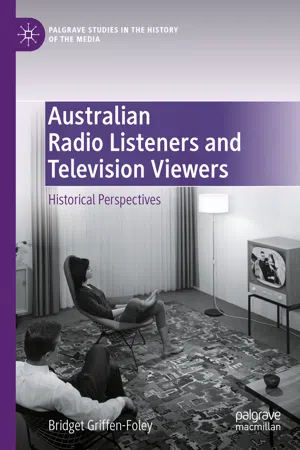
This lively and accessible book charts how Australian audiences have engaged with radio and television since the 1920s. Ranging across both the commercial and public service broadcasting sectors, it recovers and explores the lived experiences of a wide cross-section of Australian listeners and viewers. Offering new perspectives on how audiences have responded to broadcast content, and how radio and television stations have been part of the lives of Australians, over the past one hundred years, this book invites us into the dynamic world created for children by the radio industry, traces the operations of radio and television clubs across Australia, and uncovers the workings of the Australian Broadcasting Commission's viewers' advisory committees. It also opens up the fan mail received by Australian broadcasting stations and personalities, delves into the complaints files of regulators, and teases out the role of participants and studio audiences in popular matchmaking programs.
eBook - ePub
Australian Radio Listeners and Television Viewers
Historical Perspectives
- English
- ePUB (mobile friendly)
- Available on iOS & Android
eBook - ePub
About this book
Information
© The Author(s) 2020
B. Griffen-FoleyAustralian Radio Listeners and Television ViewersPalgrave Studies in the History of the Mediahttps://doi.org/10.1007/978-3-030-54637-3_11. Introduction
Bridget Griffen-Foley1
(1)
Macquarie University, Sydney, NSW, Australia
Abstract
This introductory chapter outlines the book’s focus on how Australians have consumed and engaged with radio and television—public (Australian Broadcasting Commission) and commercial—since the 1920s. It explains the book’s approach, which is to present a series of historical ‘perspectives’ based on fine-grained empirical research across Australia. Each chapter recovers and explores some of the lived experiences of Australian radio listeners and television viewers. The introduction also briefly summarises some key approaches to the study and history of media and broadcast audiences.
Keywords
Media audiencesRadioTelevisionBroadcastingAustraliaAustralian Radio Listeners and Television Viewers: Historical Perspectives is about how Australian audiences have consumed and engaged with broadcast media over the last century. It considers radio since the 1920s and television since the 1950s, covering both public (Australian Broadcasting Commission) and commercial broadcasters. Moving away from a traditional focus on what the media has produced by way of texts and images, this book explores how radio and television content has been received, debated and engaged with, as well as the off-air role of radio and television stations and programs in the lives of Australian listeners and viewers.
This book presents ‘perspectives’ on the topic, recovering and exploring some of the lived experiences of Australian broadcast audiences. The six chapters are based on a diverse range of primary sources from around Australia, many used here for the first time, including fan mail, complaints files, regulatory records, the private archives of radio clubs and the agendas and minutes of ABC Advisory Committees.
Chapter 2 explores the dynamic world for children created by the on-air and extracurricular endeavours of commercial stations and the ABC (including its famous Argonauts Club) in the years before World War II. Chapter 3 examines the emergence of other radio clubs—particularly attached to commercial stations—across Australia, and moves on to the role of television clubs . Chapter 4 intercepts some of the fan mail received by the ABC and commercial broadcasting stations and networks. Chapter 5, which is closely related to Chap. 4, is based on complaints received by radio and television broadcasters, as well as the Australian Broadcasting Control Board (1949–77), responsible mainly for the commercial sector. Chapter 6 turns its focus back to the ABC, tracing the role of the public service broadcaster’s Advisory Committees before uncovering the operations of its state-based Television Viewers’ Committees between 1959 and 1965. Chapter 7 considers programs about romance and dating since the 1930s, paying particular attention to participants and audience involvement in two creations of the 1980s: Midnight Matchmaker on Sydney radio and Perfect Match on network television.
In The Practice of Everyday Life in 1980, sociologist Michel de Certeau examined the ways in which people altered and individualised forms of mass culture in order to make them their own.1 Scholars increasingly challenged the view, drawn largely from the ‘effects tradition’, that media consumers were passive, teasing out notions of the passive and the private, the active and the public.2 By the mid-1990s scholars, including Australians Virginia Nightingale and Elizabeth Jacka, were comparing differing approaches to audience research in the social sciences.3 Barrie Gunter and David Machin edited a four-volume work on media audiences, displaying the diversity of theoretical and methodological approaches to history, measurement and effects, in 2009.4 This was followed by Nightingale’s The Handbook of Media Audiences.5
There was an increasing realisation, as Richard Butsch put it, that ‘[p]opular and scholarly discussions of audiences have long lacked historical context’.6 As Sonia Livingstone remarked, ‘it is all too easy to make the ahistorical assumption that present theory and findings apply equally well to past or future periods’.7
My book seeks to uncover and explore some of the traces of the ‘temporary communities’8 formed by Australian broadcast audiences and broadcasting institutions themselves. It is informed by major historical studies over the last 30 years including American work on audiences for entertainment and radio9; essays in Michele Hilmes and Jason Loviglio’s Radio Reader10; Kate Lacey’s study of listening as a cultural practice;11 and Paddy Scannell’s exploration of the communicative experience in modern life.12 It also builds on Australian studies including Kate Darian-Smith and Sue Turnbull’s edited collection, Remembering Television13; Mark Balnaves, Tom O’Regan and Ben Goldsmith’s book on audience measurement14; Michelle Arrow’s studies of listeners to Blue Hills;15 and work on Perfect Match by cultural studies scholars.16
It would be difficult, if not impossible, to write the definitive history of Australian broadcast audiences given the challenges of finding systematic sources created by, and about, listeners and viewers, and the multiplicity of individual experiences. Based on fine-grained empirical research, this book is instead a series of perspectives on aspects of the broadcasting experience.
Bibliography
- Arrow, Michelle. ‘“Good entertainment & good family life”: Listener readings and responses to Gwen Meredith’s The Lawsons and Blue Hills’, Journal of Australian Studies, 22(58) (1998), pp. 38–47.
- Arrow, Michelle. ‘“The most sickening piece of snobbery I have ever heard”: Race, radio listening, and the “Aboriginal question” in Blue Hills’, Australian Historical Studies, 38(130) (2007), pp. 244–60.
- Australian Journal of Cultural Studies, 4(2) (May 1987).
- Balnaves, Mark, Tom O’Regan and Ben Goldsmith. Rating the Audienc...
Table of contents
- Cover
- Front Matter
- 1. Introduction
- 2. Aunts, Uncles and Argonauts
- 3. Club Loyalty
- 4. The Fan Mail Trail
- 5. Outrage and Complaint
- 6. Viewing Television by Committee
- 7. Matchmaking
- 8. Conclusion
- Back Matter
Trusted by 375,005 students
Access to over 1.5 million titles for a fair monthly price.
Study more efficiently using our study tools.
Frequently asked questions
Yes, you can cancel anytime from the Subscription tab in your account settings on the Perlego website. Your subscription will stay active until the end of your current billing period. Learn how to cancel your subscription
No, books cannot be downloaded as external files, such as PDFs, for use outside of Perlego. However, you can download books within the Perlego app for offline reading on mobile or tablet. Learn how to download books offline
Perlego offers two plans: Essential and Complete
- Essential is ideal for learners and professionals who enjoy exploring a wide range of subjects. Access the Essential Library with 800,000+ trusted titles and best-sellers across business, personal growth, and the humanities. Includes unlimited reading time and Standard Read Aloud voice.
- Complete: Perfect for advanced learners and researchers needing full, unrestricted access. Unlock 1.5M+ books across hundreds of subjects, including academic and specialized titles. The Complete Plan also includes advanced features like Premium Read Aloud and Research Assistant.
We are an online textbook subscription service, where you can get access to an entire online library for less than the price of a single book per month. With over 1.5 million books across 990+ topics, we’ve got you covered! Learn about our mission
Look out for the read-aloud symbol on your next book to see if you can listen to it. The read-aloud tool reads text aloud for you, highlighting the text as it is being read. You can pause it, speed it up and slow it down. Learn more about Read Aloud
Yes! You can use the Perlego app on both iOS and Android devices to read anytime, anywhere — even offline. Perfect for commutes or when you’re on the go.
Please note we cannot support devices running on iOS 13 and Android 7 or earlier. Learn more about using the app
Please note we cannot support devices running on iOS 13 and Android 7 or earlier. Learn more about using the app
Yes, you can access Australian Radio Listeners and Television Viewers by Bridget Griffen-Foley in PDF and/or ePUB format, as well as other popular books in History & Social History. We have over 1.5 million books available in our catalogue for you to explore.