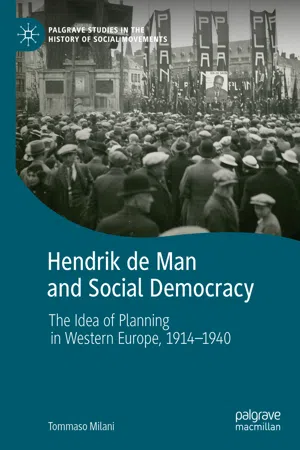
The book investigates the intellectual and political trajectory of the Belgian theorist Hendrik de Man (1885-1953) by examining the impact that his works and activism had on Western European social democracy between the two world wars. Based on multinational archival research, the book highlights how the idea of economic planning became part of a wider effort to address an ideological crisis within the socialist movement and revitalise the latter amidst the Great Depression. A heavily controversial figure also because of his subsequent involvement in Belgian wartime collaboration, de Man played a pivotal role in challenging traditional Marxist assumptions about the role of the state under capitalism and in promoting transnational exchanges between unorthodox social democrats across Europe. Starting from de Man's experience in World War I, the book analyses his departure from Marxism, his elaboration of an alternative social democratic paradigm, his entry in Belgian politics as wellas the reception of his thought in France and Britain.
eBook - ePub
Hendrik de Man and Social Democracy
The Idea of Planning in Western Europe, 1914–1940
- English
- ePUB (mobile friendly)
- Available on iOS & Android
eBook - ePub
About this book
Information
© The Author(s) 2020
T. MilaniHendrik de Man and Social DemocracyPalgrave Studies in the History of Social Movementshttps://doi.org/10.1007/978-3-030-42534-0_11. Introduction: A Man and a Movement
“The beautiful years of the Plan”: this is how, in his memoirs, the civil servant, social democratic politician, and President of the European Commission Jacques Delors recalled his time working for the Social Affairs division at France’s Commissariat Général au Plan, between 1962 and 1969.1 Paying a heartfelt tribute to “la planification à la française,” Delors sang the praises of the “uncertainty reducer” by which his country successfully allocated scarce resources without neglecting the “great parameters” such as demography, technological innovation, and the environment.2 Post-war planning, Delors contended, established a “privileged framework for the social dialogue” between various interest groups and relied on the “work of intellectuals” to promote “modernisation,” “growth,” and “more harmonious development.”3
Delors was outspoken in his belief that this method of governance had not outlived its usefulness.4 Yet, when the book came out in 2004, his message did not resonate with progressives. Under Tony Blair, the claim that “the old Left solution of rigid economic planning and state control won’t work” had become the cornerstone of New Labour.5 In the United States, Bill Clinton toasted the end of the “era of big government.”6 Gerhard Schroeder in Germany and Lionel Jospin in France also embarked on a market-oriented course: as a distinguished historian of socialism observed in 1999, “all social democratic parties now concede that there are limits to the expansion of public expenditure, and that the era of nationalisation is over. Privatisation has become acceptable, even desirable.”7 It is no accident that, when the increasingly peripheral and enfeebled Commissariat was shut down in 2006, neither side of the aisle in the National Assembly raised objections.
Three or four decades earlier, the mood could not have been more different. Between 1945 and the mid-1970s, all major parties in Europe were broadly supportive of the mixed economy, that is, an economic regime in which public authorities exerted decisive influence over the economic system, also by means of controlled enterprises, and maintained high levels of employment through aggregate demand management.8 Coordination within this multi-layered structure was ensured through planning, a concept which—as one critic wrote in 1950—had “seized the imagination” of the Europeans with unprecedented “speed and thoroughness.”9 Widespread acceptance of public regulation permeated politics. Although the term “consensus” might exaggerate the degree of convergence between Left and Right,10 it remains true that, for the first time in history, a range of forces representing almost the entire political spectrum accorded the state a pivotal role in constraining and steering—but not replacing—the market. As a result, the assertion that “the Welfare State, combined with full employment and high earnings, had added to the freedom of the citizen” was no longer anathema to most conservatives11; the argument that the coexistence of capitalism and democracy was possible, albeit in a “state of antagonistic balance,” rang true to most social democrats.12 The French sociologist Raymond Aron noted in 1966 that “the political systems of the advanced Western nations” had turned into “an acceptable compromise between the characteristic values of the three schools of liberalism, democracy, and socialism,” and because of the “success” of that compromise “ideological conflicts in the West” had petered out.13
The post-war settlement needed moderation, a desire to find common ground, and a high degree of self-discipline by political parties, trade unions, and other social actors to endure. It also required the consolidation of a distinct political culture—that is to say, a set of core values and ideas which bestowed legitimacy on its basic institutions. According to the eminent historian Tony Judt, these were provided by social democracy, namely the Western European centre-left. Social democrats maintained that “genuine improvements in the conditions of all classes could be obtained in incremental and peaceful ways” and therefore rejected “the nineteenth-century paradigm of violent urban upheaval.”14 Likewise, they distanced themselves from the communists as they refused “to commit to the inevitability of capitalism’s imminent demise or to the wisdom of hastening that demise by their own political actions.”15 Their mission was to use “the state to eliminate the social pathologies attendant on capitalist forms of production and the unrestricted workings of a market economy: to build not economic utopias but good societies.”16 Social democrats did not excel in theorising but developed a highly effective brand of politics through which civil, political, and social rights were expanded as never before: the essence of their piecemeal approach lay in “the banality of good.”17
Judt was right in stressing social democracy’s landmark but often forgotten contribution to the post-war order. His account, however, has two weaknesses. Firstly, it must be noted that Christian democracy deserves at least as much credit for shoring up stability in Western Europe after 1945.18 Secondly, Judt omitted to say that social democratic wisdom, imbued with common sense and animated by a desire to fix, instead of dismantling, capitalism, was not the expression of a coherent worldview; rather, it was the by-product of a hesitant, excruciating, and sometimes silent emancipation from an overriding, and once dominant, system of thought: Marxism.19 Only by breaking free from the Marxist ideological straightjacket social democracy could pledge unconditional allegiance to the mixed economy. The Godesberg programme approved by German Social Democrats in 1959, which included both the repudiation of the class struggle and a commitment not to seize all the means of productions, was emblematic of a wider Western European trend in this direction.20
The fact that—with the exception of Britain and, to an extent, the Nordic countries—centre-left pragmatism grew out of the exhaustion of a pre-existing revolutionary paradigm is not a minor detail in the tortuous development of social democracy and explains much of its seemingly post-ideological character in the late 1950s.21 At least from the 1880s till the outbreak of the Second World War, the lingering problem of how to cope with Marx’s legacy drew conspicuous energies from nearly all believers in socialism, intellectuals, and political leaders alike. For Marxism was not only the ideological cement of the various factions which had founded the Second International: it was also, in its popular, most basic form, a Weltanschauung, and the rock-solid belief of millions of people who had espoused the socialist cause. It would not be an exaggeration to say that other than a theory of society, Marxism was a secular religion, with its rites, its dogmas, and its clergy.22
The crystallisation of Marxism into a stiff set of propositions presented as articles of faith to the masses that occurred largely after Marx’s death is the key reason why its critique became a delicate and potentially dangerous task. Dissent could put what Leszek Kolakowski called “the spiritual certainty” of the labour movement in jeopardy, and erode the trust that workers placed in their representatives, that is, trade unions and parties.23 Intellectuals began fearing that revisions might be carried out in erratic, destructive, or polarising ways, and increasingly perceived themselves as guardians of the orthodoxy. Fulminating against Bolshevism in 1931, the then 77-year old high priest of German Marxism, Karl Kautsky, candidly admitted: “If Lenin is right, then my whole life’s work devoted to the propagation, application, and further development of the ideas of my great masters, Marx and Engels, has been in vain.”24 This was hardly an overstatement: perhaps more than anyone else, Kautsky had contributed to forging the nearly hegemonic Marxist doctrine—the one disseminated by the Sozialdemokratische Partei Deutschlands (SPD)—and set strict limits to the degree of ideological nonconformity that social democratic élites would tolerate. Welding Marxism (the ideology) and social democracy (the movement) together was one of his greatest accomplishments.
This book deals—if one pursues the analogy with religion further—with an apostasy and a heresy, for which a single individual, Hendrik de Man, must be held responsible. Once steeped in the SPD tradition, de Man left Marxism at the outset of the First World War and, building on that departure, lay down new philosophical and psychological foundations for socialism. In fact, de Man spent much of his life trying to unravel the threads of social democracy and Marxism, hence undoing what the previous generation of theorists, including his former mentor Kautsky, had worked so hard to achieve. Overcoming Marxism, at least in its dogmatic, mechanistic, late nineteenth-century incarnation, became de Man’s most pressing concern throughout the 1920s as he believed that only a profound ideological renewal would ensure the survival of social democracy. Yet, crucially, his challenge was not to remain confined to the realm of ideas: amidst the Great Depression, de Man’s apostasy (his break with Marxism) fed a whole heresy (planism) which he fostered and greatly contributed to spreading. Profiting from his established reputation as an intellectual and his first-hand analysis of recent developments in Germany, de Man moved back to Belgium, his home country, in 1933, where, on behalf of the Parti Ouvrier Belge (POB), he masterminded the campaign for a Labour Plan of his own making aimed at addressing the economic crisis. In taking up the task of revamping a party which had run out of steam, de Man had grand ambitions. Domestically, his pledge to take control over significant parts of the private sector to stimulate demand and curb unemployment energised militants and guaranteed a short-lived yet critical moment of unity within the POB. Internationally, the emphasis he placed on specific sets of nationalisations and other structural reforms broke an impasse for it appeared that, by deploying a realistic but offensive strategy, social democracy could gain traction among the economically deprived middle classes. With the once-venerated SPD in ruins and fascism on the rise, de Man’s project quickly came under the spotlight: between the summer of 1933 and the early months of 1935, the most salient cleavage within Western European social democracy no ...
Table of contents
- Cover
- Front Matter
- 1. Introduction: A Man and a Movement
- 2. Flawed Giant: European Social Democracy Before 1914
- 3. Shockwaves: Hendrik de Man and the Legacy of the Great War
- 4. Turning the Old House Upside Down: Hendrik de Man and Zur Psychologie des Sozialismus
- 5. Breakthrough: Hendrik de Man and the Genesis of the Plan
- 6. Fire and Ashes: The Fight for the Labour Plan in Belgium
- 7. Clash of Visions: The Belgian Labour Plan in France
- 8. Roads Not Taken: The Belgian Labour Plan in Britain
- 9. Delusions of Grandeur: Hendrik de Man in Power
- 10. Conclusion: Hendrik de Man and Post-War Social Democracy
- Back Matter
Trusted by 375,005 students
Access to over 1.5 million titles for a fair monthly price.
Study more efficiently using our study tools.
Frequently asked questions
Yes, you can cancel anytime from the Subscription tab in your account settings on the Perlego website. Your subscription will stay active until the end of your current billing period. Learn how to cancel your subscription
No, books cannot be downloaded as external files, such as PDFs, for use outside of Perlego. However, you can download books within the Perlego app for offline reading on mobile or tablet. Learn how to download books offline
Perlego offers two plans: Essential and Complete
- Essential is ideal for learners and professionals who enjoy exploring a wide range of subjects. Access the Essential Library with 800,000+ trusted titles and best-sellers across business, personal growth, and the humanities. Includes unlimited reading time and Standard Read Aloud voice.
- Complete: Perfect for advanced learners and researchers needing full, unrestricted access. Unlock 1.5M+ books across hundreds of subjects, including academic and specialized titles. The Complete Plan also includes advanced features like Premium Read Aloud and Research Assistant.
We are an online textbook subscription service, where you can get access to an entire online library for less than the price of a single book per month. With over 1.5 million books across 990+ topics, we’ve got you covered! Learn about our mission
Look out for the read-aloud symbol on your next book to see if you can listen to it. The read-aloud tool reads text aloud for you, highlighting the text as it is being read. You can pause it, speed it up and slow it down. Learn more about Read Aloud
Yes! You can use the Perlego app on both iOS and Android devices to read anytime, anywhere — even offline. Perfect for commutes or when you’re on the go.
Please note we cannot support devices running on iOS 13 and Android 7 or earlier. Learn more about using the app
Please note we cannot support devices running on iOS 13 and Android 7 or earlier. Learn more about using the app
Yes, you can access Hendrik de Man and Social Democracy by Tommaso Milani in PDF and/or ePUB format, as well as other popular books in History & European History. We have over 1.5 million books available in our catalogue for you to explore.