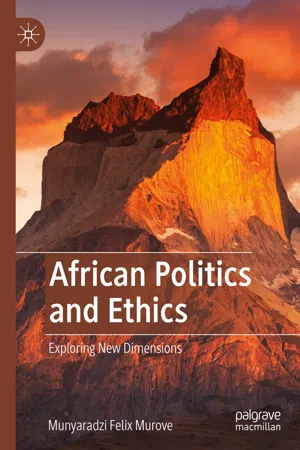
In this book, Munyaradzi Felix Murove explores African traditional ethical resources for African politics. Arguing that African ethics is integral to African post-colonial political contentious discourse, Murove invites the reader to reflect on various problematic political issues in post-colonial Africa and how African ethics has been applied in these situations. Starting with a succinct discussion of the scope of African ethics, he discusses how African ethical values have been applied by post-colonial politicians in the reconstruction of their societies. Further, Murove looks critically at the issue of African poverty and how the ethic of regional integration and economic cooperation among post-colonial African nation-states has been instrumental to efforts aimed at overcoming the scourge of poverty. The main question this book seeks to answer is: Are African traditional ethical values a panacea to modern African political problems?
- English
- ePUB (mobile friendly)
- Available on iOS & Android
eBook - ePub
About this book
Information
Topic
PhilosophySubtopic
Ethics & Moral Philosophy© The Author(s) 2020
M. F. MuroveAfrican Politics and Ethicshttps://doi.org/10.1007/978-3-030-54185-9_11. Introduction
Munyaradzi Felix Murove1
(1)
Religion, Philosophy, and Classics, University of KwaZulu-Natal, Scottsville, South Africa
Why write about African politics and ethics? From colonialism to post-colonialism, politics has remained the primary causal factor for all that has gone wrong in our current post-colonial societies in sub-Saharan Africa. Most of the social ills such as corruption, poverty, economic underdevelopment, poor governance and civil wars are prominent African problems that have their genealogy in politics. From colonialism to post-colonialism, the continent has been in a state of perennial crisis. For reasons that have remained unknown, so little has been written on politics and ethics in post-colonial Africa even though politics has been the number one factor in the ruining of people’s lives. Whilst Africa has been described as rich in terms of moral values, the political terrain remains characterized by moral barrenness. Though scholars from various disciplines have proffered different solutions to Africa’s political problems, none of those solutions seem to have worked. An academic once remarked that the problem of Africa is that those who are in political power in Africa are usually uneducated or poorly educated whist those who are educated do not have political power. This remark is quite incisive because political power has been the preserve of the poorly educated rather than the well-educated. But again, this claim cannot be sustained because the educated political leaders in Africa have behaved in a way that has caused untold human suffering. The political field does not have a culture of professionalism because politics in the African context shares a lot of similarities with the culture of urban gangsterism.
The absence of professionalism in politics has contributed to a general common sentiment that ethics and politics is an oxymoron because one cannot be ethical and simultaneously enjoying a successful political career. In politics the ends justify the means because whatever tactic a politician employs against his or her opponents is justified on the basis of the favourability of the outcomes. The Germany politician, Otto von Bismarck is on record for saying that ‘politics is the art of the possible’! This means that within the political arena whatever is deemed possible can be used for the furtherance of one’s political objectives. Alliances with one’s political foes is usually acceptable in so far as that alliance can help in furthering one’s political interests. I was once invited to give a talk on Ethics, Governance and Leadership to a group of civil servants in a certain South African province. After this talk, at lunch time I was approached by a very friendly guy who introduced himself as a politician from the ruling party and a member of parliament. He shook my hand and hugged me in appreciation of my talk and later on told me that if only such workshops could be attended by all politicians and civil servants, then society would be a far much better place. However, he went on to advise me that the political context was completely different because all those ideals about ethical leadership are not seen in terms of changing the individual politician’s life, instead, the political ideal would be to use ethics as a technique for scoring political points against the opposition or the ruling party.
It seems that politicians do not have a sense of concern for the wellbeing of the people they lead. It is no surprise that people are now accustomed to utter the following epithets about politicians—‘what do you expect from a politician?’, ‘don’t believe in what he says’, ‘politics is a dirty game’ and ‘he is a career politician’. These epithets imply that politicians are averse to ethics and most of the socially cherished virtues such as honesty, truth-telling, magnanimity, empathy, just to mention but a few. All the above epithets seem to suggest that politics has nothing to do with ethics. In a context such as that of post-colonial Africa which is characterized predominantly by excruciating poverty, poor governance, poor culture of accountability and the continuous corruption, the need for ethics in African politics cannot be overemphasized. As if that is not enough, environmental degradation is currently exerting unprecedented pressure on the human population as well as that of the natural life. In post-colonial Africa, the exercise of political power has exacerbated the existence of the above social ills because political power is being exercised in a way that impoverishes and disempowers them such that on the final analysis they are physically and mentally incapacitated to deal effectually with their existential problems. The dominant organized religions such Islam and Christianity have failed spectacularly to provide society with strong moral leadership.
Because of political and economic crises that have besieged sub-Saharan Africa, many people have fallen prey to the new form of power which is being paraded by charismatic founders of new African Pentecostal Christianity. Leaders of these new churches are currently inundated by followers because of their claims to divine power of healing most of those dreaded diseases that are currently incurable as well as their power to bestow material prosperity to the economically wretched African majority. These Pentecostal leaders have become extremely powerful and rich such that their followers and politicians alike can do almost anything for them. Sometimes these new African Pentecostal leaders have pronounced prophesies on the social media concerning the futures of African political leaders and the fortunes of the nation. Though their prophecies have not always materialized, their followers do believe in these prophesies unquestioningly. A common motif in the prophetic messages of African Pentecostal leaders is usually about the direct involvement of God in the political affairs of the country, and that whatever is happening is part and parcel of God’s grand plan. Pentecostal leaders are not so much concerned with ethics or morality. Their main interest is power. In this regard, their charismatic religious activities have not helped to bring about social, religious and economic transformation. The mushrooming of Pentecostal churches in Africa brings into focus the importance of ethics because some of these religions are unethical religions.
African ethics as captured in traditional African humanism has been integral to the political discourses of post-colonial nationalists such as Kwame Nkrumah, Leopold Senghor, Julius Nyerere, Kenneth Kaunda and Seko Toure. The writings of these fathers of African nationalism exudes some passion for the inclusion of traditional African humanistic values in their efforts towards the reconstruction of the post-colonial economic and political life. In the light of the writings of these African nationalists, the popular claim that ethics and politics are incompatible cannot be sustained with impunity. For example, though Nkrumah and Nyerere’s were highly sensitized to the ethic of the common good, with ethically good intentions they ended up impoverishing their societies. The colonial experiences of subjugation and dehumanization sharpened their moral imaginations in the reconstruction of their post-colonial societies. Politics and ethics in the ethical genre of African traditional humanism remained entangled. The post-apartheid ANC-led government spearheaded an ethical renewal programme which it called the Moral Regeneration Movement whose objective was to nurture a culture of moral sensitivity in all spheres of government and society at large. In African traditional societies, one could hardly be a leader without some authentic commitment to the shared moral values of the community.
Religion plays a vital role in the making of a people’s political outlook because political power is usually presumed to have some divine origins. It is for this reason that power is regarded as sacred. A political leader who founds favour in the eyes of religious followers is most likely to enjoy a long time of uninterrupted term in political office. In the Western world, especially with the influence of the monotheistic Judeo-Christian religion with its belief in an all-powerful God, a political culture of totalitarianism and intolerance became popular, especially during the medieval ages of European history. The connection between the culture of political totalitarianism and the belief in an all-powerful God can be discerned from the early Christian doxology which said, ‘All glory, honour and power belong to our God for ever and ever’. In the Old Testament the book of 1 Samuel has a story which says that when the Israelites requested Samuel to appoint a human king for them instead of Yahweh, it is said that after praying to Yahweh about this request, Yahweh responded jealously as follows, “Listen to all that the people are saying to you; it is not you they have rejected, but they have rejected me as their king” (1Sam. 8: v7). Evidently Yahweh was not in favour of sharing his power with human beings. Not wanting to share power with others is a practice well imbedded in the culture of political totalitarianism.
Under a totalitarian political system, all the organs of the state or organizations are controlled by an ultimate authority that enjoys an unmitigated monopoly of power. In the medieval history of Christianity, the Church was totalitarian because it spread all its tentacles into all spheres of social life. One finds that religious conceptions of God as impassable and a Controlling Power have contributed enormously to an understanding of God as an all-intrusive power in the lives of believers and everything that exists. The human response to this awesome power is supposedly to come in the form of complete submissiveness on the part of the believer. The idea that human beings should only respond to this type of power through submissiveness implies that it is the type of power which is imagined to be exercised in an arbitrary manner—no one knows what God will do in the next moment...
Table of contents
- Cover
- Front Matter
- 1. Introduction
- 2. African Ethics in a Nutshell
- 3. Ethical Politics in the Context of African Traditional Religion
- 4. African Ethics and the Post-colonial Politics of Tradition
- 5. Politics of Tradition and African Identity
- 6. African Traditional Humanism and the Ethic of Collectivism
- 7. Regional Integration and the Ethic of Co-operation in Post-colonial Africa
- 8. Traditional African Resources for Ethical Leadership
- Back Matter
Trusted by 375,005 students
Access to over 1.5 million titles for a fair monthly price.
Study more efficiently using our study tools.
Frequently asked questions
Yes, you can cancel anytime from the Subscription tab in your account settings on the Perlego website. Your subscription will stay active until the end of your current billing period. Learn how to cancel your subscription
No, books cannot be downloaded as external files, such as PDFs, for use outside of Perlego. However, you can download books within the Perlego app for offline reading on mobile or tablet. Learn how to download books offline
Perlego offers two plans: Essential and Complete
- Essential is ideal for learners and professionals who enjoy exploring a wide range of subjects. Access the Essential Library with 800,000+ trusted titles and best-sellers across business, personal growth, and the humanities. Includes unlimited reading time and Standard Read Aloud voice.
- Complete: Perfect for advanced learners and researchers needing full, unrestricted access. Unlock 1.5M+ books across hundreds of subjects, including academic and specialized titles. The Complete Plan also includes advanced features like Premium Read Aloud and Research Assistant.
We are an online textbook subscription service, where you can get access to an entire online library for less than the price of a single book per month. With over 1.5 million books across 990+ topics, we’ve got you covered! Learn about our mission
Look out for the read-aloud symbol on your next book to see if you can listen to it. The read-aloud tool reads text aloud for you, highlighting the text as it is being read. You can pause it, speed it up and slow it down. Learn more about Read Aloud
Yes! You can use the Perlego app on both iOS and Android devices to read anytime, anywhere — even offline. Perfect for commutes or when you’re on the go.
Please note we cannot support devices running on iOS 13 and Android 7 or earlier. Learn more about using the app
Please note we cannot support devices running on iOS 13 and Android 7 or earlier. Learn more about using the app
Yes, you can access African Politics and Ethics by Munyaradzi Felix Murove in PDF and/or ePUB format, as well as other popular books in Philosophy & Ethics & Moral Philosophy. We have over 1.5 million books available in our catalogue for you to explore.