Contemporary debates on "mansplaining" foreground the authority enjoyed by male speech, and highlight the way it projects listening as the responsibility of the dominated, and speech as the privilege of the dominant. What mansplaining denies systematically is the right of women to speak and be heard as much as men. This book excavates numerous instances of the authority of female speech from Indian goddess traditions and relates them to the contemporary gender debates, especially to the issues of mansplaining and womansplaining. These traditions present a paradigm of female speech that compels its male audience to reframe the configurations of "masculinity." This tradition of authoritative female speech forms a continuum, even though there are many points of disjuncture as well as conjuncture between the Vedic, Upanishadic, puranic, and tantric figurations of the Goddess as an authoritative speaker. The book underlines the Goddess's role as the spiritual mentor of her devotee, exemplified in the Devi Gitas, and re-situates the female gurus in Hinduism within the traditions that find in Devi's speech ultimate spiritual authority. Moreover, it explores whether the figure of Devi as Womansplainer can encourage a more dialogic structure of gender relations in today's world where female voices are still often undervalued.
eBook - ePub
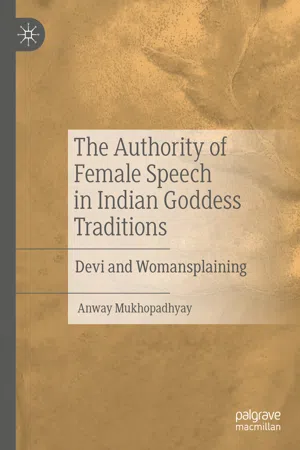
The Authority of Female Speech in Indian Goddess Traditions
Devi and Womansplaining
- English
- ePUB (mobile friendly)
- Available on iOS & Android
eBook - ePub
The Authority of Female Speech in Indian Goddess Traditions
Devi and Womansplaining
About this book
Information
© The Author(s) 2020
A. MukhopadhyayThe Authority of Female Speech in Indian Goddess Traditionshttps://doi.org/10.1007/978-3-030-52455-5_11. Introduction: What the Goddess Said—What Her Speech Means to Us Today
Anway Mukhopadhyay1
(1)
Department of Humanities and Social Sciences, Indian Institute of Technology Kharagpur, Kharagpur, West Bengal, India
Keywords
MansplainingWomansplainingGoddess traditionsPatriarchyThealogy“Dialexis”ShaktismSadhanaIn the contemporary discussions on mansplaining (Solnit 2014a, b, Chap. 1; Pot’Vin-Gorman 2019, 54–55; Turner 2017), what is foregrounded is the arrogance of male speech that sees listening as the responsibility of the dominated and speech as the privilege of the dominant (Solnit 2014a, Chap. 1, subheading 1). As Rebecca Solnit points out, “Being told that, categorically, he knows what he’s talking about and she doesn’t, however minor a part of any given conversation, perpetuates the ugliness of this world and holds back its light” (Solnit 2014a, Chap. 1, subheading 1). What mansplaining denies systematically is “equiphony” (a la Isabel Santa Cruz [Amoros 2004, 344]), the right of women to speak and to be heard as much as men are entitled to. What is at stake here is the attitudinal dimension of the patriarchally sanctioned socio-cultural interactions. Within the circuits of such interactions, women have to constantly fight for establishing the legitimacy of their speeches: “Most women fight wars on two fronts, one for whatever the putative topic is and one simply for the right to speak, to have ideas, to be acknowledged to be in possession of facts and truths, to have value, to be a human being” (Solnit 2014b, Chap. 1, subheading 2). Mansplaining, one may argue, is a cross-culturally evident phenomenon. It is not confined to specific geo-cultural cartographies. The Brahmin man mansplains to his wife in the most orthodox social scenarios of India, just as the white male boss of a (white/non-white) female employee does in his office, located in a Western metropolis. It is quite difficult to find out the “innocent” man, the humble listener to the female speech who does not conflate the binary of speaking/listening with that of male/female.
However, while patriarchy and androcentrism are undeniably global in scope, discourses alternative or counterpointing to them are also present, throughout the planet, even though the global systems of patriarchy label them as obscure local cultures lacking global outreach. Hence, it is high time we reinstalled these “local”, “obscure” alternative traditions at the heart of the global culture today. Since we inhabit a more dynamic planet than our predecessors did, it is possible now to build bridges between discourses, imaginative “heterotopias” (Hetherington 1997, viii), multiple alterities, which would have remained unconnected in a less comprehensively networked globe. It is within this context that I situate the issue of the authoritative female speeches textualized in the Indic goddess traditions. In these traditions, the difference between the goddess and the woman is often blurred, as the concept of reincarnation brings the goddess and her human avatar – the fleshly woman – close to each other. The authority of female speech is underpinned in the various versions of the Devi Gita, a sub-genre of Shakta scriptural literature presenting the goddess – either in her transcendental form or in her human avatar – as authoritatively speaking to humans and gods on cosmic secrets and the way to moksha/liberation. Similarly, in various tantric texts, we come across humble male listeners who respectfully receive the enlightening speeches of the Goddess.
Of course, in Indic scriptures, there is ample evidence of mansplaining: men impose their ideas on women; men assert their prejudiced ideas about women; men deny the intellectual potential of women; men deny women access to certain spiritual and intellectual resources – in text after text, within the Sanskritic tradition. Hence, it is not that I have, in this book, set out to project a binaristic opposition between the mansplaining West and a womansplaining India. I have rather focused on the alternative traditions of womansplaining in Indic goddess cultures which are not just alternative to the Western traditions of mansplaining but also alternative to the Indian modes of mansplaining, both historic and contemporary. However, rather than continuously juxtaposing the traditions of womansplaining in India against those of mansplaining, I have tried to tease out those strands of womansplaining within the Indic goddess cultures which do not simply present a gynocentric reversal of mansplaining but rather necessitate a thorough re-imagining of gender in the present scenario. While Caroline Turner points out that both mansplaining and womansplaining might sound disturbing to their recipients (of the opposite gender) (Turner 2017), Nell Stevens argues that womansplaining is different from mansplaining by virtue of being characterized by the sharing of wisdom with friendliness and love (Stevens 2018). I have tried to trace the ethos of womansplaining underlined by Stevens, from the perspective of an (implicit) “ethics of sexual difference” (Irigaray 2004, 7–19). Irigaray (2004, 8) questions: “Has a worldwide erosion of the gains won in women’s struggles occurred because of the failure to lay foundations different from those on which the world of men is constructed?” I would like to argue that the paradigm of womansplaining as presented by Stevens can be seen as an attempt at laying foundations of communication different from those that encourage mansplaining. Moreover, Irigaray’s philosophy of sexual difference motivates Britt-Marie Schiller to figure forth the “incomplete masculine” who knows that he is not “omnipotent” and that “the other is not at his disposal” (Schiller 2011, 132). A central objective of this book is to explore how the instances of authoritative female speech in the Indian goddess cultures necessitate a reframing of masculinity by impelling the male audience of authoritative female speech to understand and appreciate the significance of turning into the “incomplete masculine”.
By drawing on the kind of work initiated by Miranda Shaw and Loriliai Biernacki and improvising on their approaches (Shaw 1995, 3–19; Biernacki 2007, 3–27), the present book focuses on the possible hidden connections between the textualized female speeches that exude the aura of authority and the non-textualized female presences, the embodied female speeches turned into silence by textual, cultural and political erasures. It is true that we can by no means establish an easy correlation between goddess traditions and empowered women. However, I would argue that while we cannot establish the presence of powerful women from the presence of empowered female speech in a goddess text, we cannot totally erase that presence as a possibility, either. Women’s history, in most of the cases, has been a history of shadowy traces, rather than concrete memorializations. Arguing that all textual representations of powerful female figures and voices are just figments of male imagination and have no connection with flesh-and-blood women will lead to lending omnipotence, at least theoretically, to male intelligence and male discourse (Shaw 1995, 12–14, 19; Biernacki 2007, 6–10, 20–27). However, in my work, rather than establishing any easy equation between goddesses and empowered women, I have followed two trajectories – (a) adapting the New Historicist paradigm (Brannigan1998, 6–9) to my requirements, I have critically engaged with the lack of a robust archival presence of flesh-and-blood women in the goddess traditions and tried to present some surmises (without claiming their absolute factuality) about the presence of empowered women behind or around the empowered female speech textualized in the Indic goddess cultures, and (b) following the political thrust of the Cultural Materialist method (Brannigan 1998, 9–11), I have argued for a recontextualization and reinterpretation of these textualized female speeches in the present scenario of India and the world at large.
In Indic traditions, texts are always open; they have been subjected to multiple modifications, endless pluralization, in terms of adaptations, reshapings and ideological reframing. Most of the texts are anonymous, or assigned a mythical authorship. We don’t have a concrete history of the hands or mouths (Indian culture has been, largely, an oral culture) that worked behind the formation of these texts. In the case of the history o...
Table of contents
- Cover
- Front Matter
- 1. Introduction: What the Goddess Said—What Her Speech Means to Us Today
- 2. Authoritative Female Speech and the Indic Goddess Traditions: An Overview
- 3. Divine and Divine-Human Speeches of the Devi: The Speech Contexts and the Dynamics of Authority in the Devi Gitas
- 4. Authority of Female Speech, Efficacy of Female Guidance: The Goddess and Women in Tantric Contexts
- 5. Two “Devis”, Two “Gurus” Speaking with Authority: Sarada Devi and Anandamayi Ma
- 6. Modifying Masculinity: Tantric Culture, Female Speech and Reframed Masculinities
- 7. The Beauty of Womansplaining: The Authoritative Speech of Devi in India, in the World
- Back Matter
Trusted by 375,005 students
Access to over 1.5 million titles for a fair monthly price.
Study more efficiently using our study tools.
Frequently asked questions
Yes, you can cancel anytime from the Subscription tab in your account settings on the Perlego website. Your subscription will stay active until the end of your current billing period. Learn how to cancel your subscription
No, books cannot be downloaded as external files, such as PDFs, for use outside of Perlego. However, you can download books within the Perlego app for offline reading on mobile or tablet. Learn how to download books offline
Perlego offers two plans: Essential and Complete
- Essential is ideal for learners and professionals who enjoy exploring a wide range of subjects. Access the Essential Library with 800,000+ trusted titles and best-sellers across business, personal growth, and the humanities. Includes unlimited reading time and Standard Read Aloud voice.
- Complete: Perfect for advanced learners and researchers needing full, unrestricted access. Unlock 1.5M+ books across hundreds of subjects, including academic and specialized titles. The Complete Plan also includes advanced features like Premium Read Aloud and Research Assistant.
We are an online textbook subscription service, where you can get access to an entire online library for less than the price of a single book per month. With over 1.5 million books across 990+ topics, we’ve got you covered! Learn about our mission
Look out for the read-aloud symbol on your next book to see if you can listen to it. The read-aloud tool reads text aloud for you, highlighting the text as it is being read. You can pause it, speed it up and slow it down. Learn more about Read Aloud
Yes! You can use the Perlego app on both iOS and Android devices to read anytime, anywhere — even offline. Perfect for commutes or when you’re on the go.
Please note we cannot support devices running on iOS 13 and Android 7 or earlier. Learn more about using the app
Please note we cannot support devices running on iOS 13 and Android 7 or earlier. Learn more about using the app
Yes, you can access The Authority of Female Speech in Indian Goddess Traditions by Anway Mukhopadhyay in PDF and/or ePUB format, as well as other popular books in Social Sciences & Indian & South Asian History. We have over 1.5 million books available in our catalogue for you to explore.