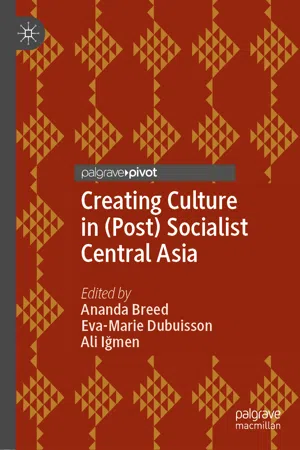
This book brings together historical and ethnographic research from Kyrgyzstan, Kazakhstan, and Xinjiang, in order to explore how individuals and communities work to create and maintain forms of 'culture' in contexts of ideological repression and erasure. Across Inner Central Asia, in both China and the Soviet Union, while ethnic culture was on one hand lauded and promoted, it was simultaneously folklorized in the face of broader projects of socialist modernity. How do local intellectuals, cultural organizers, and performers work to negotiate their own forms and understandings of cultural meaning within the institutions and frameworks of a long twentieth century? How does scholarly attention to cultural production, tradition, and performance help to inform our understanding of (ethnic) nations not as given, but as coming into being?
eBook - ePub
Creating Culture in (Post) Socialist Central Asia
- English
- ePUB (mobile friendly)
- Available on iOS & Android
eBook - ePub
Creating Culture in (Post) Socialist Central Asia
About this book
Information
Print ISBN
9783030586843
Subtopic
Regional Studies© The Author(s), under exclusive license to Springer Nature Switzerland AG 2020
A. Breed et al. (eds.)Creating Culture in (Post) Socialist Central Asiahttps://doi.org/10.1007/978-3-030-58685-0_11. Introduction: Making Culture in (Post) Socialist Kazakhstan, Kyrgyzstan, and Xinjiang
Ananda Breed1 and Ali Iğmen2
(1)
College of Arts, University of Lincoln, Lincoln, UK
(2)
Department of History, California State University, Long Beach, CA, USA
Abstract
In this volume, we introduce specific contexts of historical and contemporary negotiation around the categories of ‘culture’ and ‘performance’ in Kyrgyz and Kazakh cultural environments in Central Asia. How are cultural forms imagined, created, and performed—as a mechanism to both perform sovereignty and to reimagine traditional forms in the socialist and postsocialist periods? The relationships, institutional conditions, and creative labor required to generate or maintain particular forms of culture (literature, education, oral tradition, performance) are referred to here as ‘culture work,’ and theorized as a form of liminal interweaving. How and why do processes of culture work occur? What is the specific content of what might be promoted or allowed as ‘culture’ in highly ideologized contexts, following the fall of the Soviet Union in 1991 as instances of nation-building and identity formation, or as a mode of cultural survival under cultural assimilation and violence in China today?
Keywords
Soviet Post-Soviet Central AsiaChinaSocialist multiculturalismLiminalityCultural subjectivityCultural traditionsIn this book, authors present specific contexts of historical and contemporary negotiations around the categories of ‘culture’ and ‘performance’ in Kyrgyz and Kazakh cultural environments in Central Asia. Together, our authors aim to address a current lack of scholarship regarding the use of culture work—the ways in which cultural forms are imagined, created, and performed—as a mechanism to both perform sovereignty and to reimagine traditional forms in the socialist and postsocialist periods. The contributing chapters will analyze how and why these processes of work occur, as well as the specific content of what might be performed, following the fall of the Soviet Union in 1991 as instances of nation building and identity formation, and as a mode of cultural survival under cultural assimilation and violence in China today. Since cultural forms in Central Asia have been largely under-researched within the fields of Performance Studies, Anthropology, Literary Studies, Area Studies, and History, the co-editors and contributors of this volume will provide a cross-disciplinary approach to provide some of the key concepts, practices and contexts. In particular, there will be an emphasis on what social and political factors informed the cultural forms at different stages of history.
All of the new independent states of post-Soviet Central Asia, in particular Kyrgyzstan and Kazakhstan, have inherited mechanisms of national celebration, as well as its object: the ‘nation’ itself defined largely in linguistic, cultural, and territorial terms. However, while newly national states have inherited a strong institutional and ideological legacy in the sphere of cultural production, this cannot be viewed as a simple case of post-Soviet reproduction (Adams 2010: 6). The Central Asian states such as Uzbekistan lack not only the underlying hard power of the previous system, but also even the organizational and ideological commitment to soft power resources such as mass spectacle (Ibid.: 5–6). That means that within the institutions of cultural production, there is plenty of space for actors to—whether intentionally or unintentionally—subvert the aims of stated projects (Ibid.), which were largely geared toward the celebration and memorialization of national identity and culture within each former republic. As Adams rightly noted, though we can say in the case of contemporary Uzbekistan that the state maintains a certain dominance over cultural discourses in the country, ultimately that ‘state’ is a ‘collectivity of actors who were in the process of making difficult decisions about the future of their country and their culture’ (5).
The chapters presented in this collection speak to the heart of this argument, and challenge one of its assumptions: given the flexibility we see in cultural production today, perhaps we could conjecture that such practical and ideological ‘wiggle room’ was actually always a fundamental feature of the system, even in the strong power days of the Soviet period. While Soviet discourses of shared, recognizable national cultural forms were certainly predominant and highly active, it is important to recognize that these were not ultimately totalizing in their scope, nor defined top-down. Kudaibergenova (2017) has similarly argued that titular ethnic intellectuals and authors in the Soviet period, though highly constrained, certainly managed to insert their own conversations and images of ethnicity and history in the ‘national’ canon of Soviet Kazakhstan. Similarly, papers from the contemporary period emphasize that though cultural organization and performances may draw on existing structural forms, the vision and content of those projects is one not predetermined, but rather perpetually ‘coming into being.’
We hope the analyzes presented here will generate the potential to learn from past and present articulations of culture within the in-betweenness or liminal space of performance, in order to better articulate the embodiment of culture as a negotiating factor of identities, cultures, and countries in transition. What kind of social and political interventions have been negotiated through culture? What are some of the artistic adaptations of cultural forms for new and emerging purposes? How might cultural forms serve as a microcosm of the macrocosm of current global movements? How do the examples provided in this volume respond to overarching challenges or innovations in the interdisciplinary crossover between performance, politics and culture?
The Soviet discourse and practice of ‘culturedness’ (kul’turnost’) became an established political and cultural form during the Stalinist era in Soviet Central Asia, just as all other regions of the Soviet Union.1 The ‘cultured’ Soviet citizen in the region needed to be well-versed in literature, music, theatre, and other artistic fields, all within the bounds of the Marxist–Leninist ideology. In urban centres such as Tashkent and other capital cities of the Soviet Socialist Republics, the state opera, ballet, theatre, and philharmonia carried out the state-sanctioned cultural activities in larger scale. The nomadic Kyrgyz and Kazakh populations, and those in smaller rural regions came into contact with Soviet ‘culturedness’ mostly in Lenin’s Corners in factories and collective farms, and in Red Clubs and other Houses of Culture. First, being ‘cultured’ required the improvement of traditional forms of art with modern, namely Western forms of art. For example, modern stage productions were to replace traditional performances of the akyn (bards).
Gradually, however, indigenous cultural forms found their way into Soviet literature, theatre and film. The Soviet policy, supported by the slogan ‘national in form, socialist in content’ encouraged talented writers such as the Kyrgyz author Chingiz Aitmatov to forge a Soviet artistic tradition that blended indigenous and Soviet forms of cultural productions. During the first half of the Soviet era most Soviet authors, artists, actors and other people of the arts learned to assert themselves within the limitations of the official Soviet cultural forms. This delicate and often dangerous assertion took place in a liminal space, in which professional artists found various ways to stay ‘national in form, socialist in content,’2 a dictum guiding the research and understanding of every performative sphere of life from art (Tagangaeva 2016) to music (Harris 2008) to language (Shelestyuk 2019); one could even understand the very category or notion of tribal identity itself in this new way, as Edgar (2004) has well-described in the case of Turkmenistan.
The two-sided notion of a specifically socialist multiculturalism was experienced throughout the former Soviet Union and China over the twentieth century and tended to follow relatively specific patterning linking categories of ethnic and performative identity. For example, in her exposition of the establishment and development of Soviet national art in Buryatia, Tagangaeva (2016) explains how ‘a specific visual aesthetic and discourse [was] formed, based on the close link between art and ethnicity. National art was tied to the development of Soviet ethnography, which enabled the naturalization of art through geographic and ethnic essentialist attributes’ (393). Ethnographic and academic research on ‘folk’ and artistic traditions led to a typology of nations defined in cultural terms, all which in turn orbited, and were still oriented toward, the cultural center of Russian modernism, and thus the Soviet institutionalization of art can be understood also as the colonization of cultural form (Ibid.: 397–399). In Buryatia, for example, artists working in the Soviet framework confronted the category of the ‘national’ as clichéd orientalism (Ibid.: 405–406). In China at the same time, comparable demarcations of cultural form led further, for example, to the canonization of ‘national musical traditions’ of ethnic minorities like the Uyghur Shashmuqam (Harris 2008). Although the artistic outcome of such endeavours often created bland and propaganda laden productions, many individuals dedicated themselves to improving the quality of their work. Many took pride in their education in art institutes and higher education institutions while not abandoning their ethnic, regional, and national ways of seeing and being in the world.
In our contributions to this volume, we wish to foreground the work and activity of individuals and groups in the establishment, maintenance, and performance of cultural traditions across Central Asia. Here we view ‘culture’ not as a given, but as a space continually (re)claimed by those working creatively within environments of political socialism and nationalism including indigenous performative and intellectual traditions. In formulating our approach to this special collection of essays and to best articulate the ‘coming into being’ of varied cultural forms and performatives, we bring together key concepts and terms that are derived from our varied disciplines and theoretical frameworks including: interweaving, liminality, dwelling, and affective sovereignty, which we explain briefly here. Additionally, throughout our research articles we explore how other cultural and linguistically specific terms that connote a specific definition within Kyrgyz, Uzbek, Russian, Tajik, or Kazak, might contribute a deeper understanding of how our theoretical terminology might apply in other contexts or across cultures as well. The terminology provides a web-like structure that links between the articles in this volume to generate new thought processes that potentially provides alternative points of access or lenses between disciplines, our own form of border crossing or liminality.
Anthropologist Victor Turner has described liminality as ‘a fructile chaos, a fertile nothingness, a storehouse of possibilities, not by any means a random assemblage but a striving after new forms and structure, a gestation process, a fetation of modes appropriate to and anticipating postliminal existence’ (1990: 12). The articles here explore the Kyrgyz thinker Arabaev’s and Kyrgyz actresses’ development as influential intellectuals in their ow...
Table of contents
- Cover
- Front Matter
- 1. Introduction: Making Culture in (Post) Socialist Kazakhstan, Kyrgyzstan, and Xinjiang
- 2. ‘The Kara Kirghiz Must Develop Separately’: Ishenaaly Arabaev (1881–1933) and His Project of the Kyrgyz Nation
- 3. Liminal States: Personal Dreams and Performance in Kyrgyzstan During and After the Soviet Era
- 4. Epic Performances in Central Asia
- 5. Poets of the People: Learning to Make Culture in Kazakhstan
- 6. Lament in an Affluent Era: Cultural Politics of Kazakh Life Cycle Songs in Xinjiang
- 7. Conclusion: Interweaving Texts
- Back Matter
Trusted by 375,005 students
Access to over 1.5 million titles for a fair monthly price.
Study more efficiently using our study tools.
Frequently asked questions
Yes, you can cancel anytime from the Subscription tab in your account settings on the Perlego website. Your subscription will stay active until the end of your current billing period. Learn how to cancel your subscription
No, books cannot be downloaded as external files, such as PDFs, for use outside of Perlego. However, you can download books within the Perlego app for offline reading on mobile or tablet. Learn how to download books offline
Perlego offers two plans: Essential and Complete
- Essential is ideal for learners and professionals who enjoy exploring a wide range of subjects. Access the Essential Library with 800,000+ trusted titles and best-sellers across business, personal growth, and the humanities. Includes unlimited reading time and Standard Read Aloud voice.
- Complete: Perfect for advanced learners and researchers needing full, unrestricted access. Unlock 1.5M+ books across hundreds of subjects, including academic and specialized titles. The Complete Plan also includes advanced features like Premium Read Aloud and Research Assistant.
We are an online textbook subscription service, where you can get access to an entire online library for less than the price of a single book per month. With over 1.5 million books across 990+ topics, we’ve got you covered! Learn about our mission
Look out for the read-aloud symbol on your next book to see if you can listen to it. The read-aloud tool reads text aloud for you, highlighting the text as it is being read. You can pause it, speed it up and slow it down. Learn more about Read Aloud
Yes! You can use the Perlego app on both iOS and Android devices to read anytime, anywhere — even offline. Perfect for commutes or when you’re on the go.
Please note we cannot support devices running on iOS 13 and Android 7 or earlier. Learn more about using the app
Please note we cannot support devices running on iOS 13 and Android 7 or earlier. Learn more about using the app
Yes, you can access Creating Culture in (Post) Socialist Central Asia by Ananda Breed, Eva-Marie Dubuisson, Ali Iğmen, Ananda Breed,Eva-Marie Dubuisson,Ali Iğmen in PDF and/or ePUB format. We have over 1.5 million books available in our catalogue for you to explore.