Throughout, it is argued that differences between Hong Kong and Britain are not attributable merely to local culture and tradition, but are the consequence of wider social, economic and political conditions through which cultural continuity and change are mediated. Women Doing Intimacy will be of interest to students and scholars of family life and gender studies.
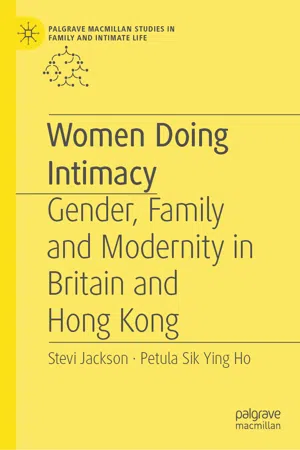
eBook - ePub
Women Doing Intimacy
Gender, Family and Modernity in Britain and Hong Kong
- English
- ePUB (mobile friendly)
- Available on iOS & Android
eBook - ePub
Women Doing Intimacy
Gender, Family and Modernity in Britain and Hong Kong
About this book
This book offers a comparative study of the lives of young adult women and their mothers in Hong Kong and Britain. Set against the backdrop of debates regarding the consequences of late modern social change for family and intimate life, the authors consider the challenges of exploring these issues across differing cultures. The book focuses on a range of topics including: mother-daughter relationships; romantic, sexual and marital relationship trajectories; and the imagined futures of daughters.
Information
© The Author(s) 2020
S. Jackson, P. S. Y. HoWomen Doing IntimacyPalgrave Macmillan Studies in Family and Intimate Lifehttps://doi.org/10.1057/978-1-137-28991-9_11. Introduction: The Genesis of a Transnational Collaborative Project
Stevi Jackson1 and Petula Sik Ying Ho2
(1)
University of York, York, UK
(2)
University of Hong Kong, Pok Fu Lam, Hong Kong
This book derives from a comparative study of the personal lives of young adult women and their mothers in Hong Kong and Britain (England and Wales) against a backdrop of social change in both societies. Transnational collaborative qualitative research of the kind we describe here is relatively unusual, in part because it presents practical difficulties, not least in financing it, but also because of the parochial, local focus of most social research, especially in western countries. We were fortunate to gain funding from an ESRC Hong Kong Bilateral Award, co-funded by Hong Kong’s Research Grants Council (RES-000-22-362). A central element of our bid was to challenge the Eurocentrism of current debates about families, intimacy and social change under late modern social conditions though investigating the lives of two generations of women in one ‘western’ (British) and one East Asian (Hong Kong) location. We are not simply treating these two locations as isolated examples, or as different modernities, but as part of a web of asymmetrical global interconnections that have produced the condition of the contemporary world variously described as late, second or post-modernity. In this endeavour, we have been influenced by feminist and other critical engagements with theorisations of late modern intimacy (Smart 2007; Heaphy 2007; Jamieson 2011) and by postcolonial critiques of parochially western theories of modernity (Bhambra 2007, 2014). In this short introduction, we locate ourselves in relation to our project, explain how we came to be collaborators, the intellectual impetus behind our work, what each of us brought to it and the challenges we faced in conducting the research and writing this book.
We first met in May 2004 in Trondheim, Norway, at a conference entitled: ‘Heteronormativity: A Fruitful Concept?’ We were staying at the same hotel, went sightseeing together and discovered shared research interests in sexuality and intimacy. We stayed in touch and each invited the other to speak at conferences at our home institutions and Stevi then asked Sik Ying to contribute to a book on East Asian sexualities she was co-editing (Jackson et al. 2008). When the ESRC issued a call for bilateral projects with Hong Kong, Stevi saw it as an opportunity to further her interest in East Asian societies and immediately thought of Sik Ying as a potential partner. Thus began a collaboration that has continued and moved on to new projects—and extensive plans for the future. As is usually the case in feminist research, the work we have undertaken together reflects both personal and political investments.
We have both lived through the social changes we describe here. We are of the same generation as the mothers in our sample and represent the two populations whose lives we document—white British and Hong Kong Chinese women. Significantly, too, our own life histories evince the interrelationship between the two locales and the heritage of British colonialism . Stevi, the daughter of a British sailor, spent two years in Hong Kong in one of the most turbulent periods of its history , 1966–1968, when her father was posted to the naval base there (HMS Tamar). As a teenager at the time, Hong Kong made a lasting impression on her and was central to her politicisation. Educated at the British forces’ school, St George’s, in Kowloon Tong and living in naval quarters in Happy Valley, she could have spent her entire time in the colonial ex-pat community. She chose not to do so, instead making the most of opportunities to see more of Hong Kong and meet local people, shopping in markets in Wanchai and Causeway Bay and enjoying the vibrant, chaotic street life. Hong Kong then was very different from the modern cosmopolitan city of today. Thousands of people lived in squatter settlements, in huts constructed out of scraps of wood, corrugated iron and plastic or in overcrowded unsanitary tenements; there were beggars in the streets (then a rare sight in the UK) and informal markets and hawkers everywhere. The rich lived in opulent mansions on The Peak or in Kowloon Tong (where Stevi went to school) and frequented exclusive shops and hotels in the centre of the city. Stevi also learnt about white privilege, which enabled her to observe excessive wealth at close quarters. Although her father was a naval rating, not of the officer class in forces still rigidly class segregated, the fact of being white gave her entry into spaces she could or would never have accessed in the UK. She could go into hotels patronised by the super-rich just to use the toilets, knowing her whiteness would protect her from challenge. She could even to go to entertainment venues at some of these hotels and meet the offspring of the rich and, being white, gain invitations to parties in their homes and even, once, on a yacht, and see at first-hand how they lived. Notably these were the local rich—she could never have ‘passed’ as of an acceptable class within the social circles of the white colonial elite. The very wide, and very visible, gulf between rich and poor, along with the racial divide and the virulent anti-Chinese racism of most of her British contemporaries, provided Stevi with an object lesson in the evils of colonialism , a lesson that had much to do with her later becoming a sociologist.
In 1967, at the height of the Cultural Revolution in China , Hong Kong erupted in rioting against the colonial regime (see Chapter 2). There had been some riots the previous year over a fare rise on the cross-harbour Star Ferry, but this was something new and different. What started as a labour dispute escalated, led by Maoists leftists in Hong Kong, into mass street demonstrations, which met with considerable force from the authorities with the use of tear gas, baton rounds and live ammunition. Some of the leftists resorted to violent methods, including the use of homemade bombs and weapons. The protests lasted 8 months into early 1968. Stevi recalls travelling to school with grilles on the bus windows and soldiers armed with machine guns as protection as well as bomb disposal teams dealing with three devices placed in or near the naval ratings’ housing where she lived (the officers, tucked away in the salubrious neighbourhood of The Peak were less vulnerable). She does not remember being scared, just excited and, while opposed to the extremes of violence used, thinking that the protesters had a just cause. This experience, therefore, did not do anything to alter her critical stance on the colonial regime. Her time in Hong Kong planted the seeds of her later interest in East Asian societies. For all its problems, there was much about Hong Kong that she loved and which left her with a deep attachment to it and with a continued—and continuing—concern about its future.
Sik Ying was only eight years old at the time of the disturbances, but one particular memory of them has stuck in her mind, and also tells us something about the contrasting lives led by the local Chinese and even humble members of the British population. At the time Sik Ying’s family (her parents, grandmother and 6 children) lived in Sai Ying Pun in one room of an apartment shared with two other families—a contrast with the roomy three-bedroomed flat where Stevi lived with her parents and sister. Sik Ying remembers one tragic and horrific incident from the riots: the death of the radio actor and social commentator Lam Bun, who was attacked by the leftists, doused with petrol and set alight in his car. The reason this mattered to an eight-year old was because of the significance of the serialised radio drama Dai Zengfu (Big/Real Man’s Diary), starring Lam Bun, in her daily life. Her mother listened to the show every night at 10 pm. She would bribe the children into helping her assemble plastic flowers and toys (factory outwork) by telling them that if they were able to work hard until Dai Zengfu started, they would be rewarded with late supper snacks—sesame soup, red bean soup and sometimes wonton noodles. As a result of Lam Bun’s death, which shocked the family, the much-loved show that had marked the end of their working day was terminated.
Soon after the disturbances, Sik Ying’s family moved to a new public housing estate in East Kowloon. She was educated at St Paul’s School (Lam Tin), which, like most schools in Hong Kong, was church run, reflecting the colonial context in which Christian organisations and missionaries provided much of the welfare and education for the local population. St Paul’s was a school for girls run by the Sisters of St. Paul de Chartres, an order than had been active in Hong Kong since the mid-nineteenth century. Sik Ying went on to obtain her undergraduate and master’s degrees at the University of Hong Kong, where she was subsequently employed. It was, therefore, a thoroughly colonial education , modelled on the British system.1 Later, as a mature student, Sik Ying went to the UK for postgraduate study, gaining her Ph.D. from the University of Essex in 1996. Overseas education is valued in Hong Kong and in the colonial era British education was seen as the best available. Studying in the UK was also facilitated by the colonial system. Sik Ying’s Ph.D. was funded by a Commonwealth Scholarship, by a grant specifically for junior women academics who did not have a Ph.D. She also acquired a British passport as part of a special scheme to discourage educated people from fleeing Hong Kong prior to the 1997 handover to China .
Sik Ying arrived in the UK in the early 1990s, by which time Hong Kong had changed dramatically since the 1960s. It had experienced rapid economic growth with GDP per capita rising substantially year on year from $714 in 1968 to $13,281 in 1990.2 It was still, by this measure, not as wealthy as the UK (with a per capita GDP of $20,808 in 1990)3 but was now identified as one of the ‘Asian Tigers’ and no longer as a ‘third world’ economy. The gulf between rich and poor remained, but the educated middle classes were doing well, enjoying high salaries and the benefits of a technologically advanced consumer society. On arriving in the UK, Sik Ying was shocked to find that the country was so backward, especially technologically. For example, the accommodation office at the Essex University was using pencil to record room bookings and allocation. She found British people polite but rather slow and inefficient after the hard-working fast-paced life in Hong Kong. She also felt that she was richer than her UK peers, could afford expensive designer clothes and long international phone calls to her boyfriend in Holland. Yet at the same time she was disappointed and disoriented by her encounter with the reality of life in Britain. Her English was not as good as she thought, despite being educated through the medium of English since she started secondary school, and she had a Hong Kong accent. Her understanding of western culture was also limited in terms of the common-sense know-how needed to navigate daily life and interact with the Europeans among whom she was living and studying. She was criticised for what she ate, how much she was able to eat and for remaining slim and felt that Asian women were looked down on. A Danish flatmate told her that she and other Asian women were not taken seriously because they looked too young and lacked confidence in public presentations. Yet despite these setbacks, she adapted and began to enjoy the slower pace of life in the recognition that gaining her Ph.D. would put her on the path to career success—which it ultimately did, while also setting in train the developments whereby her path would cross with Stevi’s. Stevi, meanwhile, had been teaching in a post-1992 University throughout the 1980s, when there were very few sociology posts available (see Platt 2003), but in 1993 managed to move to the more established University of Strathclyde, and then, in 1998, secured the Chair in Women’s Studies at the University of York. It was here, though teaching and supervising graduate students from East Asia that her interest in that part of the world was rekindled.
Our lives, then, bear testimony to the interconnected histories of Hong Kong and the UK and give us something in common beyond a shared academic interest in intimate relationships. By the time we met, we had each, through different processes, begun to question the hegemony of ‘western’ knowledge, the ways in which theory generated from Europe and the USA was treated as if it were universal knowledge. Even among feminists keen to acknowledge differences among women and to champion perspectives from the Global South, East Asia was largely ignored. Sik Ying’s experiences in the UK had left her well versed in European theory but also, in combination with her life experiences, with a more critical perspective on the western world and its knowledge claims than she had previously been able to develop as a colonised subject. Returning to work at the University of Hong Kong, she could not help but be aware of the theoretical hegemony of western scholarship and ways in which knowledge from beyond the west was treated as peripheral, of only local relevance. Stevi, meanwhile, was striving to cast off the parochial western blinkers that had previously confined the scope of her academic vision and was beginning to see the privileges that her location in the ‘west’ had afforded her and make connections with the white privilege she had enjoyed many years before in Hong Kong. She had learnt from her East Asian graduate students who had also connected her to networks of scholars from the region, enabling her to discover the richness of feminist work being produced there but which was largely unknown in British sociology and women’s and gender studies. It was this that precipitated our first meeting in Trondheim. Stevi had noticed that the names of a small group of Hong Kong scholars appeared on the conference programme and wanted to meet them. Spotting a group of Chinese people at breakfast in the hotel she took a chance and walked over to their table, asked if they were the delegates from Hong Kong (they were) and introduced herself.
We started working together on the proposal for the project in 2009, began to plan the research in 2010 and conducted the fieldwork over the next eighteen months. It was in some ways opportunistic, a response to a funding call that offered a rare opportunity for collaboration between UK and Hong Kong scholars. It was not, however, only opportunistic, as we had a genuine intellectual aim: to do work that challenged western knowledge claims. Even so, the UK and Hong Kong may seem odd cases for comparison as one is a nation and the other is a Special Administrative Region of China.4 This asymmetrical relationship, however, is part of what makes the comparison of interest. As our personal biographical narratives indicate, these two societies are a product of their interconnected histories and, as we will argue later, of the wider global connections that shaped the modern world.
Working together was not always easy or straightforward. Although we had stayed in touch over the intervening years since our first meeting, we did not know each other very well when we began the project and there was, therefore, a certain degree of risk in collaborating and in not fully understanding each other’s approach to research or the intellectual baggage we each brought to it. It was very much a learning experience for both of us. We had slightly different intellectual agendas, differing theoretical and methodological concerns and intellectual histories in addition to our specific cultura...
Table of contents
- Cover
- Front Matter
- 1. Introduction: The Genesis of a Transnational Collaborative Project
- 2. Conceptualising and Investigating the Gendered Consequences of Modernity in Britain and Hong Kong
- 3. Interconnected Histories: Locating Women’s Lives in Time and Space
- 4. What Makes a Family? Meanings and Practices
- 5. Mother–Daughter Relationships
- 6. Love and Sex in Marital and Non-marital Contexts
- 7. Imagined Futures in Uncertain Times
- 8. Concluding Reflections
- Back Matter
Trusted by 375,005 students
Access to over 1.5 million titles for a fair monthly price.
Study more efficiently using our study tools.
Frequently asked questions
Yes, you can cancel anytime from the Subscription tab in your account settings on the Perlego website. Your subscription will stay active until the end of your current billing period. Learn how to cancel your subscription
No, books cannot be downloaded as external files, such as PDFs, for use outside of Perlego. However, you can download books within the Perlego app for offline reading on mobile or tablet. Learn how to download books offline
Perlego offers two plans: Essential and Complete
- Essential is ideal for learners and professionals who enjoy exploring a wide range of subjects. Access the Essential Library with 800,000+ trusted titles and best-sellers across business, personal growth, and the humanities. Includes unlimited reading time and Standard Read Aloud voice.
- Complete: Perfect for advanced learners and researchers needing full, unrestricted access. Unlock 1.5M+ books across hundreds of subjects, including academic and specialized titles. The Complete Plan also includes advanced features like Premium Read Aloud and Research Assistant.
We are an online textbook subscription service, where you can get access to an entire online library for less than the price of a single book per month. With over 1.5 million books across 990+ topics, we’ve got you covered! Learn about our mission
Look out for the read-aloud symbol on your next book to see if you can listen to it. The read-aloud tool reads text aloud for you, highlighting the text as it is being read. You can pause it, speed it up and slow it down. Learn more about Read Aloud
Yes! You can use the Perlego app on both iOS and Android devices to read anytime, anywhere — even offline. Perfect for commutes or when you’re on the go.
Please note we cannot support devices running on iOS 13 and Android 7 or earlier. Learn more about using the app
Please note we cannot support devices running on iOS 13 and Android 7 or earlier. Learn more about using the app
Yes, you can access Women Doing Intimacy by Stevi Jackson,Petula Sik Ying Ho in PDF and/or ePUB format, as well as other popular books in Social Sciences & Cultural & Social Anthropology. We have over 1.5 million books available in our catalogue for you to explore.