eBook - ePub
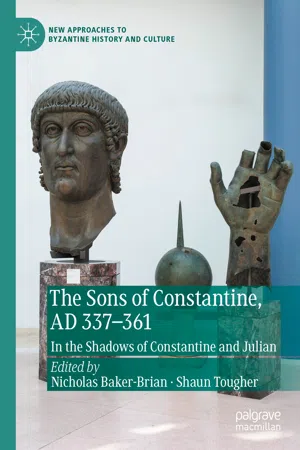
The Sons of Constantine, AD 337-361
In the Shadows of Constantine and Julian
- English
- ePUB (mobile friendly)
- Available on iOS & Android
eBook - ePub
The Sons of Constantine, AD 337-361
In the Shadows of Constantine and Julian
About this book
This edited collection focuses on the Roman empire during the period from AD 337 to 361. During this period the empire was ruled by three brothers: Constantine II (337-340), Constans I (337-350) and Constantius II (337-361). These emperors tend to be cast into shadow by their famous father Constantine, the first Christian Roman emperor (306-337), and their famous cousin Julian, the last pagan Roman emperor (361-363). The traditional concentration on the historically renowned figures of Constantine and Julian is understandable but comes at a significant price: the neglect of the period between the death of Constantine and the reign of Julian and of the rulers who governed the empire in this period. The reigns of the sons of Constantine, especially that of the longest-lived Constantius II, mark a moment of great historical significance. As the heirs of Constantine they became the guardians of his legacy, and they oversaw the nature of the world in which Julian was to grow up. The thirteen contributors to this volume assess their influence on imperial, administrative, cultural, and religious facets of the empire in the fourth century.
Information
© The Author(s) 2020
N. Baker-Brian, S. Tougher (eds.)The Sons of Constantine, AD 337-361New Approaches to Byzantine History and Culturehttps://doi.org/10.1007/978-3-030-39898-9_11. Introduction: In the Shadows of Constantine and Julian—The Sons of Constantine, AD 337–361
Nicholas Baker-Brian1 and Shaun Tougher1
(1)
Cardiff University, Cardiff, UK
Thus Edward Gibbon in his History of the Decline and Fall of the Roman Empire characterised the period during and immediately after the death of Constantine I, when the sons of the emperor rose to the rank of Augustus and acquired the empire as an inheritance from their father. As Gibbon had observed earlier in the work—as highlighted by John Pocock2—“in elective monarchies, the vacancy of the throne is a moment big with danger and mischief”.3 Gibbon’s moralising historiography found fertile ground in the case of Constantine’s succession: his creative fusion of his themes and sources, including his revisionist treatment of Philostorgius’ account of Constantine’s will,4 impressed upon his readers the idea that the succession of Constantine’s sons was a time of broken oaths, compromised bishops, gullible emperors, mutinous armies and internecine slaughter. However, the appeal of this brief period to both ancient and modern authors has lain not simply in its seemingly salacious details but also in its explanatory potential. The circumstances behind the succession of Constantine Caesar, Constantius Caesar and Constans Caesar to the most senior position in the imperial college have been regarded as supplying an explanation both for the dysfunctional nature of the House of Constantine and for the ultimate failure of the dynasty as an imperial enterprise. An early exponent of the family’s dysfunctionality was one of its own members. Julian “the Apostate” (r. 361–363), Constantine’s nephew and a cousin of Constantine II, Constantius II and Constans, offered an especially incisive portrait of his relatives’ failings.5 However, while the substance of the portrait was familial, the context was political. In the super-charged atmosphere following Julian’s acclamation as Augustus by his troops in Paris in spring 360, Julian wrote letters to a number of city councils (including the Senate in Rome) in which he justified his rebellion against Constantius II. Central to Julian’s strategy was the transformation of Constantius II, the reigning emperor, into a tyrant, the antithesis of a just and temperate ruler.6 His role in the “great slaughter”—to quote Libanius’ characterisation7 of the dynastic cull that took place in the weeks following Constantine’s death that removed a host of potential claimants from the lines of succession—was thus paramount in projecting the image of Constantius II as a ruler whose ruthlessness led him to sacrifice his own family: “Six of my cousins and his, and my father who was his own uncle and also another uncle of both of us on the father’s side, and my eldest brother, he put to death without a trial; and as for me and my other brother, he intended to put us to death but finally inflicted exile upon us; and from that exile he released me, but him he stripped of the title Caesar just before he murdered him.”8 However, as Julian also noted, in his later years Constantius II was “stung by remorse”9: his failure to produce a male heir to the throne and his lack of success in his foreign campaigns against the Sasanian Persians on Rome’s eastern fro...The voice of the dying emperor had recommended the care of his funeral to the piety of Constantius; and that prince, by the vicinity of his eastern station, could easily prevent the diligence of his brothers, who resided in their distant governments of Italy and Gaul. As soon as he had taken possession of the palace of Constantinople, his first care was to remove the apprehensions of his kinsmen, by a solemn oath which he pledged for their security. His next employment was to find some specious pretence which might release his conscience for the obligation of an imprudent promise. The arts of fraud were made subservient to the designs of cruelty; and a manifest forgery was attested by a person of the most sacred character. From the hands of the bishop of Nicomedia, Constantius received a fatal scroll, affirmed to be the genuine testament of his father; in which the emperor expressed his suspicions that he had been poisoned by his brothers; and conjured his sons to revenge his death, and to consult their own safety by the punishment of the guilty. Whatever reasons might have been alleged by these unfortunate princes to defend their life and honour against so incredible an accusation, they were silenced by the furious clamours of the soldiers, who declared themselves, at once, their enemies, their judges, and their executioners. The spirit, and even the forms of legal proceedings were repeatedly violated in a promiscuous massacre; which involved the two uncles of Constantius, seven of his cousins, of whom Dalmatius and Hannibalianus were the most illustrious, the Patrician Optatus, who had married a sister of the late emperor, and the Praefect Ablavius, whose power and riches had inspired him with some hopes of obtaining the purple. If it were necessary to aggravate the horrors of this bloody scene, we might add, that Constantius himself had espoused the daughter of his uncle Julius, and that he had bestowed his sister in marriage on his cousin Hannibalianus. These alliances, which the policy of Constantine, regardless of public prejudice, had formed between the several branches of the imperial house, served only to convince mankind, that these princes were as cold to the endearments of conjugal affection, as they were insensible to the ties of consanguinity, and the moving entreaties of youth and innocence.1
Table of contents
- Cover
- Front Matter
- 1. Introduction: In the Shadows of Constantine and Julian—The Sons of Constantine, AD 337–361
- Part I. Creating a Dynasty
- Part II. Representations of Authority
- Part III. Administration and Governance
- Part IV. Religion and Culture
- Back Matter
Trusted by 375,005 students
Access to over 1.5 million titles for a fair monthly price.
Study more efficiently using our study tools.
Frequently asked questions
Yes, you can cancel anytime from the Subscription tab in your account settings on the Perlego website. Your subscription will stay active until the end of your current billing period. Learn how to cancel your subscription
No, books cannot be downloaded as external files, such as PDFs, for use outside of Perlego. However, you can download books within the Perlego app for offline reading on mobile or tablet. Learn how to download books offline
Perlego offers two plans: Essential and Complete
- Essential is ideal for learners and professionals who enjoy exploring a wide range of subjects. Access the Essential Library with 800,000+ trusted titles and best-sellers across business, personal growth, and the humanities. Includes unlimited reading time and Standard Read Aloud voice.
- Complete: Perfect for advanced learners and researchers needing full, unrestricted access. Unlock 1.5M+ books across hundreds of subjects, including academic and specialized titles. The Complete Plan also includes advanced features like Premium Read Aloud and Research Assistant.
We are an online textbook subscription service, where you can get access to an entire online library for less than the price of a single book per month. With over 1.5 million books across 990+ topics, we’ve got you covered! Learn about our mission
Look out for the read-aloud symbol on your next book to see if you can listen to it. The read-aloud tool reads text aloud for you, highlighting the text as it is being read. You can pause it, speed it up and slow it down. Learn more about Read Aloud
Yes! You can use the Perlego app on both iOS and Android devices to read anytime, anywhere — even offline. Perfect for commutes or when you’re on the go.
Please note we cannot support devices running on iOS 13 and Android 7 or earlier. Learn more about using the app
Please note we cannot support devices running on iOS 13 and Android 7 or earlier. Learn more about using the app
Yes, you can access The Sons of Constantine, AD 337-361 by Nicholas Baker-Brian, Shaun Tougher, Nicholas Baker-Brian,Shaun Tougher in PDF and/or ePUB format, as well as other popular books in History & European Medieval History. We have over 1.5 million books available in our catalogue for you to explore.