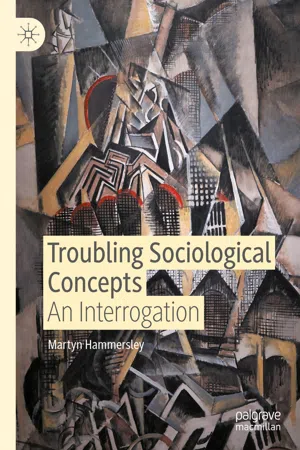
Sociology addresses challenging social issues and seeks new ways to understand them. However, much sociological terminology suffers from multiple, vague, or uncertain meanings. This is true of many of the central terms that sociologists use, such as 'power', 'ideology', 'culture', 'social class', and even 'society'. The result is that the conclusions reached by sociological investigations are frequently subject to discrepant interpretations, and their validity is difficult to assess. The chapters in this book address several of the key terms employed by sociologists, examining the concepts associated with them in depth – from both an historical and an analytical perspective. The aim is not to develop an entirely new framework but rather to document the various meanings associated with these terms, and to suggest ways in which they could be refined or developed for the purposes of sociological analysis. Since the concepts addressed are of wide relevance, Troubling Sociological Concepts will be of interest and use to researchers and students across the social sciences.
- English
- ePUB (mobile friendly)
- Available on iOS & Android
eBook - ePub
About this book
Information
© The Author(s) 2020
M. HammersleyTroubling Sociological Conceptshttps://doi.org/10.1007/978-3-030-51644-4_11. Introduction
Martyn Hammersley1
(1)
The Open University, Milton Keynes, UK
The most succinct rationale for this book is that, in an important sense, sociologists often do not know what they are talking about. This is because they give insufficient attention to the vague, and multiple, senses of key terms they employ, as well as to the serious conceptual problems these can involve. Any understanding of the world depends to a considerable extent on the concepts in which it is framed. A very long time ago, Max Weber (1904/1949: 92–93) complained that many of those used by social scientists and historians were ‘ambiguous constructs’ whose meaning ‘is only concretely felt but not clearly thought-out’ (p94). More than half a century later, Lachenmeyer (1971: 1) made a similar point: ‘sociologists use terms and theoretical statements that are imprecise because they abound in ambiguity, vagueness, opacity and contradiction’. Similar complaints have been made in other areas of social science, especially in the study of politics, where there have been several systematic attempts to understand the process of conceptualisation and to refine concepts accordingly (see, for instance, Sartori et al. 1975; Oppenheim 1981; Sartori 1984; Goertz 2006; Collier and Gerring 2009; Schaffer 2016).
The need for clarity should be obvious. If, for example, it is said that ‘inequality is increasing’, or ‘racism is widespread’, we need to know what is meant by ‘inequality’ and by ‘racism’, as well as in what respect the one is increasing and the other is widespread. If these phrases are used as rallying cries, vagueness may not matter; indeed, it could be an advantage. However, for the purposes of sociological analysis it is essential to know what is being claimed rather more precisely. Distinctions are required to trace out potentially significant similarities and differences among the phenomena being investigated, ones that will enable us to understand and explain those phenomena better. Furthermore, without more clarity, any assessment of the truth of sociological claims is likely to be fruitless. Indeed, where there is disagreement in the interpretation of terms, the different sides of the argument will often talk past one another.
Many years ago, Sartori (1975) suggested that social science had become a ‘Tower of Babel’, and this description is even more true today than it was when he was writing. For example, if we consider the term ‘social structure’, which is frequently treated as central to sociology, we find that it has been given very different senses: a relatively stable pattern of social interaction; a hierarchical set of positions (for example, occupations) to which people are ‘allocated’; or a hidden, generative process (as, for instance, in the notion of ‘structural racism’). As Rubinstein (2001: 2) remarked : ‘there is a striking degree of obscurity and confusion over [the concept of social structure], a concept that is widely regarded as defining the sociological perspective’. The situation is hardly better with terms derived from everyday usage. For example, ‘work’ is the focus of a major subdiscipline of sociology, but it has multiple meanings, and the main sense of this term still adopted by sociologists—paid employment—excludes similar activities that are outside the monetary economy, ones which may be of equal significance in many respects. Furthermore, the other senses of the term—expenditure of energy, actions whose satisfactions are entirely indirect, or that are undertaken as a result of constraint—are often relied upon implicitly in sociological usage.
In this book I explore the meanings that have been given to several key terms that are widely employed in sociological explanations, and in social science more generally. These include ‘ideology’; ‘culture’; ‘society’; ‘social class’; ‘sex’ and ‘gender’; ‘ethnicity’ and ‘race’; ‘power’; ‘values’ and ‘interests’. They by no means exhaust the corpus of sociological concepts, but the terms discussed have long been central to the discipline. I look at some of the history of each one, the competing senses given to it, and the problems these involve. I do not claim to have resolved the problems, but I do make proposals about how the terms can best be defined and used; as well as occasionally about how they should not be used. However, these can be no more than suggestions, since the problems involved here, like many others faced by social scientists, are not ones that are open to immediate solution. Instead, solutions have to be worked towards, collectively. Of course, one conclusion could be that some of these terms ought to be abandoned. For example, Jenkins (2002: ch3, 2010) has proposed this as regards ‘society’, ‘culture’, and ‘social structure’; Latour (1986: 278) proposes abandoning ‘power’; and I reach a similar recommendation regarding ‘ideology’. However, there is no point in proposing that a term be abandoned unless we examine the meanings it has been given and the purposes these have served: only if it can be shown that it is not necessary for these purposes, or that the purposes fall outside the remit of sociology, can such a proposal be justified.
In my view, one of the most disabling problems facing sociology, at present, is that (for a variety of reasons) it does not operate as a collective enterprise aimed at resolving problems through careful thought and investigation, but rather to a large extent simply houses competing approaches, these often asserting supposedly definitive accounts about highly complex matters. The aim of this book is to prompt a more deliberative approach to the problems surrounding major terms that sociologists employ.1
Some Assumptions and Principles
My approach to this task necessarily relies on assumptions, both about sociology and about the use of language, ones that may not be widely shared. In fact, it is almost inevitable, given the fundamental divisions that now prevail within the discipline, that these assumptions will be contentious. Some colleagues may deny that there are significant problems with sociological concepts, or that dealing with them is a priority. And, among those who recognise the problems, there are likely to be differences in view, both about what is wrong and about what needs to be done.
This situation is not new. In the mid-twentieth century, Talcott Parsons (1937: ch1, 1970) insisted that, given the requirements of analytical science, sociological concepts must form part of a properly systematic theory. Around the same time, other sociologists, equally unhappy with the state of the discipline, insisted on a much narrower conception of theory, as offering explanations for specific types of outcome; and they demanded that any theory be expressed in formal, perhaps even in axiomatic, terms (see, for instance, Hochberg 1959). Yet others placed primary emphasis on statistical analysis and the need for concepts to be operationally defined (Lundberg 1942; Lazarsfeld and Rosenberg 1955). Meanwhile, at the other end of the spectrum, there were those suggesting that sociology is an ‘art form’, that it unavoidably has a discursive character that is similar to modes of writing in the humanities, or even to works of art and literature (Nisbet 1976; Stein 1963). From this perspective, a more ‘essayistic’ approach was recommended, with metaphor and other literary devices being regarded as essential, albeit requiring careful handling.
These arguments continued in subsequent decades. Indeed, those who reject the models of natural science and mathematics have recently turned towards the humanities in much more radical ways, for example extolling the virtues of evocative and allusive forms of language (Tyler 1986), and/or insisting on the need for sociologists to develop their own personal styles. One aspect of this is the emergence of ‘arts-based research’ (Leavy 2015). In light of this, some have questioned the very idea of, and need for, clarity of expression (Lather 1996; MacLure 2003). An older, pre-postmodern, version of this idea was adopted by Adorno, for whom any writing that is easily understood involves complicity with, and reinforcement of, the dominant, oppressive culture, and the economic system underpinning it (see Jay 1984: 11–12). Meanwhile, others complain about sociological obscurity and ‘jargon’, calling for sociologists to write in a manner that lay audiences can understand (see, for instance, Toynbee 1999). Here, any difference between sociological and lay thinking, and their associated modes of expression, is downplayed or rejected.
Underlying these variations in view about sociological language are, of course, fundamental disagreements about the task and character of sociology itself. I cannot address these here in any detail, but I owe it to readers to outline my own views briefly, so that they can take these into account in approaching the discussion of key sociological terms in subsequent chapters. At the same time, I hope that the book will nevertheless be of use to those who hold different views from mine.
Broadly speaking, I adopt a Weberian conception of social science: as aimed at producing explanations for particular patterns of events or outcomes, rather than generic theories about what causes what; as committed to objectivity, in the sense of being aimed solely at the production of value-relevant factual knowledge, and also to minimising bias; and as concerned with producing explanations that accurately represent both the meanings of actions for participants and their causation or consequences (see Hammersley 2014). From this point of view, sociological research is a specialised activity aimed solely at producing value-relevant knowledge of a particular kind, not with directly serving any other practical goal, such as improving policy or practice, challenging social inequalities, bringing about ‘social change’, troubling patriarchy, countering homophobia, or resisting racism—to mention various of the (undoubtedly desirable) goals that some sociologists take to be their task. I also assume that, like other disciplines, sociology is devoted to producing knowledge-claims that meet a relatively high threshold of likely validity compared to that which applies most of the time in everyday life (Hammersley 2011: ch5). Finally, I do not regard the discipline as adopting a completely different view of social phenomena from our mundane understandings of the social world. For me, sociological concepts are refinements of ones used by everybody, refinements designed to serve the specialised function of sociological analysis: namely, to produce explanations for important social processes and outcomes, explanations that are more likely to be true than those from other sources.
In accord with this conception of sociology as an academic discipline, I take it that communication among researchers plays a crucial role in discovering the truth about what is being investigated, that this can only be achieved through a dialectical process (Hammersley 2011: ch7); in other words, through efforts aimed at achieving mutual understanding, as well as careful scrutiny of the arguments and evidence presented by others; all this against the background of what is taken to be already known, and the intellectual problems with which the discipli...
Table of contents
- Cover
- Front Matter
- 1. Introduction
- 2. Ideology
- 3. Culture
- 4. Society
- 5. Social Class
- 6. Sex and Gender
- 7. Ethnicity, Race, and Racism
- 8. Power
- 9. Values, Interests, Goals, and Attitudes
- Back Matter
Trusted by 375,005 students
Access to over 1.5 million titles for a fair monthly price.
Study more efficiently using our study tools.
Frequently asked questions
Yes, you can cancel anytime from the Subscription tab in your account settings on the Perlego website. Your subscription will stay active until the end of your current billing period. Learn how to cancel your subscription
No, books cannot be downloaded as external files, such as PDFs, for use outside of Perlego. However, you can download books within the Perlego app for offline reading on mobile or tablet. Learn how to download books offline
Perlego offers two plans: Essential and Complete
- Essential is ideal for learners and professionals who enjoy exploring a wide range of subjects. Access the Essential Library with 800,000+ trusted titles and best-sellers across business, personal growth, and the humanities. Includes unlimited reading time and Standard Read Aloud voice.
- Complete: Perfect for advanced learners and researchers needing full, unrestricted access. Unlock 1.5M+ books across hundreds of subjects, including academic and specialized titles. The Complete Plan also includes advanced features like Premium Read Aloud and Research Assistant.
We are an online textbook subscription service, where you can get access to an entire online library for less than the price of a single book per month. With over 1.5 million books across 990+ topics, we’ve got you covered! Learn about our mission
Look out for the read-aloud symbol on your next book to see if you can listen to it. The read-aloud tool reads text aloud for you, highlighting the text as it is being read. You can pause it, speed it up and slow it down. Learn more about Read Aloud
Yes! You can use the Perlego app on both iOS and Android devices to read anytime, anywhere — even offline. Perfect for commutes or when you’re on the go.
Please note we cannot support devices running on iOS 13 and Android 7 or earlier. Learn more about using the app
Please note we cannot support devices running on iOS 13 and Android 7 or earlier. Learn more about using the app
Yes, you can access Troubling Sociological Concepts by Martyn Hammersley in PDF and/or ePUB format, as well as other popular books in Social Sciences & Social Classes & Economic Disparity. We have over 1.5 million books available in our catalogue for you to explore.