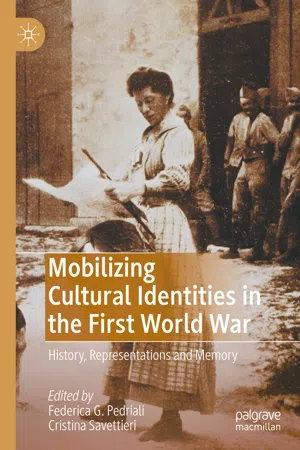
This book tackles cultural mobilization in the First World War as a plural process of identity formation and de-formation. It explores eight different settings in which individuals, communities and conceptual paradigms were mobilized. Taking an interdisciplinary approach, it interrogates one of the most challenging facets of the history of the Great War, one that keeps raising key questions on the way cultures respond to times of crisis. Mobilization during the First World War was a major process of material and imaginative engagement unfolding on a military, economic, political and cultural level, and existing identities were dramatically challenged and questioned by the whirl of discourses and representations involved.
eBook - ePub
Mobilizing Cultural Identities in the First World War
History, Representations and Memory
- English
- ePUB (mobile friendly)
- Available on iOS & Android
eBook - ePub
Mobilizing Cultural Identities in the First World War
History, Representations and Memory
About this book
Information
© The Author(s) 2020
F. G. Pedriali, C. Savettieri (eds.)Mobilizing Cultural Identities in the First World Warhttps://doi.org/10.1007/978-3-030-42791-7_11. Introduction
Cristina Savettieri1 and Federica G. Pedriali2
(1)
Department of Philology, Literature and Linguistics, University of Pisa, Pisa, Italy
(2)
School of Languages, Literatures and Cultures, University of Edinburgh, Edinburgh, UK
Keywords
WWI MobilizationCircuit of cultureCultural identitiesThis book is an experiment in historical research and cultural inquiry. Its aim is to tackle cultural mobilization in the First World War as a fundamental site of identity formation and de-formation and explore eight different settings in which individuals, communities, or conceptual paradigms were mobilized. The key material process of making war, mobilization was also a massive phenomenon of cultural engagement and production, one that engendered displacement of values and beliefs, the fashioning of new identities, and the spread of cultural artefacts conveying new social imaginings. In the diverse flux of experiences of wartime (Becker 2012), the direction of those symbolic displacements, the quality and nature of those new identities, and the features of those artefacts along with the meanings underlying new social imaginings can be appreciated only by means of flexible tools and interdisciplinary approaches. First of all, mobilization implies a continuous shift from the symbolic to the material realm of experience and the intertwining of bodies, actual policies and objects with emotions, desires, ideas, and imaginations. As fundamental studies on mobilization (Horne 1997a, 2012) and war cultures (Audoin-Rouzeau and Becker 2000) have demonstrated, such notions as propaganda and the manipulation of the public opinion cannot make sense of all frames of meaning and the relevant identities that were set in motion by the war. In contexts in which propaganda actions were properly organized just in the last two years of war, cultural mobilization had unfolded massively from the very beginning of the conflict, thus confirming that an organized system based on the adjustment and adulteration of truth was sufficient, yet not necessary, for fostering engagement or provoking critical responses. Most appropriately, John Horne (1997b) has discussed self-persuasion and self-mobilization as applying to key forms of engagement and participation that were autonomous from state initiatives. Moreover, in a broad sense, cultural mobilization cannot be simply identified with support to the war or as instrumental in keeping consensus: even those who were not interventionists and fought without any profound commitment to the reasons of the war or openly disputed the opportunity of the conflict were all culturally mobilized, that is, called to rearrange their own views, beliefs, and actions and react to the war.
Against the backdrop of mobilization, the very notion of agency requires profound rethinking: new formations, whether identities, artefacts, practices or concepts, need to be observed within a dynamic of circulation or, better, within a “circuit” in which production and consumption of given cultural contents were not just top-down processes imposed by state agencies onto passive recipients. The seminal schema of the circuit of culture, developed in the context of cultural studies in the 1980s and the 1990s (Johnson 1986; du Gay et al. 1997; Hall 1997), stresses how “meanings are produced at several different sites and circulated through several different processes or practices” (Hall 2013, p. XIX) and hence how cultures are more than just linear and stable reflections of facts or events. In the historical setting of the First World War, narratives and representations were, at the very same time, driven and driving forces, both expressions of official arrangements of power and sites of constant exchange and negotiation of meanings, which hybridized with and reacted to the official paths of mobilization, opening up a dynamic space of floating cultural materials. Existing political, national, and gender identities were dramatically challenged and questioned by the whirl of discourses that called to mobilization in a twofold sense: they were urged to respond actively and concretely to the war and they were also symbolically put in motion by it, that is, confronted with destabilizing and reshaping. This is not just because of the extraordinary conditions in which war cultures developed, but more radically, because cultural identities stem from multiple factors and, as such, are continuously susceptible to hybridization. Even though the linguistic root of the word “identity”—from the Latin pronoun and adjective idem (“same”)—resonates with ideas of stability and uniformity, identity, whether individual or collective, is the result of a process, a heterogeneous construction that relies on the dynamic intersection of different identifiers confronted by the continuous impact of experience. Hence, the transnational and global scope of war cultures should not overshadow their intrinsically discrete character. Not only did each national context have specific forms of and attitudes towards mobilization, which depended on long-term cultural frameworks and shared national imaginings, but also within the same context different cultural responses were provoked that were shaped by factors of gender, class, race, and even age, each intersecting the other and thus engendering multifaceted outcomes. Therefore, the idea of uniform national discourses affecting all social subjects involved in the war in terms of either influence or rejection does not fit the plurality and complexity of individual and collective responses provoked by the conflict. Moreover, it does not consider the dialogic character of personal representations and narratives of the war years and the rebound effect they were able to engender in specific sites of the public sphere: individual experiences fostered accounts and images that partly absorbed public discourse and its contents, partly reshaped it. Notions such as hegemony and subordination prove essential to provide dynamic and diverse outlines of phenomena of mobilization and its spatial configuration within mobilized societies: the production of meanings located in marginalized areas of the public sphere can be fully appreciated only by observing their position in relation with other dominant clusters of meanings and contents underpinning different social subjects as well as other power relationships.
Cultural mobilization, unlike the material processes of mobilization, is not a linear process also with regard to time, that is, it did not just start and end at a given moment: it kept unfolding even when the war was over in the form of post-war political engagement, collective and individual remembrance and mourning practices, self-narratives, and nationalized artistic commitment (Rasmussen 2014). Multiple chronologies are activated in the play of cultural mobilization: this is particularly evident in remembrance practices and sites of memory, which stimulated remobilization and the production of new meanings in the circuit of culture in the post-war years and even later, on the occasion of anniversaries of the war or to coincide with significant changes of the polity and, accordingly, of its narratives and symbols. Episodes of remobilization can vary according to the subjects remobilized and the contexts in which they took place: in post-war societies, personal narratives of the conflict could depart from the shared framework of public initiatives of remembering or, when the making of the memory of the war served political purposes, as in fascist Italy, unorthodox views and attempts at remobilizing subordinated accounts of the conflict could be marginalized, affected by self-censorship or censored tout court. In the very same contexts, individual remobilization in the form of political and artistic engagement contributed actively to building a new circuit of culture within which representations of the war were essential to the circulation of new political meanings and thus to the formation of new identities.
There is a further level that this book wishes to explore: conceptual mobilization and the way war cultures contributed to setting in motion new concepts and the rethinking of certain interpretative patterns and frameworks. The unprecedented nature and scale of warfare still foster theoretical reflections on violence, mass death, trauma, the dynamic of attachment to a community, and the functioning of brutalization, to mention just few of the issues that critical theory and philosophy have been exploring since the seminal writings by Walter Benjamin in the aftermath of the First World War. Even if it apparently falls outside the scope usually covered by the term “mobilization,” this book shall consider the displacement that the war ignited within given conceptual fields as comparable to processes of identity formation and de-formation occurred during and after the war. On the one hand, this critical gesture builds on a specific line of studies that aim to assess the impact that the war exerted on philosophy (Baldwin 2003; de Warren and Vongehr 2018) and thus shares its main theoretical premise, according to which philosophy and conceptual thinking in general are not to be considered as set apart from politics, society, and the ordinary world; on the other, it departs from those critical attempts in that it is more concerned with the mobilizing power of the war and its unprecedented theoretical challenge to such areas as ethics and biopolitics than with the history of philosophy, its internal periodization, and some of its specific issues.
Gathering the very different approaches and objects of study of nine scholars in a variety of disciplines ranging from cultural history and classics to literature and philosophy, this book is organized in four parts, each including two chapters, ideally brought into dialogue with each other. Each part has been conceived as pivoting around some facets of cultural mobilization and identity formation: “Political Identities”; “Italian Masculinities”; “Conceptual Frameworks”; “Remembering.” While maintaining a transnational scope, which will cover cases and examples from different national contexts, this book pays significant attention to the Italian front, most neglected even in recent studies on the war. This focus depends not only on the specific expertise of some of the contributors, but also on the need to observe phenomena of cultural mobilization from apparently peripheral perspectives. The relatively brief national history of Italy at the time of the outbreak of the conflict, the distinctive features of the country’s delayed entry into the war, as well as the unaccomplished demobilization of the post-war years and the radical transformation the polity underwent with the rise of fascism make this war theatre a fundamental setting that needs scholarly re-centring. This book, then, wishes to contribute to the recent wave of major publications (Parati 2016; Wilcox 2018) which have claimed the importance of the Italian front for a global comprehension of the conflict.
Part I, devoted to “Political Identities,” presents two chapters which analyse two cases of political engagement and identity formation, respectively set at different stages of what might be termed the “long war,” whereby we consider the period preceding the outbreak of the conflict and the years following it as integral to the understanding of key issues of mobilization. The two different cases analysed here—intellectual and political circles of pre-war Britain and artistic engagement in post-war Italy—offer insights into the political uses of given cultural traditions and the ways these could inspire pre- and post-war political actions. In the first chapter, entitled “Classical Idealism and Political Action: Jane Malloch and Henry Brailsford in the First World War,” Elizabeth Pender proposes an entirely new perspective on the political re-writing of classical idealism in First World War Britain. Centred on the life trajectories of two intellectuals whose political identities were mobilized in different ways by the war, this chapter opens the book with a fascinating and complex case of cultural circulation and re-signification. Pender analyses the features of Hellenic idealism and its ties with both liberalism and radical politics by considering the influence of one of the most celebrated British classicists, Gilbert Murray, and by reconstructing the lives, beliefs, and political activism of two of his students in Glasgow in the 1890s, Henry Brailsford and Jane Malloch. After becoming socialists at university, the couple were later married and pursued parallel careers: Brailsford a respected political journalist and reformer; Malloch a militant suffragette. Deeply imbued with ideas of social justice nurtured by Hellenic idealism, these three outstanding figures developed radically different political stances: at the outbreak of the war, Murray advocated the justness of the British intervention in the conflict from a liberal perspective, while Brailsford, meanwhile turned a socialist, claimed a fully pacifist position; Malloch, departing from both liberal thought and internationalist pacifism, passionately supported the war. Factors of class and gender underpin this multifaceted outline and its divergent outcomes: a common cultural framework, based on values of equality and social justice, inspired different political cultures and shaped political identities remarkably at odds with each other. Proposing a profound reassessment of the role classical knowledge played in processes of mobilization in favour of and against the war, this chapter establishes one of the main theoretical premises of this book: even in apparently homogenous contexts, the same cultural materials intersect a diverse set of identifiers and experiences, and therefore produce multiple meanings at different sites of the circuit of culture and momentous displacements and re-writing of given values. If this demonstrates the inherent flexibility of classical culture, it also shows to what extent the exceptional conditions of cultural circulation immediately before and during the war encouraged hybridization and the mobilization of different kinds of identities.
The second chapter of the section, authored by Simona Storchi and entitled “Artists at War: Artistic Identities and the Politics of Culture in Post-World War I Italy,” moves to the post-war years and tackles one of the most crucial contexts of post-war Europe, that is, Italy. Among the victorious countries, Italy is probably the only one that proved unable to exploit the positive effects of victory (Baravelli 2015) from both a political and social point of view. In fact, the myth of the mutilated victory, arisen from the disappointing outcomes of the Versailles peace conference, stirred up a new violent wave of nationalist mobilization, as if the war were not over. In this context, where cultural demobilization did not take place, the formation of new political identities strictly connected to the war years was a major phenomenon that unfolded also in the artistic field and prepared the ground for the circuit of fascist culture to develop. What is striking is that, in some cases, the politicization of artistic contents relied on claims of autonomy and the retrieval of essentialist notions such as Italianism and classicism: Storchi’s chapter is an exemplary study of the heteronomous...
Table of contents
- Cover
- Front Matter
- 1. Introduction
- Part I. Political Identities
- Part II. Italian Masculinities
- Part III. Conceptual Frameworks
- Part IV. Remembering
- Back Matter
Trusted by 375,005 students
Access to over 1.5 million titles for a fair monthly price.
Study more efficiently using our study tools.
Frequently asked questions
Yes, you can cancel anytime from the Subscription tab in your account settings on the Perlego website. Your subscription will stay active until the end of your current billing period. Learn how to cancel your subscription
No, books cannot be downloaded as external files, such as PDFs, for use outside of Perlego. However, you can download books within the Perlego app for offline reading on mobile or tablet. Learn how to download books offline
Perlego offers two plans: Essential and Complete
- Essential is ideal for learners and professionals who enjoy exploring a wide range of subjects. Access the Essential Library with 800,000+ trusted titles and best-sellers across business, personal growth, and the humanities. Includes unlimited reading time and Standard Read Aloud voice.
- Complete: Perfect for advanced learners and researchers needing full, unrestricted access. Unlock 1.5M+ books across hundreds of subjects, including academic and specialized titles. The Complete Plan also includes advanced features like Premium Read Aloud and Research Assistant.
We are an online textbook subscription service, where you can get access to an entire online library for less than the price of a single book per month. With over 1.5 million books across 990+ topics, we’ve got you covered! Learn about our mission
Look out for the read-aloud symbol on your next book to see if you can listen to it. The read-aloud tool reads text aloud for you, highlighting the text as it is being read. You can pause it, speed it up and slow it down. Learn more about Read Aloud
Yes! You can use the Perlego app on both iOS and Android devices to read anytime, anywhere — even offline. Perfect for commutes or when you’re on the go.
Please note we cannot support devices running on iOS 13 and Android 7 or earlier. Learn more about using the app
Please note we cannot support devices running on iOS 13 and Android 7 or earlier. Learn more about using the app
Yes, you can access Mobilizing Cultural Identities in the First World War by Federica G. Pedriali, Cristina Savettieri, Federica G. Pedriali,Cristina Savettieri in PDF and/or ePUB format, as well as other popular books in History & Historiography. We have over 1.5 million books available in our catalogue for you to explore.