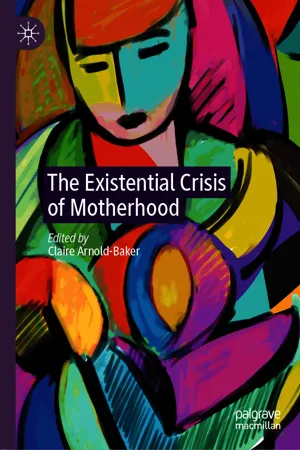
This book offers a new perspective on the motherhood experience. Drawing on existential philosophy and recent phenomenological research into motherhood, the book demonstrates how motherhood can be understood as an existential crisis. It argues that an awareness of the existential issues women face will enable mothers to gain a deeper understanding of the multifaceted aspects of their experience. The book is divided into four sections: Existential Crisis, Maternal Mental Health Crisis, Social Crisis and Working with Existential Crisis, where each section. Each chapter is based on either experiential research or the author's extensive therapeutic experience of working with mothers and reflects different aspects of the motherhood journey, all through the lens of a philosophical existential approach. The book is essential reading for mental health practitioners and researchers working with mothers, midwives and health visitors, but it is also written for mothers, with the aim to offer newinsights on this important life transition.
- English
- ePUB (mobile friendly)
- Available on iOS & Android
eBook - ePub
The Existential Crisis of Motherhood
About this book
Information
Part IExistential Crisis: The Philosophical Tensions of Being a Mother
© The Author(s) 2020
C. Arnold-Baker (ed.)The Existential Crisis of Motherhoodhttps://doi.org/10.1007/978-3-030-56499-5_11. Introduction: The Existential Crisis of Motherhood
Claire Arnold-Baker1
(1)
The New School of Psychotherapy and Counselling, London, UK
The Existential Crisis of Motherhood
Crisis is not usually a word associated with motherhood. It is most often described or thought of as a joyful and happy event, that is wanted and expected and therein lies the paradox of motherhood. It evokes powerful emotional responses which are often contradictory. Can an experience be both joyful and shocking? Induce intense love but also frustration? Evoke deep feelings of guilt but also pride. It is this ambiguity surrounding the experience of motherhood which has also led to the plethora of research and literature in this area. Research which aims to capture the essence of an experience which feels on the one hand ethereal and other worldly but at the same time is corporeal and grounded.
The word crisis usually conjures up an image of great emotional turmoil and distress; a time of extreme trouble or danger (Collins Dictionary 1993). But viewing motherhood in this way is to look at only one side of the equation. Monk (2013) warns that making motherhood a crisis accounts for its medicalisation and the resultant need for intervention. Whilst this may be the experience of those mothers who have experienced birth trauma, for example, it isn’t the experience of all mothers. Yet the transition to motherhood is a significant period of time for all mothers. It’s complexity, therefore, is due to there being myriad experiences for women, where each mother’s journey is unique.
There are, however, other types of crisis, which are not so traumatic in that an individual would feel in danger, but which serve to turn our lives upside down. These periods of crisis are momentous times in one’s life which cause us to stop and think again. They create periods of unsettledness that can lead to a questioning or re-evaluation of our lives. Typically, they occur at major life transitions, such as adolescence, mid-life or retirement. But they can also arise at other crisis points in our lives, such as redundancy, bereavement or the loss of a relationship.
All of these times of crisis involve a period in which the person’s life changes, often suddenly and in unexpected ways. The normal patterns or routines of life are disrupted, either by events, change in circumstances or changes to the individual’s relationship to themselves or other people. Times of crisis have been described as ‘everything is turned upside down’ (Deurzen 2009: 107), or as a ‘disruption of the normal course of life’ (Jacobsen 2006: 42) or as ‘something extraordinary and personally decisive’ (Bollnow 1959 cited Jacobsen 2006: 42). As Deurzen states, ‘crises may also occur in ordinary situations or even events that would seem apparently happy, such as pregnancy or birth’ (Deurzen 2009). The changes that occur during a crisis often lead to a re-examination of an individual’s life, when they rethink their values and beliefs and how they see themselves and their lives. These periods are often quite difficult and intense. It takes time for an individual to make sense of what has happened to them and to begin to see their lives in new ways.
Maternity as Life Crisis
In Jacobsen’s (2006) exploration of the phenomenon of life crisis, he elucidates three dimensions of a crisis: crisis as adversity, crisis as loss and crisis as an opening of existence. The adversity that Jacobsen refers to describes what one would normally associate with crisis; an adverse event or situation that must be overcome. These events are often out of our control and are subject to chance. They involve ‘boundary situations’ (Jaspers 1951), the limits to our existence to which individuals must decide how they respond, or what attitude they choose to take towards the challenges they represent (Frankl 1964). As Jacobsen (2006) states, these crises cannot be changed and therefore need to be accepted as the individual’s existential ground.
Crisis can also involve a loss, this can be a loss of something material or relational, i.e. the loss of a person due to bereavement or the loss of a job or a home, but it also concerns an individual’s loss of meaning or a loss to their worldview. Likewise, this sense of loss may concern a person’s sense of themselves, where their values and beliefs are challenged by events or situations out of their control.
When motherhood is viewed through this lens the loss is not initially apparent. Mothers gain a new baby and a new way of life. Yet mothers also lose a sense of the ‘old me’ and feel that life will never be the same again. The paradox of motherhood is that with gains there are also losses too, you cannot have one without the other—they are two sides of the same coin. The mother’s meaning in life changes on the birth of her baby (Arnold-Baker 2015; Prinds et al. 2013); her priorities change but there are also changes in her views about herself and her life. Although there is often a gap after the birth before mothers are able to assimilate and make sense of their new ways of being. It is this aspect of loss that Jacobsen refers to as a ‘loss of the unfolding of life’. Although for motherhood this rupture is a welcomed one, it is still a rupture in a woman’s existence. A rupture which is expected but also sudden—in the moment of birth everything changes.
Motherhood, therefore, is a crisis moment for women; one which can be experienced as either an adversity, a loss or an unfolding of existence. Raphael (1975) conceptualised the rite de passage of ‘mother-becoming’ as Matrescence and likens it to adolescence, in terms of the many changes; physical, emotional and hormonal that occur. If adolescence is seen as a crisis point in a person’s life, then so too must motherhood.
In fact, anthropological cross-cultural studies have shown that the physiological experiences of childbirth are ‘almost universally treated as a traumatic life crisis event’ (Kruckman 1992: 139). Many cultures mark this period in a ritualised or structured way, which indicates a transition in social roles and gives the new mother time to recuperate and for her needs and tasks to be taken care of. This integration phase which follows what is seen as a major life transition helps mothers to incorporate and become absorbed into their new social state (Van Gennep 2004). Yet in Western Society there is little social support for new mothers and ‘no formal social structuring of the puerperium1 once the mother has returned home’ (Kruckman 1992: 138) and so women are left to overcome this traumatic life crisis, and work things out for themselves, with little or no support.
Existential Crisis
The crisis of motherhood takes on a new perspective when we consider the Greek origins of the word, Krisis—meaning to decide or to choose. From this viewpoint, motherhood becomes a time when women are expected to make many decisions and choices not only for their new-borns but also for themselves as well. Everything must be chosen, and women become aware of the enormity of these choices. This is brought to the fore because a woman’s life has changed totally and forever when she has a baby. It is a transformation which mothers are never fully able to prepare for: as Dani explains ‘So as much as you can be prepared, I don’t know if anything quite prepares you for the experience’ (Arnold-Baker 2015: 134). Motherhood also becomes a time when women are confronted with the basic tenets of existence: of life and death; and of the complex interaction between choice, freedom and responsibility (Arnold-Baker and Donaghy 2005; Arnold-Baker 2015). This focus, that occurs in early motherhood, sheds light on how we understand and experience our existence in all its richness. Which means that we need to treat the crisis of motherhood as an existential one.
An existential crisis is quite distinct from the usual definition of crisis—although all types of crisis might also lead to an existential crisis. More specifically an existential crisis occurs when we stop to consider our existence in its entirety. When we question our life, our values and beliefs and the meaning and purpose we give to our lives. As with the Greek Krisis, an existential crisis requires us to make a decision about our existence. We experience an existential crisis when we are confronted with the unpredictable nature of our lives. When we come to realise that the expectations we have of life are also subject to chance. Jaspers (1951) describes these as the limitations of our existence or boundary situations, these unknown aspects of existence which come into play despite our best intentions. This is most keenly seen during the birth process where mothers, having thought about and made their birth plans, are confronted with the unpredictable nature of birth. In those moments, mothers become aware of the many other possibilities that are now opening up for them and which they had not previously considered or were even able to grasp beforehand. The birth process, and therefore motherhood, creates a situation of thrownness for mothers; a term Heidegger (1962) used to denote the arbitrary and unfathomable nature of existence. He believed that we are always thrown into a world that we did not choose. Whilst this is certainly true for the new-born baby, it is also true for the mother. The mother becomes aware that her sense of her life has changed immeasurably, that she is subject to chance and that there are elements of her life th...
Table of contents
- Cover
- Front Matter
- Part I. Existential Crisis: The Philosophical Tensions of Being a Mother
- Part II. Maternal Mental Health Crisis: Understanding Maternal Mental Health from an Existential Perspective
- Part III. Social Crisis: An Existential Understanding of the Impact on Motherhood of Social and Cultural Aspects
- Part IV. Working with Existential Crisis in Clinical Practice
- Back Matter
Trusted by 375,005 students
Access to over 1.5 million titles for a fair monthly price.
Study more efficiently using our study tools.
Frequently asked questions
Yes, you can cancel anytime from the Subscription tab in your account settings on the Perlego website. Your subscription will stay active until the end of your current billing period. Learn how to cancel your subscription
No, books cannot be downloaded as external files, such as PDFs, for use outside of Perlego. However, you can download books within the Perlego app for offline reading on mobile or tablet. Learn how to download books offline
Perlego offers two plans: Essential and Complete
- Essential is ideal for learners and professionals who enjoy exploring a wide range of subjects. Access the Essential Library with 800,000+ trusted titles and best-sellers across business, personal growth, and the humanities. Includes unlimited reading time and Standard Read Aloud voice.
- Complete: Perfect for advanced learners and researchers needing full, unrestricted access. Unlock 1.5M+ books across hundreds of subjects, including academic and specialized titles. The Complete Plan also includes advanced features like Premium Read Aloud and Research Assistant.
We are an online textbook subscription service, where you can get access to an entire online library for less than the price of a single book per month. With over 1.5 million books across 990+ topics, we’ve got you covered! Learn about our mission
Look out for the read-aloud symbol on your next book to see if you can listen to it. The read-aloud tool reads text aloud for you, highlighting the text as it is being read. You can pause it, speed it up and slow it down. Learn more about Read Aloud
Yes! You can use the Perlego app on both iOS and Android devices to read anytime, anywhere — even offline. Perfect for commutes or when you’re on the go.
Please note we cannot support devices running on iOS 13 and Android 7 or earlier. Learn more about using the app
Please note we cannot support devices running on iOS 13 and Android 7 or earlier. Learn more about using the app
Yes, you can access The Existential Crisis of Motherhood by Claire Arnold-Baker in PDF and/or ePUB format, as well as other popular books in Psychology & Medical Theory, Practice & Reference. We have over 1.5 million books available in our catalogue for you to explore.