eBook - ePub
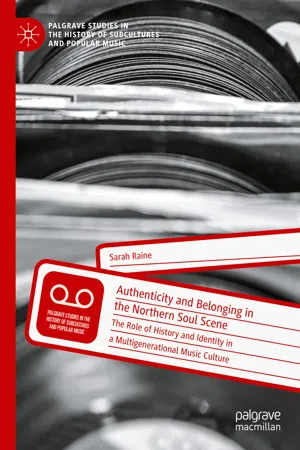
Authenticity and Belonging in the Northern Soul Scene
The Role of History and Identity in a Multigenerational Music Culture
- English
- ePUB (mobile friendly)
- Available on iOS & Android
eBook - ePub
Authenticity and Belonging in the Northern Soul Scene
The Role of History and Identity in a Multigenerational Music Culture
About this book
This book, which builds on a three-year immersive ethnographic study, argues that what scene participants do and say within the northern soul scene constitutes a claim to belong. For younger members, making claims to belong is problematic in a scene where dominant notions of authenticity held by insiders are rooted in a particular past: the places, people, events, and soundscapes of particular venues during the 1970s. In order to engage with this past, young men and women participate in a range of discursive practices. This book argues that these practices, and the ways they intersect and deviate from dominant notions of authenticity, represent shared and individual negotiations of the 'true soulie'. In doing so, it reveals the rich experiences of the younger generation of this multigenerational music scene, and the ways they establish a claim to belong to a scene first formed before they were born.
Information
© The Author(s) 2020
S. RaineAuthenticity and Belonging in the Northern Soul ScenePalgrave Studies in the History of Subcultures and Popular Musichttps://doi.org/10.1007/978-3-030-41364-4_11. We Share the Floor
Placing the bag on the floor, the ritual of the evening begins.1
Having arrived early into a cool and cavernous hall, I push my bag underneath the chair and hang my coat on the back, claiming my space. The chair I have chosen is on the right-hand side of the room. Not too close to the speakers—distorted in their attempt to fill the vast town hall with the sound of stylus on vinyl—yet not too close to the bar and the pressing humanity in the peak hours to come, either. The tables are set at ninety degrees to the dance floor, forming long rectangles with chairs tightly packed around. The chair that I choose is two in. Later, when the large hall is full of people dancing and watching, I will be able to sit down to rest aching feet. This seat, too, will be free of the leaning bodies standing around the edge, and yet close enough for me to get back on to the floor unencumbered for the right record.
A base established, my boyfriend Charlie and I walk to the bar to order a drink.2 Gin and tonic in a small plastic cup, to be nursed around the edge of the dance floor even though it remains relatively empty; it’s 9.05 pm and only a few people brave the expanse of the wooden floor, polished and ready for the night ahead. We thumb through the flyers advertising future “northern” events at other venues that clutter our table as people slowly join us. Nods and shouted greetings as we all secure our place for the evening. Not quite comfortable enough to dance in full view of the slowly filling room, I ease myself in, glancing around for familiar faces and taking Dutch courage from the alcohol in front of me.
Plastic glass empty, I reach underneath the chair and into my bag to pull out my dancing shoes. A slight heel and leather soles, sourced painstakingly online and embroidered with what I regard to be tongue-in-cheek red flames. They arrive at this northern soul event as they always do: pristine. Saved from the wet and grime of the outside world, soles smooth for the step and slide of the scene dance style. Learning from past nights, I make sure that the shoe’s tongue is dead centre, the arch of my feet cushioned from the tight laces necessary for high kicks and fast footwork. I slide my foot across the carpet, twist my ankle and adjust the fit.
Watching the familiar movements of the dancers on the floor as I wait my turn—my first record—I see my ritual reflected in the preparations of others around the edge: bags placed under chairs, coats on backs, dancing shoes laced and drinks purchased. The hall begins to fill with people, and an almost indecipherable murmur beneath the music begins to transform the room. Rachel and Emma arrive, two women in their mid-twenties that I have known for several years. I catch their eyes and wave. They smile back as they head straight down the side of the dance floor, as usual, to the right-hand side of the stage where the younger soulies tend to gather. Rachel and Emma, along with the expanding crowd, take up their places on the dance floor and the seats to the side. The confident ones who have been here before push through the people amassing at the tables by the door, eager to greet friends and to get good seats. Those here for the first time take up a spot between the bar and the dance floor. From there they have a good view of the dancers, but are saved from the real action by beckoning pints and a sticky perimeter of carpet.
A record sounds out across the room. The one I have been waiting for but couldn’t predict. It moves me to move, from my seat into a space, and I become part of the motion on and off the dance floor. Weaving in and out of the dancers already in place, I find a space of my own, not too close to the sides and away from those who flail or aggressively expand their area. It’s a fast record, so I begin with simple steps on every other beat. Smooth and capable, if not the eye-catching performance of the most competent dancers: a debut performance for this particular audience. And it works. Those around me move into the in-between spaces, a harmonious ebb and flow of step and slide, a relationship of movement that binds me into a kaleidoscope for those on the balcony above. My claim to the space of the dance floor accepted by those dancing around me, the five years spent dancing, watching, practising in quiet moments channelled into a public demonstration of belonging.
My tentative first steps begin to mature, to sync seamlessly with the rhythm. My head raises, my arms are more expressive. I look around and away from myself to the arms and faces of others, dancing alongside me: a mutual tuning-in relationship, bodies connecting without previous planning and yet avoiding contact. And I feel bound to this: to these people with whom I share the floor, and to the music that captivates my body and my thoughts.
Another three-minute explosion of sound comes to an end and, in the lull between records, the next seven-inch single lined up on one of the two decks is introduced by the DJ over the microphone. A “valuable rarity” (like many of the other sounds that grace this hall); the important facts of artist, record label, date of pressing, price, and its history so far on the scene are mapped out, justifying this inclusion in a set of rare soul. It doesn’t ring any bells. But it’s good. No; it’s amazing. What is it? I glance around to see who is mouthing the lyrics. Some are, but others look on with a similar mixture of rapture and frenzied movement, making the most of this discovery that we have made. A record worth feeling sore for in the morning—a high-kick, a backdrop, a spin. And it seems to be contagious as the limbs flail and the etiquette of the dance floor becomes harder to follow. A moment for “giving it all you’ve got”, and for some dancers around me their performance of the evening. Yet even as I dance “in” the music, changing my movements to suit the tempo and breaks of an unfamiliar song, I consciously channel this through the repertoire that I have learnt during my time on the soul scene.
And as I dance, I feel the eyes of the on-looking crowd, gathering at the edges of the dance floor as the room begins to fill. I am aware of the movements of other dancers around me, eager to claim a bigger area of the floor through purposeful strides. Honed through observation and practice, slides and steps and shuffles are the core palette of my movement. Unlike the laughing women by the bar, drawing scowls in their stiletto heels on polished wood, my measured movements demonstrate to other regular attendees my right to be there, to be given space. Like the DJ that performs his claim to membership on the decks and the mic, the dance floor offers me a way into and through the scene. My competency is expressed by this insider style and my understanding of the rules of space, through my knowledge of lyrics sung out loud as I dance.
The record crackles to an end and I move back to my seat on the edge. I watch as a well-known label is displayed on the screens above the stage, calling men and women to the floor. It requires no introduction, yet the DJ belts out a familiar foreword, hurried on by the unspoken yet palpable anticipation of a full dance floor. The instrumental breaks of this “northern soul classic” are echoed further by seemingly choreographed claps—a call to arms of the insider—identifying those who don’t quite know enough, responses too slow or retrospective, too early, too many. Those out of the music stutter in their movements as their mistimed clap echoes across the room, while the others are bound together in a staccato waltz.
With their bags and coats, with their steps and their spins, a handshake or a shouted salutation, those that enter the hall for this northern soul event claim not only physical space but their right to be there, to take up that chair or that area of the dance floor. A claim that is reiterated throughout the night, by slight dips of the head, an extension of a hand, a leg, a lull, a clap, a moment for catching your breath. Those who do it out of turn stand out: sore thumbs in the harmonious movement of this cultural space; an outsider in an underground community; a stranger in a room full of friends.
References
- Raine, S. (2016). We Share the Floor. Litro #156: Movement.
- Schütz, A. (1951). Making Music Together: A Study in Social Relationship. Social Research, 18(1), 76–97.
Footnotes
1
This section is a reworking of a short piece of fiction that I published in Litro (Raine 2016) and was influenced by an article by Alfred Schütz (1951).
2
All names in this study are pseudonyms, used to protect the identity of the individual. This research was undertaken within Birmingham City University’s Research Ethical Framework and approved by the Birmingham School of Media’s ethics committee.
© The Author(s) 2020
S. RaineAuthenticity and Belonging in the Northern Soul ScenePalgrave Studies in the History of Subcultures and Popular Musichttps://doi.org/10.1007/978-3-030-41364-4_22. “Going To A Happening”
At the Peak of the Night
One of the biggest nights of the northern soul calendar, The King’s Hall Allnighter in Stoke on Trent attracts soul fans from across the UK, and tonight is no different. Slowly filling with those delayed by long journeys, the dance floor in the main room is now packed. Those too late to claim a seat have begun to stand along the edge of the floor. Sally, having done her turn selling tickets on the door, smiles and waves frantically as she strides purposefully to claim a space. In her fifties, Sally is one of the younger members of the “original” generation. This group of people make up the majority at the King’s Hall tonight and at most other venues in the northern soul scene. Many make their journeys eager to tattoo out their love of rare soul. They reconnect with old friends over a drink before striding out onto the dance floor, some mid-conversation to the first bar of a favourite record.
One of few women visibly involved in the organisation and running of large, national events, Sally is well known off and on the dance floor. Her duty at the door now done, she finds her place at the front next to the speakers and launches into a smooth performance that she has refined through decades of practice. The other dancers around her grant her space in recognition of competence and her status within the scene, both of which are viewed as indicators of a long-term participation. Such longstanding personal experiences of the scene are worn proudly and respected by others.
Alongside Sally and other members of the “original” generation, young men and women also pound the floor with serious faces. None fall into standing onlookers alongside the side, worse for wear, or bump into other dancers as they mark out their space. These competent performances have been carved out at smaller events, on bedroom carpets and kitchen floors. For most of the dancers in this hall it has been a process of trial and error, hours spent watching at events and studying YouTube videos, clumsy beginnings under the cover of busy dance floor and the darker corners of venues. Three King’s Hall allnighters puncture a busy year of events, an opportunity to “be seen” by soulies that travel here from across the UK (and further afield).
John, aged twenty-seven, is towards the back, but several rows of bodies in; arms expressive, eyes closed, shouting out the words. A far cry from the quiet newcomer sat alone on the balcony upstairs three years ago, wondering how a space at the front could be earned. An expressive dancer, few would guess that his ego is still in recovery from a cruel critique of his dancing, handed out by others as he moved off the floor during a big night such as this. And Esther in her early thirties, her first night here but dancing right in the middle. Her years as a professional dancer, discussed with me at great length in a studio last year, not on display as it would be in her local venues in the West Midlands. Disco, ballet, street dancing all stripped out for this, her debut at the King’s Hall: a performance of, in Esther’s words as she consciously prepared for this moment, “pure northern soul”. Like me, each has felt the eyes of knowledgeable onlookers as they take to the floor, preparing for the one of the biggest nights in the year.
From whispered mutterings as they pass people on their way off the dance floor to aggressive confrontations, John, Esther and other young people that I have spoken to over the last four years have been made aware that their claim to belong hangs in the balance. The act of critiquing those on the floor beside you, or sharing your critique with your neighbour, is as much a part of northern soul dancing practices as the dancing itself.1 Young people, like any other dancer at northern soul events, are watched. Their performance is judged, and their claim to space on the floor—or a place on the scene—are assessed and allocated by the others around them. And like Sally, whose body and dance style lays claim to the mythologised venues of the 1970s, younger dancers are not only judged by their performance on the floor but by their age. John may have perfected a high kick, but his playfulness and smiles on the floor at previous events had singled him out as irreverent. It was not his competency, but his depth of knowledge about and respect for the scene that was questioned. His knowledge is also critically restricted by his age; his ...
Table of contents
- Cover
- Front Matter
- 1. We Share the Floor
- 2. “Going To A Happening”
- 3. “Let’s Talk It Over”
- 4. “I Got Something Good”
- 5. The History Lesson
- 6. “Back in the Day”
- 7. “I’m Where It’s At”
- 8. “Hey Girl Don’t Bother Me”
- 9. “A Little Togetherness”
- Back Matter
Trusted by 375,005 students
Access to over 1.5 million titles for a fair monthly price.
Study more efficiently using our study tools.
Frequently asked questions
Yes, you can cancel anytime from the Subscription tab in your account settings on the Perlego website. Your subscription will stay active until the end of your current billing period. Learn how to cancel your subscription
No, books cannot be downloaded as external files, such as PDFs, for use outside of Perlego. However, you can download books within the Perlego app for offline reading on mobile or tablet. Learn how to download books offline
Perlego offers two plans: Essential and Complete
- Essential is ideal for learners and professionals who enjoy exploring a wide range of subjects. Access the Essential Library with 800,000+ trusted titles and best-sellers across business, personal growth, and the humanities. Includes unlimited reading time and Standard Read Aloud voice.
- Complete: Perfect for advanced learners and researchers needing full, unrestricted access. Unlock 1.5M+ books across hundreds of subjects, including academic and specialized titles. The Complete Plan also includes advanced features like Premium Read Aloud and Research Assistant.
We are an online textbook subscription service, where you can get access to an entire online library for less than the price of a single book per month. With over 1.5 million books across 990+ topics, we’ve got you covered! Learn about our mission
Look out for the read-aloud symbol on your next book to see if you can listen to it. The read-aloud tool reads text aloud for you, highlighting the text as it is being read. You can pause it, speed it up and slow it down. Learn more about Read Aloud
Yes! You can use the Perlego app on both iOS and Android devices to read anytime, anywhere — even offline. Perfect for commutes or when you’re on the go.
Please note we cannot support devices running on iOS 13 and Android 7 or earlier. Learn more about using the app
Please note we cannot support devices running on iOS 13 and Android 7 or earlier. Learn more about using the app
Yes, you can access Authenticity and Belonging in the Northern Soul Scene by Sarah Raine in PDF and/or ePUB format, as well as other popular books in History & British History. We have over 1.5 million books available in our catalogue for you to explore.