This book examines the modes of representation of the East in Argentinean literature since the country's independence, in works by canonical authors such as Esteban Echeverría, Juan B. Alberdi, Domingo F. Sarmiento, Lucio V. Mansilla, Pastor S. Obligado, Eduardo F. Wilde, Leopoldo Lugones, and Roberto Arlt. The East, which has always fascinated intellectuals and artists from the Americas, inspired the creation of imaginary elements for both aesthetic and political purposes, from the depiction of purportedly despotic rulers to a genuine admiration for Eastern history and millennial cultures. These writers appropriated the East either through their travels or by reading chronicles, integrating along the way images that would end up being universalized by the Argentinean dichotomy between civilization and barbarism, all the while assigning the negative stereotypes of the exotic East to the Pampa region. With time, the exoticism of the Eastern world would shed its geopolitical meaningand was ultimately integrated into the national literature, thus adding new elements into the Argentinean imaginary.
eBook - ePub
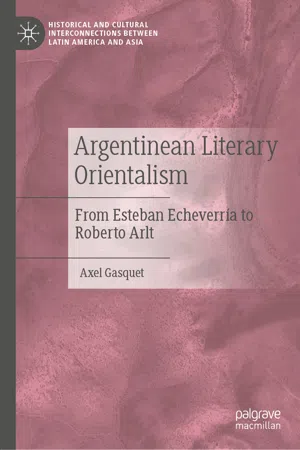
Argentinean Literary Orientalism
From Esteban Echeverría to Roberto Arlt
- English
- ePUB (mobile friendly)
- Available on iOS & Android
eBook - ePub
About this book
Information
Print ISBN
9783030544652
Part IIntroduction
© The Author(s) 2020
A. GasquetArgentinean Literary OrientalismHistorical and Cultural Interconnections between Latin America and Asiahttps://doi.org/10.1007/978-3-030-54466-9_11. Which East by Way of the South?
Axel Gasquet1
(1)
Department of Spanish Studies, University of Clermont Auvergne, Clermont-Ferrand, France
They have discovered these and other horrendous things, but never mentioned what is wonderful about the East, as if all those who had written about it were great bastards.Umberto Eco, Baudolino (2000)
We never go so far as when we know not where we are going.Oliver Cromwell
This study analyzes a seemingly marginal subject within Argentinean literature: Orientalism, the attraction for the East—its cultures and exotic influence. After the publication of The Ruins or Meditation on the Revolutions of Empires by Constantin-François de Volney, as well as the works of Domingo F. Sarmiento or Juan Bautista Alberdi, Eastern issues aroused aesthetic as well as political interest in Argentina. Orientalism is a constituent part in the formation of Argentinean national literature. Eastern literature arrived in the River Plate region with a European bias. During the eighteenth century, the East began to be viewed in the West as new and untamed regions that stood opposite to Eurocentric civilization. The image of the Other was created, from which one had to urgently distance oneself to affirm Europe as the continent of civilization, the pinnacle of all arts and sciences. Concurrently, the East became attractive to Westerners because of its diverse cultures. Yet, the East was difficult to characterize through a collection of epithets, whether stigmatizing or laudatory. It inspired all types of thinkers, artists, and adventurers. In its positive European version, the East had to conform to the picturesque as defined by Western anthropology. It is fair to say that this definition did not serve to negate, but rather to corroborate, in Europe, a negative political image of the East: all despotism is imbued with Eastern traits.
Prolegomena
The impact of travel literature on early Argentinean literature is known, but the study of incipient Orientalism in the political and literary spheres has been neglected. In that sense, Argentinean Orientalism is not simply an imitation of its European version. On the contrary, Argentinean Orientalism exhibits a strong form of regional adaptation. It became an endogenous element of the so-called South American barbarism. South America’s original flaw in its political thought would have been stricken by the concept of Eastern fatality. Hence, Orientalism became an indispensable conceptual tool in any analysis of institutional deficiencies and the national political organization. Eastern thought took hold in South America by gradually being adapted. It acquired an autonomy that could be compared to the European and American models. From that moment on, the attraction and repulsion of the East would become a constant in Argentinean literature. Though always marginal and rarely perceptible, our objective here is to realize an evaluation of this persistent component in this literature. We will analyze the importance of the Eastern themes in the works of Esteban Echeverría, Alberdi, Sarmiento, Lucio V. Mansilla, Pastor S. Obligado, Eduardo F. Wilde, Leopoldo Lugones, and Roberto Arlt.
Given the breadth of Argentinean Orientalist literature, it was necessary to limit this study to works published before 1941, with our final analysis devoted to the African writings of Roberto Arlt. Until the 1920s, echoes of Eastern assimilation resonated within the ideological and cultural layout of the land. Eastern imprints, perceptible in the mood of the Independence Centennial celebrations (1910), are characterized by the political construction and appropriation of the discourse on the East, a process that has subsequently dissipated. We will try to show that, with obvious cultural ramifications, Orientalism clearly played a long-standing ideological role in the Argentinean political sphere before acquiring its autonomy and slowly achieving greater creative freedom and evocative strength.
Another fundamental trait of Argentinean Orientalism literature is that, from Sarmiento and Mansilla, testimonies of Argentinean travelers through these regions began to be published regularly. This essential change represents a decisive and qualitative leap: Orientalist readers were now travelers who rendered their testimony in writing. Obviously, this testimony did not presuppose the objectivity of their statements. Voyages to the East were by now quite common and travelers adhered to widely known travel guides that were also ideologically flawed; however, in situ presence assured travelers the chance of forming objective reconsiderations. Their European archetypes were, for the most part, derived from French writers (Volney, Chateaubriand, Hugo, Lamartine, Gautier, Nerval, Flaubert), but also from Spanish (Espronceda, Larra, Zorrilla, et al.) and English Romantic writers (Byron). It is noteworthy that a consistent objective of modern travel literature was to revisit places about which classical authors had written, while also creating a kind of referential itinerary or spiritual pilgrimage.
Before delving into an analysis of the various literary testimonies, we will study the conditions of the ideological and political impact of European Orientalism on the River Plate region. This will require a review of eighteenth-century Orientalist theses and their legacy of Enlightenment, with reference to the case of Volney and the School of Ideology, which fills the first chapter. We will also see how the Orientalist debate is presented at the end of the eighteenth century (mostly in France) by attempting to evaluate its ideological and aesthetic impact on the then young Argentinean literary figures. Afterwards, throughout eight chapters, we will introduce a chronological series of travel writers who were active for just over a century (circa 1830–1940). To these we have accorded a monographic treatment. The methodological choice for this approach was dictated by the length of the period studied. In addition, the chronological progression of the monograph allows us to better convey the slow and constant rhythm prevalent in the Orientalist discourse within Argentinean literature while observing the essential features of its evolution.
What Is Orientalism?
This field of study is so vast that, not to risk going astray, it was necessary to limit our research. Concerning Orientalism, what is the purpose of this book? To understand the scope of Orientalism in Argentinean literature, we will offer a series of clarifications that apply to the research range, to the historical particularities unique to the River Plate region, and to the limitations of our literary corpus.
Orientalism, as a discipline, includes all that relates to Eastern cultures, religions, arts, and native languages. This wide range makes it a vague and imprecise concept to study. Its conceptual imprecision is inversely proportional to its ideological utility. At its core, Orientalism typically includes almost all “non-Occidental” cultures, that is, it presupposes a tacit knowledge of the West and implicitly places the geographical East in the realm of radical Otherness. The Orientalist subject in the West has always caused concern and can still do so to cultures south of the Mediterranean (the Maghreb), the Eastern Mediterranean (the Levant) or the Far East, but equally to that of Central Asia, the Caucasus region and, in certain cases, Eastern Europe. Furthermore, until recently, Orientalism included certain regions of Sub-Saharan Africa, particularly those with large Muslim populations (Sudan and the coastal areas along the Indian Ocean) and non-Muslim countries (Ethiopia). In these latter cases, Orientalism is devoid of any geographical notion and is reduced to a mere ethnographic bias, that is, one that lumps together those areas that are not part of the Western tradition. Thus, the term’s enormous interdisciplinary approaches. Orientalism is, by its nature a facile term to employ when pointing out what is wrong with the East. In short, to Orientalists, the East represents all that is inscrutable or exotic in comparison to the West.
Our purpose here is not to examine the ideological usages of Orientalism. Edward Said, in his now classic work Orientalism (1978), has done that in depth. This does not mean that we do not share most of his theses as, for example, that the Orient is a political-ideological-cultural construction of the West, whose goal was to establish a symbolic form of political control and supremacy over the East. This objective was reached through European colonialism during the nineteenth and twentieth centuries, with its predominantly British and French variants. However, unilaterally, Said also reduces the East to Muslim Arab cultures, while neglecting the Far East and the Indian subcontinent. Our aim, however, is not to delve into the regional exclusions of the term, but to limit ourselves to the literary one. Henceforth, we will study the ideological construction of the Argentinean nation in the nineteenth century, with a special interest in the political consequences of literary Orientalism in Argentina. This study will therefore not pretend to participate in colonial/post-colonial studies.
What Is Argentinean ...
Table of contents
- Cover
- Front Matter
- Part I. Introduction
- Part II. The East in the Pampas
- Part III. Eastern Prints from Globetrotters, Tourists and Positivists
- Part IV. Mirages of the East
- Part V. Building Up a Literary and Cultural History of Argentinian Orientalism
- Back Matter
Trusted by 375,005 students
Access to over 1.5 million titles for a fair monthly price.
Study more efficiently using our study tools.
Frequently asked questions
Yes, you can cancel anytime from the Subscription tab in your account settings on the Perlego website. Your subscription will stay active until the end of your current billing period. Learn how to cancel your subscription
No, books cannot be downloaded as external files, such as PDFs, for use outside of Perlego. However, you can download books within the Perlego app for offline reading on mobile or tablet. Learn how to download books offline
Perlego offers two plans: Essential and Complete
- Essential is ideal for learners and professionals who enjoy exploring a wide range of subjects. Access the Essential Library with 800,000+ trusted titles and best-sellers across business, personal growth, and the humanities. Includes unlimited reading time and Standard Read Aloud voice.
- Complete: Perfect for advanced learners and researchers needing full, unrestricted access. Unlock 1.5M+ books across hundreds of subjects, including academic and specialized titles. The Complete Plan also includes advanced features like Premium Read Aloud and Research Assistant.
We are an online textbook subscription service, where you can get access to an entire online library for less than the price of a single book per month. With over 1.5 million books across 990+ topics, we’ve got you covered! Learn about our mission
Look out for the read-aloud symbol on your next book to see if you can listen to it. The read-aloud tool reads text aloud for you, highlighting the text as it is being read. You can pause it, speed it up and slow it down. Learn more about Read Aloud
Yes! You can use the Perlego app on both iOS and Android devices to read anytime, anywhere — even offline. Perfect for commutes or when you’re on the go.
Please note we cannot support devices running on iOS 13 and Android 7 or earlier. Learn more about using the app
Please note we cannot support devices running on iOS 13 and Android 7 or earlier. Learn more about using the app
Yes, you can access Argentinean Literary Orientalism by Axel Gasquet, José I. Suárez in PDF and/or ePUB format. We have over 1.5 million books available in our catalogue for you to explore.